
16.24.a - The Secret Keepers
FRANCE AS IT MEANS — a Pantin atelier fifty years in the making, a Paris passage invisible to the rushing eye, and why the French never needed to try.

Today at a Glance: Your PAID weekly newsletter
Bonjour, my dear friends and subscribers, both new and long-time.
Un grand merci (a big thank you) for being part of this wonderful global family of Francophiles. Your support enables me to continue growing and improving MyFrenchLife™ Magazine and the le Bulletin newsletter, offering more to this growing global community.
Here’s what you’ll find today:
This week “16.24.a - The Secret Keepers
Feature: Fifty Years, Eight Hundred Tapestries, One Staircase
Introducing new Contributor: Elisabeth Perotin
This week’s ‘What’s happening in ‘MyFrenchLife™ Magazine’ - a selection of new contributors and fresh articles from across France.
You can also find the free newsletter ‘‘16.24 - A Gateway to Another Century - here during the weekend.
Warm regards
Judy - 20.6.2026
1. Fifty Years, Eight Hundred Tapestries, One Staircase
A story about what France hides in plain sight — and why it's always worth looking closer.
The suburb is called Pantin. You won’t find it in most travel guides. It sits just outside the périphérique, northeast of Paris, in that particular zone of France with a canal, a car park, and light industrial units that, on closer inspection, house the silk atelier of Hermès and the headquarters of Chanel.
France does this. It puts its most extraordinary things in unremarkable places and waits to see who notices. It has been doing this for centuries. The patience is almost a provocation.
I found out about Pantin the way I find out about a lot of things: a magazine, left in the pocket of an aeroplane seat, my sort of magazine, and a feature about two people in their eighties still working, still weaving — literally weaving — tapestries by hand in a business park northeast of Paris.
Eight hundred tapestries over fifty years. Man Ray. Basquiat. Steel threads woven into wool.
I kept turning the pages back, re-reading. The world was larger than I’d thought. And France, as usual, had been keeping secrets. [Ha! How often do I say that?]
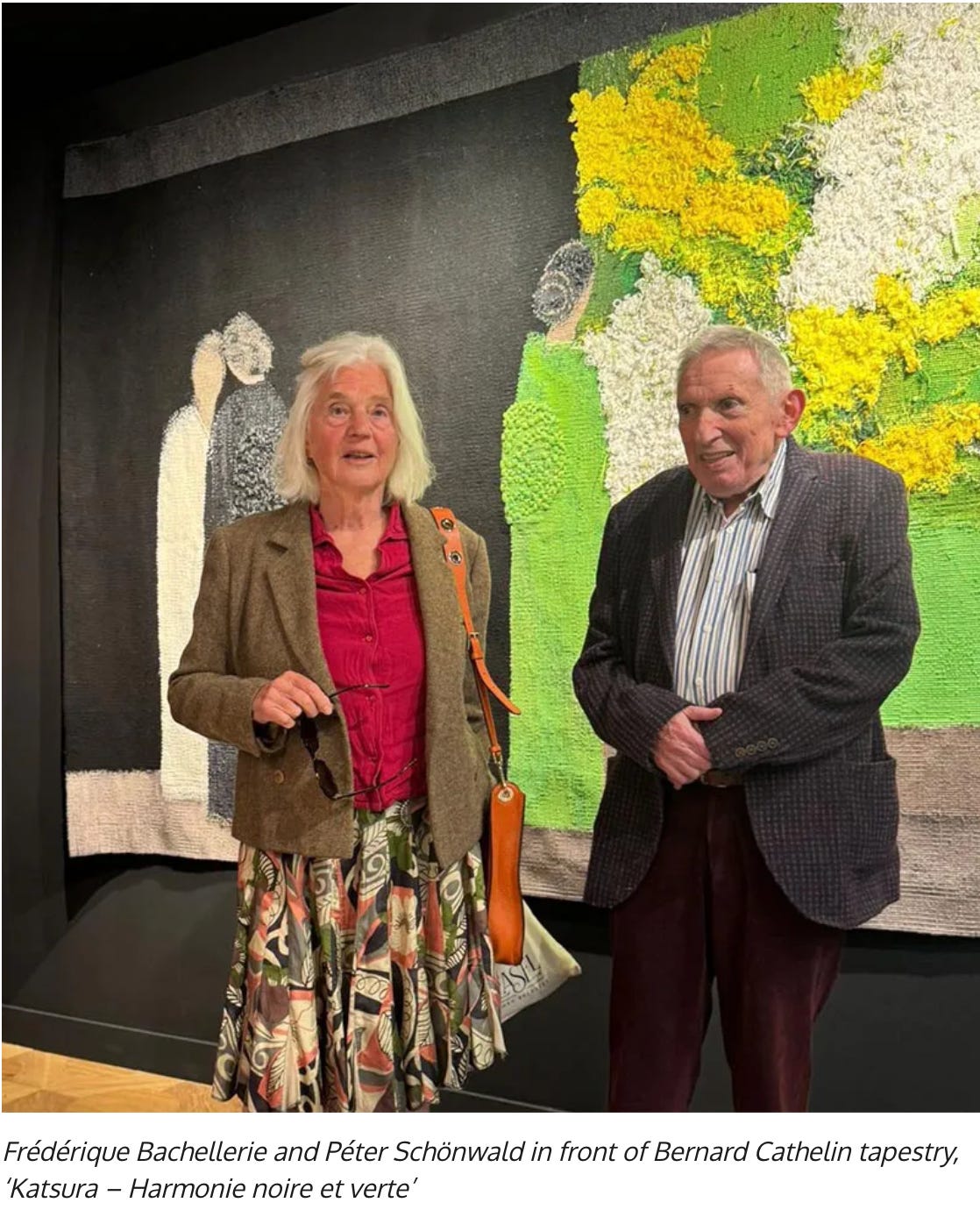
Frédérique Bachellerie and Péter Schönwald founded Atelier 3 in 1972. She is eighty-three. He is eighty-two. They are still taking commissions.
What they do — and the distinction matters more than it might first seem — isn’t really reproduction. It is interpretation. At Atelier 3, the weaver works from the front of the loom, watching the piece develop in real time. This is not the Gobelins method. At that great state manufactory in the 13th arrondissement, weavers have worked from the reverse of the fabric, executing numbered cartoons, for four hundred years. The outcome is decided before the first thread is laid. At Atelier 3, the weaver brings herself to the work the way a musician brings herself to a score — never playing it exactly the same way twice, the piece alive in the making of it.
Bachellerie and Schönwald rejected the reverse-loom tradition. Quietly, without a manifesto, in a business park in Pantin.
Their stories are as unlikely as their work. Bachellerie was born in France, raised in Hungary during the Communist era, and went to Chile in 1961 to study textiles at the School of Applied Arts in Santiago. South American folklore entered her bones and never left. She returned to Hungary with a diploma nobody recognised, made her way eventually to Paris, and kept pushing at the edges of a medium the art world had largely decided was finished. Schönwald arrived in Paris from Budapest, worked as a TV producer, as a bookseller, and had yet to weave a single thread when they met. He learned. They founded the studio together.
Then, in 1973 — one year after they opened — a nearby gallery was showing a lithographic series by Man Ray. The Revolving Doors: geometric coloured collages he had begun in 1919, formal and strange and full of interior logic. Bachellerie persuaded the gallery owner, Françoise Tournier, to let them interpret one. To echo Man Ray’s black pencil, they wove steel threads into wool. Tournier loved it and commissioned nine more.
Then she brought the artist himself to see them.
Man Ray was eighty-three. He couldn’t climb the stairs to the studio, so Schönwald — thirty years old, the bookseller turned weaver — carried him up.
At the top, Man Ray looked at the spinning wheels and said they reminded him of Marcel Duchamp. Then he was quiet for a moment.
“It’s a shame I’m this age,” he said. “We could do some very fun things. We could do some very fun things together.”
He died not long after.
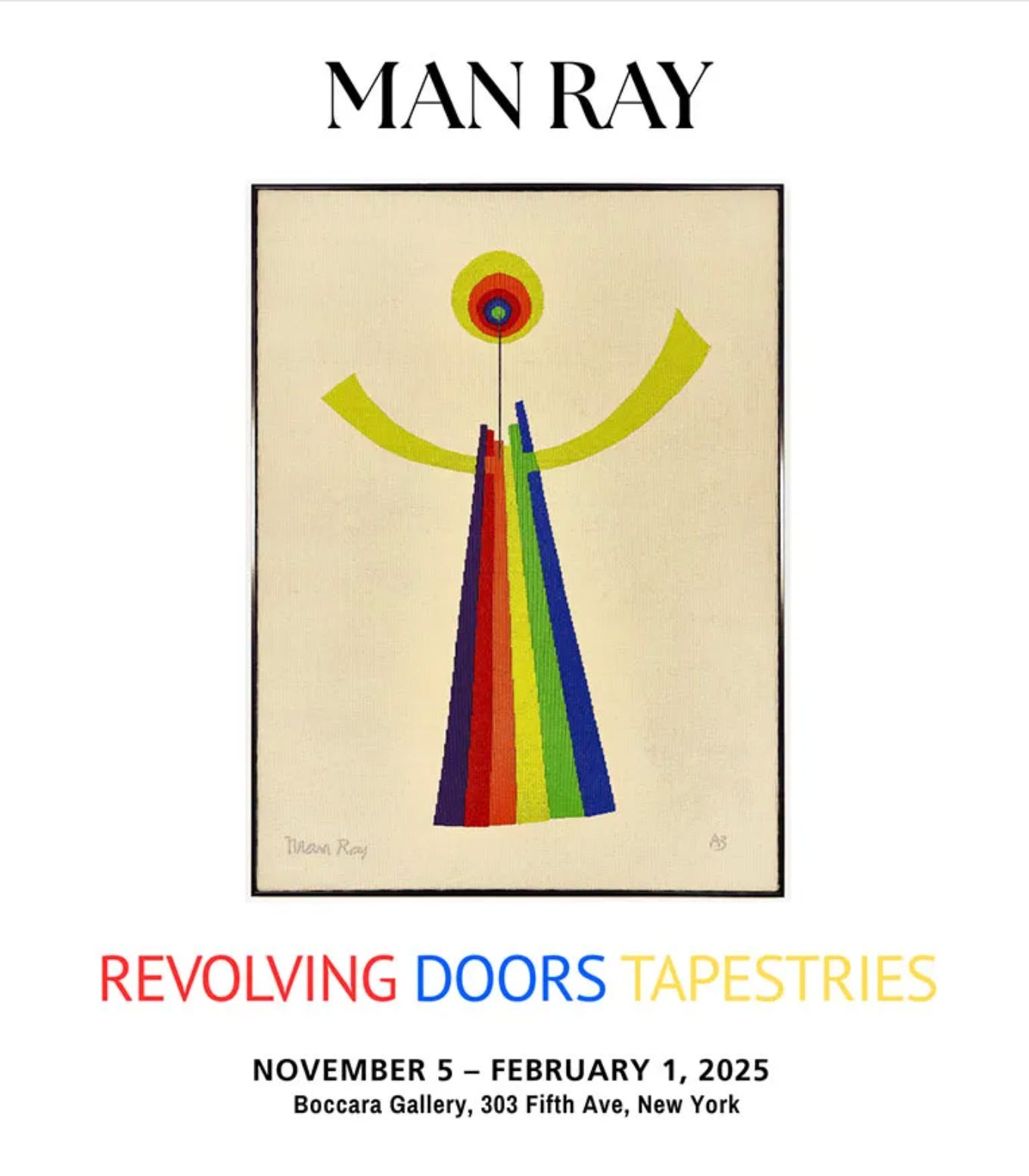
The complete Revolving Doors series — all ten tapestries — was shown recently at Boccara Gallery in New York. Its first presentation in the United States. Fifty-two years after a thirty-year-old carried their maker up a flight of stairs.
The rest of this essay— Bachellerie’s account of what translation actually demands, the Basquiat commission, and what it means to still be making things in your eighties — is for Annual Subscribers and Mighty Supporters.
If France’s habit of hiding its most extraordinary things in unremarkable places is the kind of story you come here for, this is exactly why the PAID subscription exists.