
A Day (and a Lifetime) in Terrasson-Lavilledieu
I just needed toothpaste. What I got was fogged glasses, unsolicited health advice, and a front-row seat to mild municipal collapse, by Jenn Becker

This is how I know I’m about to lose the day.
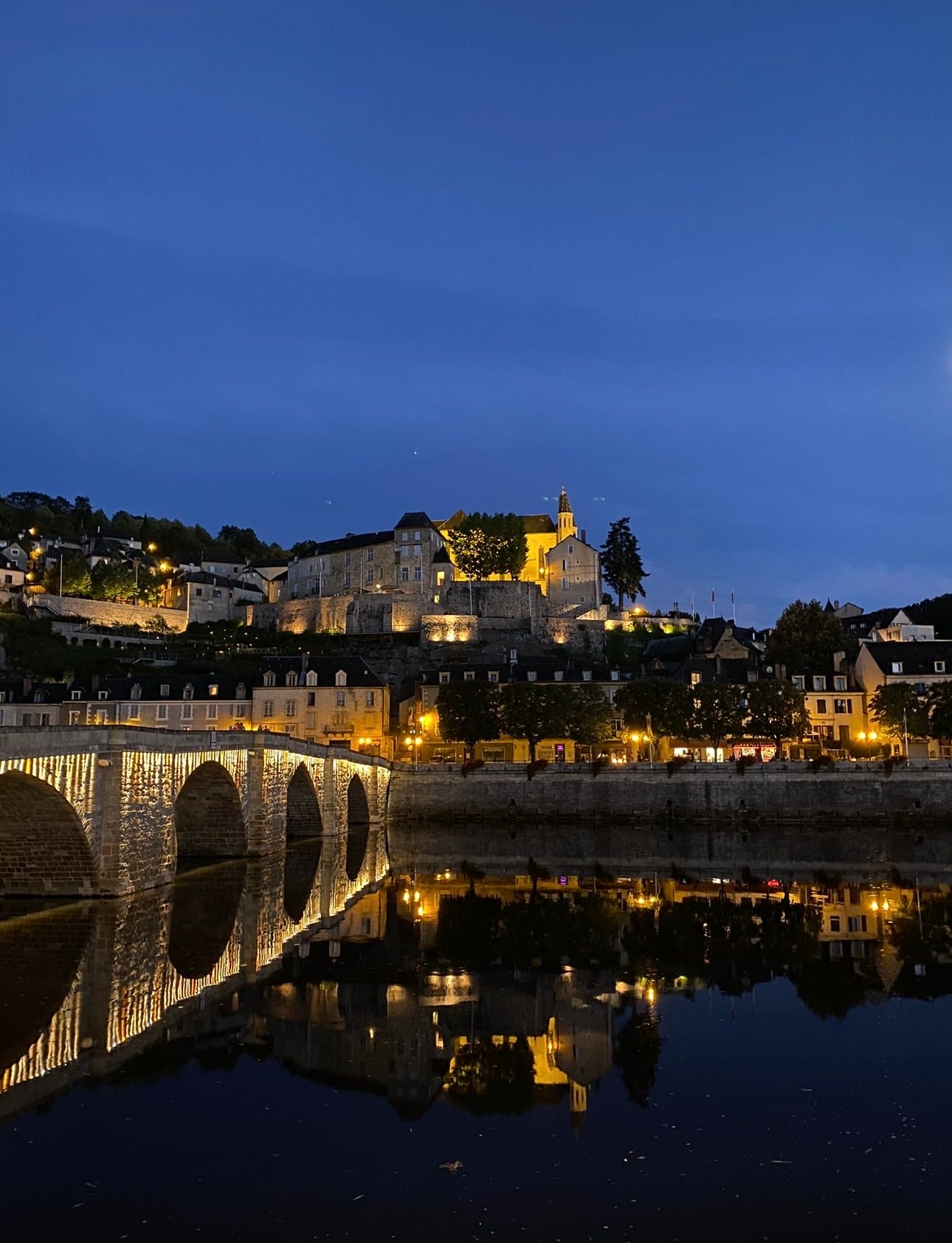
Terrasson-Lavilledieu is a small town in the Dordogne with two names, one river, an abbey that has grasped too much, and a strict but unspoken code of conduct that no one will explain to you until you’ve broken it publicly.
No one can tell you why there are two names
If you ask, people say, “Ah yes, well…” and gesture vaguely toward history, the river, or taxes. The Mairie has brochures. The brochures suggest no one survived the editing process, while answering questions I did not ask, and introduced several new ones.
From above, the town looks like a medieval illustration someone spilled espresso on. Stone houses cling to the cliff like they have a chip on their shoulder – literally. The Vézère cuts through the middle of the Village, slow and unimpressed. Above everything sits the Abbey of Saint-Sour, rebuilt so many times it’s basically a historical remix.
My house was built in 1647 by monks from that abbey.
Just wait for that story!
I moved to rural France, thinking it would be peaceful.
Instead, I got a town where beer freezes solid in winter, techno plays during festivals, fireworks are launched from the medieval Church, and eleven geese stand guard on the bridge like they know something the rest of us don’t.
The geese only move as a pack.
They do not smile.
They are not decorative.
They are deeply employed in psychological operations.
So, the toothpaste. In rural France, it is mandatory that you visit four shops to buy three things, and at least one of those shops will be closed for reasons no one remembers agreeing to while their website specially says that they will be open.
I came into town alone, American, faking competence, holding a shopping list that said toothpaste like that would protect me.
The Unwritten Laws (Learned the Hard Way)
Terrasson runs on rules.
They are unwritten, inconsistently applied, and enforced anyway.
Law #1: The Boulangerie Is a Moral Test
If you enter without saying bonjour—clearly, audibly, and with eye contact—the bread will still be sold to you. But it will be disappointed. This is worse.
Law #2: Bonjour Has a Daily Limit
You may greet a person once per day. A second bonjour suggests confusion, desperation, or a possible attempt at intimacy.
Law #3: Market Day Is Mandatory Citizenship
If you miss it, you will not know who is sick, who is feuding, or why everyone is suddenly whispering about mushrooms.
Law #4: Opening Hours Are a Concept, Not a Promise
A shop may close at 11:47 a.m. or 12:03 p.m. Asking why will not help you.
Law #5: Everyone Knows Something You Don’t—and They’re Fine With That
This is the most important one.
I learned these rules by doing everything wrong while smiling politely.
Coffee, or How to Accidentally Announce You’re Not From Here
Before errands, there is coffee.
This is non-negotiable.
But in Terrasson, coffee is not a beverage.
It is a social contract.
In the morning, you may order:
• un café (espresso, fast, standing)
• un café crème (if you intend to sit and while away the morning)
After lunch, café crème becomes suspicious and you get the side eye if ordered.
In the afternoon, it is borderline scandalous.
I order wrong once.
The bar goes quiet.
Someone coughs.
I correct myself quickly, like a woman defusing a bomb with dairy.
I sit with my espresso served in a cup the size of a thimble, and immediately burn away my remaining American instincts.
That’s when Jean-Michel arrives.
Jean-Michel wears orange trousers. Not muted orange. Not rust. Emergency-exit orange. His cologne enters the room before he does and stays long after, like a diplomatic incident. Is he claiming squatters rights?
He orders coffee loudly, explains it to the bar owner (who has worked there since 1987), and launches into a speech about politics that may involve Macron, may involve himself, and definitely involves the future.
I pretend to read my phone.
Jean-Michel nods at me.
We are now acquainted.
Next stop, the Pharmacy. Remember the toothpaste?
The Pharmacy (Toothpaste Plus Consequences)
The pharmacy smells like eucalyptus, disinfectant, and unresolved knee injuries.
In France, pharmacies are not an afterthought; they’re a priority. You can live in a village without a bakery, a café, or even a functioning post office, but there will always be a pharmacy. Sometimes two. Occasionally three. Always with a line.
This is a country that takes health seriously, but not in a panicked way. More in a measured concern over time way. Pharmacies here are part clinic, part confessional, part social hub. People queue patiently with prescriptions, supplements, compression socks, and deeply personal ailments they are absolutely prepared to discuss at conversational volume.
The green cross outside glows like a beacon of reassurance. Inside, pharmacists do not rush. They listen. They ask questions. They consider your posture, your tone, and possibly your life choices. You don’t buy things here–you are assessed.
I ask for toothpaste.
The pharmacist nods gravely.
I leave with toothpaste, throat spray, magnesium (twice), Vitamin D (I might just start selling that on the black market), and a warning about drafts. I am now vaguely afraid of drafts.
Jean-Michel is behind me in line. He clears his throat meaningfully and shares an opinion about health that no one requested.
The pharmacist listens.
I listen.
No one interrupts.
This is also a rule.
As I leave, the pharmacist leans in and says quietly,
“Careful with the cold.”
This advice applies to weather, people, and Terrasson in general.
Mangeons Frais (Where Confidence Goes to Die)
I stop at Mangeons Frais because I realize I need one thing there.
One thing is never one thing… I’m a Gemini.
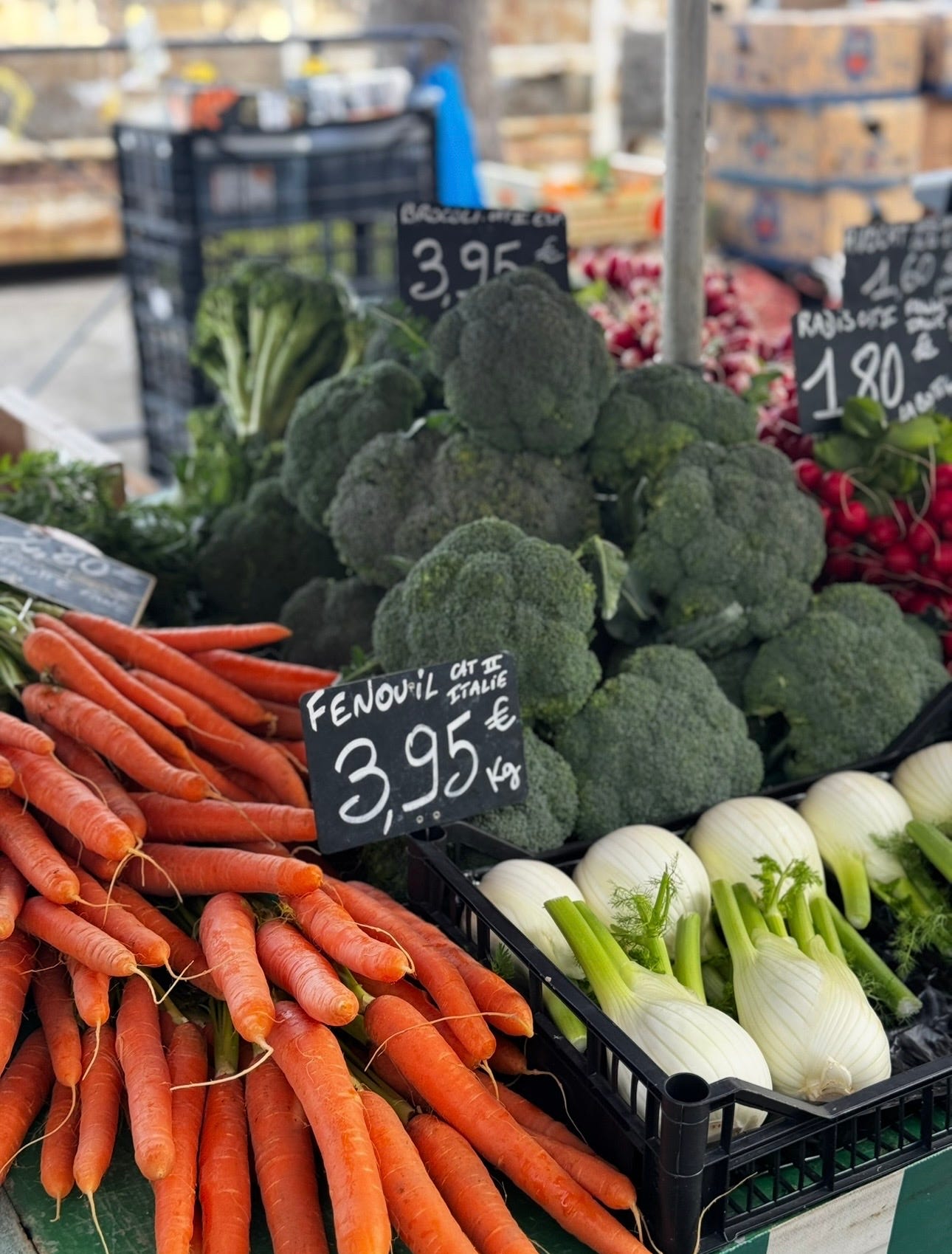
Mangeons Frais is a French produce chain that looks like a warehouse but behaves like a farmers’ market, having an identity crisis. It’s cold, loud, humid, and aggressively committed to freshness. The lighting is unforgiving. The floor is always slightly wet. The produce arrives in towering wooden crates like it was just unloaded from a truck driven directly out of the countryside.
This is not a place for browsing.
This is a place for decisions.
There are no neat aisles. Fruits and vegetables are stacked in heroic piles that suggest abundance, urgency, and mild danger. Everything looks perfect and slightly stressed. Tomatoes glow like jewels. Lettuce displayed like it’s preparing for a photo shoot. Mushrooms sit in brown paper trays, daring you to know the difference.
You do not select produce casually here. You handle it. You inspect it. You turn it over in your hands like a precious object. And if you touch the wrong one, someone will quietly appear and hand you a better one without speaking.
Inside, my glasses immediately fog up. The air is humid, vegetal, and morally serious. Produce is treated like sacred objects but stacked like a demolition site.
I touch a tomato.
This is a mistake.
Someone appears instantly and hands me a better tomato.
I nod as if I can tell the difference.
I put the vegetables into dog bowls.
This is allowed; it’s how it’s done. Stacks of green dog bowls are provided for you to put your produce in. Once you have checked out, you dump everything from the dog bowls into plastic bags. Hmm..I think I could come up with a better system.
Jean-Michel is here. Of course, he is.
He is lecturing a man about carrots. The man is not asking questions. The carrots look stressed. Something about Orange?
I grab a black radish, and since the yellow Kiwis are on sale, some of them, some jalapeños (can’t find those everywhere in rural France), and a quart of heavy cream at 35%. I’m sure I’ll need that for something before the ‘past due’ date.
The Walk (Featuring Fleur and Several Centuries of Guilt)
Car loaded, time for a walk.
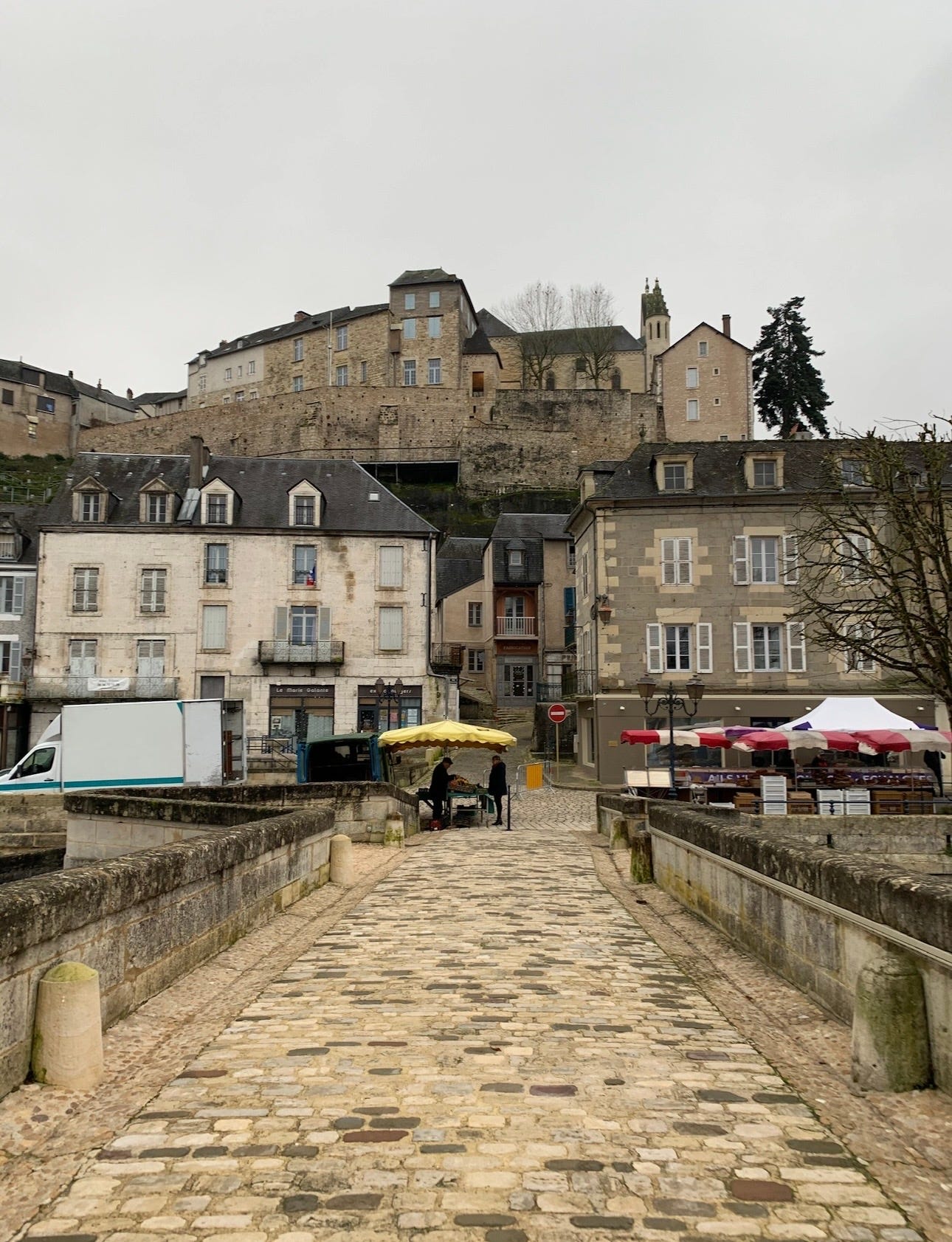
I walk Fleur up toward the abbey because it’s beautiful and also because uphill walking makes me feel virtuous.
She immediately pees on something ancient that probably has a plaque.
I apologize to no one in particular.
The Abbey of Saint-Sour looms above the town, stone stacked on stone by people who never imagined dog poop bags or Mangeons Frais. Scaffolding clings to it permanently, like it’s being slowly repaired by time itself.
Jean-Michel appears again on the steps, speaking loudly into his phone about “when I take over.”
Take over what remains unclear. Possibly the town. Possibly Europe.
I nod politely and keep walking, as one does when confronted with a man who might be running for something, or from something.
Bar-Tabac (Where the Republic Briefly Pauses)
I stop for another coffee.
This time, I get it right.
I order un café.
The bar owner nods.
The machine hums.
And then it makes a sound I have never heard before.
Not a grind.
Not a hiss.
A long, wounded sigh.
Steam bursts sideways. Someone swears quietly. The espresso stops halfway through its own existence, neither here nor there. The machine goes dark.
No coffee emerges.
No one moves.
The bar owner stares at the machine. The machine stares back. This feels personal.
“C’est pas possible,” someone says.
Jean-Michel appears beside me instantly, like he’s been waiting for this his whole life.
“It’s the pressure,” he announces, to no one in particular. “I said this would happen.”
The bar owner opens the machine. Closes it again. Opens it once more, as if hoping for a different outcome.
People do not leave.
They gather.
A man suggests it’s the water. A woman blames the weather. Someone says the word circuit and everyone nods gravely.
The line reorganizes itself into a semi-circle. Chairs are pulled closer. Opinions are offered freely.
Someone orders a rosé.
At eleven in the morning.
This is allowed now.
The bar owner makes a phone call. The phone call is long. At least three people listen without pretending not to.
Jean-Michel is explaining France.
To me.
To the room.
Possibly to the machine.
Five minutes later, the pompiers arrive.
No siren.
Just presence.
They inspect the machine solemnly. One crouches. One nods. One says nothing, which seems important.
A gendarme wanders in. He is not in a hurry. He orders nothing. He observes.
At this point, no one expects coffee anymore. That phase has passed. We are in something else now.
The machine is declared fatiguée.
This feels ominous.
Someone claps. Someone sighs. Someone asks if it will be fixed today.
The answer is unclear.
I eventually leave without coffee.
No one apologizes.
As I step outside, Jean-Michel pats the counter like a man saying goodbye to a friend.
“C’est la France,” he says.
I nod.
I have learned something. I’m not sure what.
Leaving Town
By the time I leave Terrasson, I have toothpaste, magnesium, vegetables, and information I did not ask for but will apparently need later.
As I cross the bridge, the geese stare down like angels.
Jean-Michel is giving a speech.
To no one.
I came in for one thing.
I leave with half a day gone, my arms full, and the quiet certainty that this strange, demanding, hilarious little town has somehow become home.
Not because it makes sense.
Not because it’s easy.
But because it doesn’t ask who I used to be.
It just hands me toothpaste, unsolicited advice, fogged glasses, and a front-row seat to the ongoing chaos….and expects me to keep up.
Jenny
Have you ever gone in for one thing in a French town and lost the entire day? Tell me in the comments.
Introducing Contributor Jenny Becker
Visit her Contributor Page — Explore more of Jenny’s work→
Thanks for reading MyFrenchLife™ – MaVieFrançaise®! This fabulous article by Jenny Becker is public, and we encourage you to share it.
MyFrenchLife™ – MaVieFrançaise® is a reader-supported publication. To receive new posts and support my work, consider becoming a free or paid subscriber.
Fabulous!