
A Love Affair with Bandol
You come for the wine. You come back for the place. One perfect day in France's most quietly addictive appellation by Debra Fioritto.

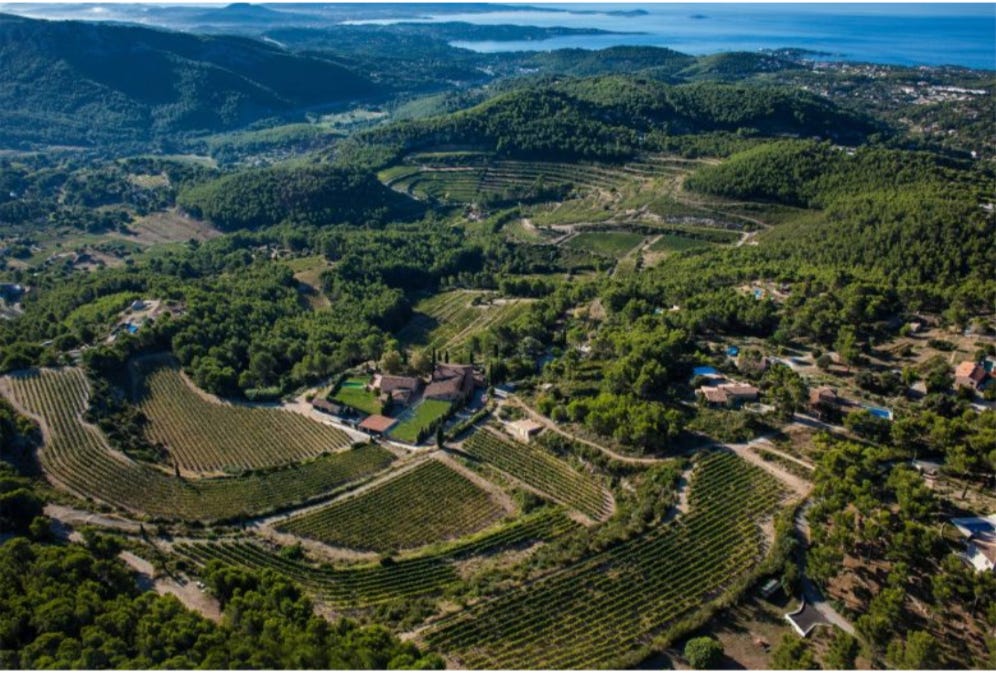
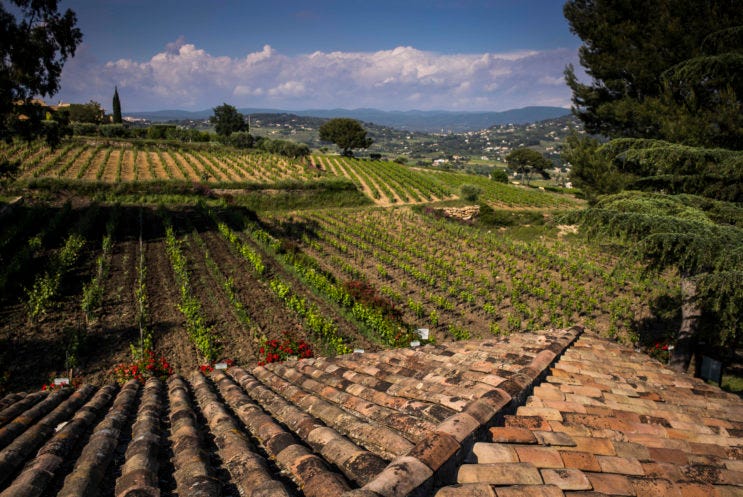
The road up to Château Pibarnon is one lane wide and climbs through the hills above the Mediterranean. The first time you drive it, you worry about meeting someone coming down. We did, about halfway up — a truck came around a bend and managed to pull just enough off the road that we could squeeze past on our way to the top. The gate at the summit was open. We pulled in alongside a long golden-stone mas and got out. Lemon trees framed the door to the tasting room, the fruit heavy enough to pick. But before going in, we walked to the edge of the ridge because below us the restanques — the dry-stone terraces — fell away in the shape of a bowl, ringed in green, with a glimpse of the sea gleaming past the lip. It’s the kind of view that makes you forget why you came.
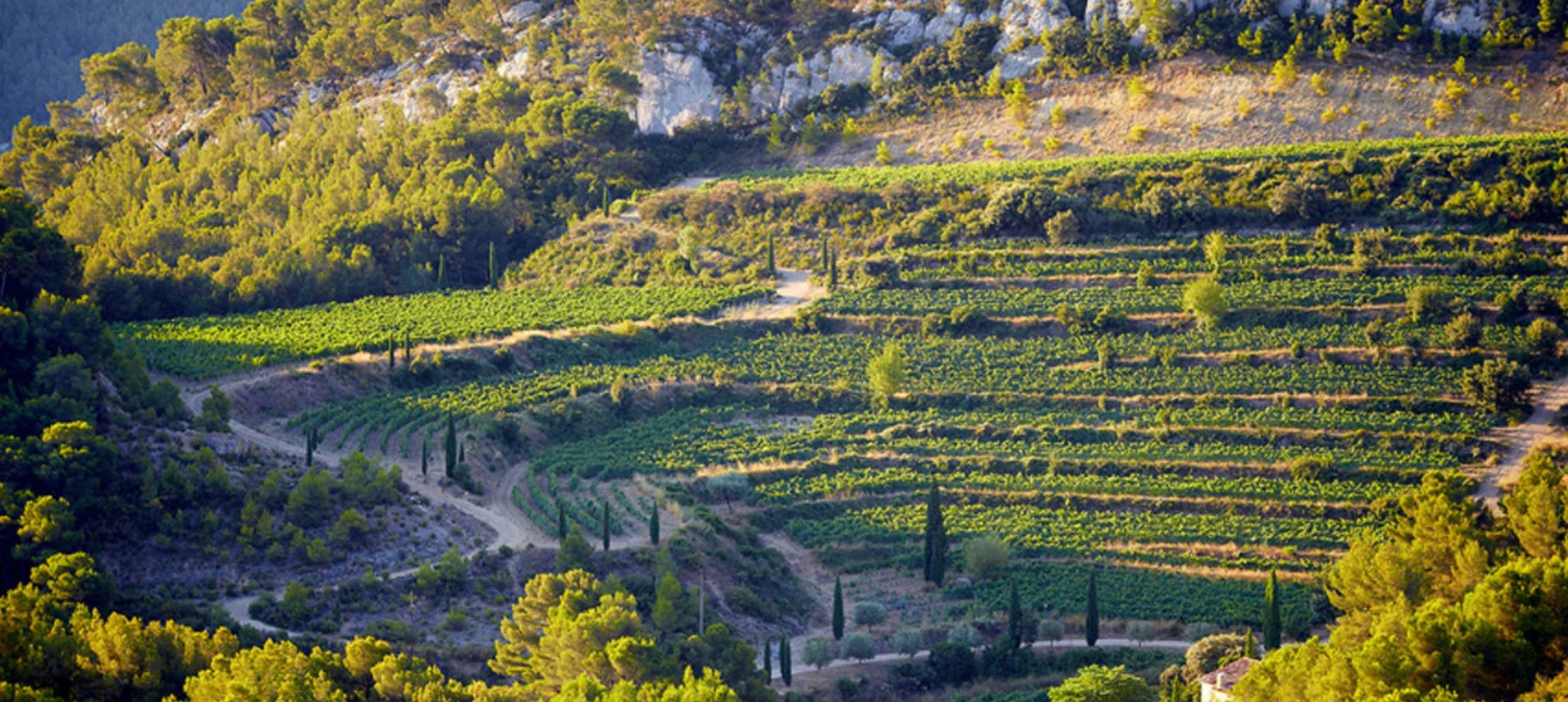
My niece Kristen had stood in this same spot three years earlier and said,
This is the first time I really understand what they mean when they talk about terroir. Here I see it, taste it, smell it, touch it, and hear it.”
I’d been next to her and felt it too — a place making an argument for itself before the first sip of anything. Now Lauren and Leah were having the same moment, and I understood what had been happening to me, slowly, over a decade of returning. You come to Bandol because of the wine. You come back because of the place. You keep coming because someone hands you a glass at the top of a hill, and you realize you’ve been let in.
It started, for me, by accident. In 2016, I wandered into Domaine Lafran-Veyrolle without knowing what Bandol was, bought a couple of bottles of the red almost as an afterthought, and fell in love with them back in the States — where I then discovered I couldn’t find them anywhere. At the time, Domaine Tempier was about the only Bandol you could buy in America, thanks to Kermit Lynch. Everything else had to be found in France.
Four years later, a small caviste near my house poured Château Pibarnon rosé at a tasting, and that sealed it. I became a Bandol ambassador, serving at home and taking it to friends’ houses when invited for dinner. I went in 2022 with Kristen and Ben — the trip where Kristen stood on the ridge looking at the restanques — and by the time I came back in September 2025, Kermit Lynch had added Gros Noré and Terrebrune alongside Tempier, and two friends who’d met the wines at my table — Lauren and Leah — had asked if I’d take them. So I did. What follows is one day. It’s the day the whole trip turned on, and I think it’s a fair map of what Bandol offers anyone who goes looking.
We’d arrived on a Sunday evening and walked down to the harbor, where a band was playing in the square, and people were dancing. We stood and watched for longer than we’d meant to before walking to the bar, Le 8.27, recommended by our hotel. The owner’s name was Patrick. He asked where we’d been and where we were going, and rattled off three or four domains we should try. We wrote them down, hoping we would be able to stop at a couple.
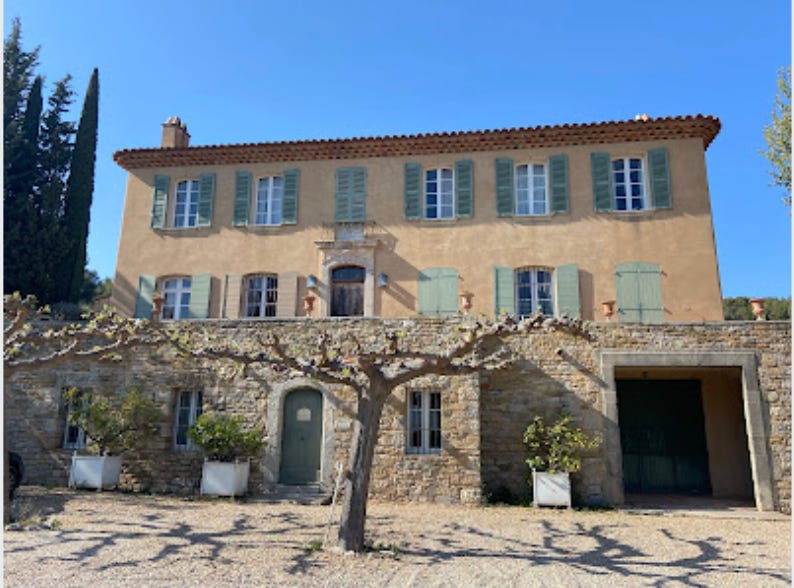
Château Pradeaux was our first stop on Monday morning, on Lionel’s recommendation. Lionel is a friend from Paris who works in wine, supplies luminaries like Alain Ducasse, and when he told me I had to try Pradeaux, I booked it.
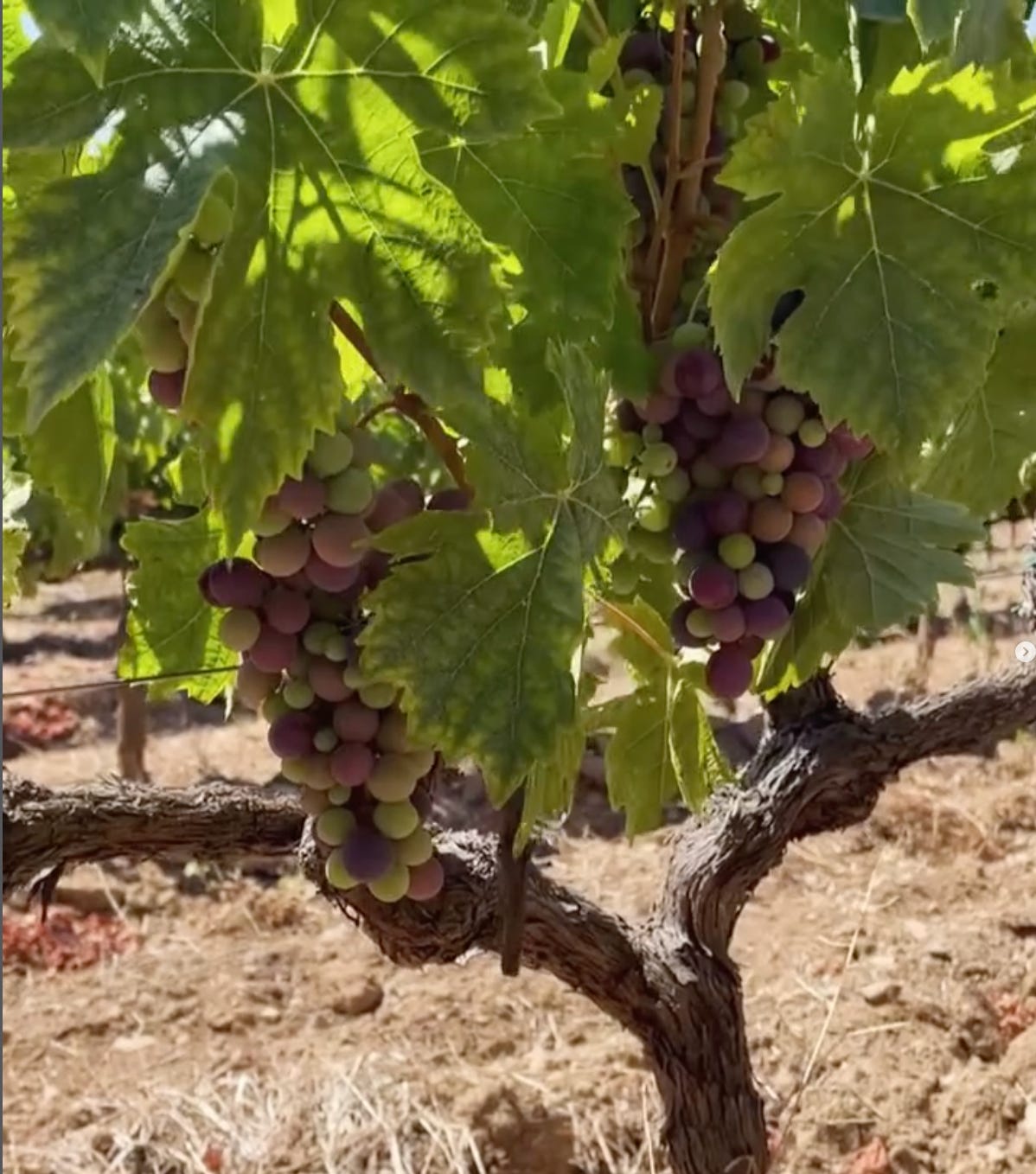
We pulled in a little early and were met by three barking dogs. We sat in the car debating for a minute whether to wait for a human to call them off or just get out. I got out. The dogs quieted, turned around, and led us to the front door. We were still early, so we wandered down a path between the vines and looked at the grapes — plump, almost shiny, blue-black. Mourvèdre, we guessed. At nine, we walked back to the heavy wooden door and rang the bell. An older woman let us in and ushered us into the courtyard; Eric had stepped out for a minute, she told us, but would be right back. The courtyard was quietly Provençal — flowering vines throwing a bit of shade across the stone. We waited. Eric came back and walked us out into the vineyard, explaining in excellent English the care they take of the vines and the rules they have to follow for the AOC. This was a revelation to Lauren and Leah, who hadn’t realised how many rules govern how a Bandol wine is even grown — what can be planted, how it’s pruned, and when it can be picked. I watched their faces change. Whatever respect they’d had for the wine before, they had more of it now. We moved on to the chais, where Eric walked us through the aging — how long, in what, why. The dogs came with us, and it was clear they knew the route; they’d led people through this space before. At one point, Madame joined us and told us we were lucky to have the extra time, because they’d cancelled the harvest that day — rain was forecast. At least tomorrow’s grapes, she said, would come into the cellar clean, since they’d have had a shower first.
This was the third time we’d heard about the rain. The hotel had mentioned it that morning, school had been cancelled, so getting out of the parking lot would be easy. Eric had mentioned it while walking out to the vines. Now Madame. We kept smiling politely, but the sun was blazing, and the sky was cloudless, and the three of us were starting to wonder if everyone in Bandol was just a little dramatic about the weather.
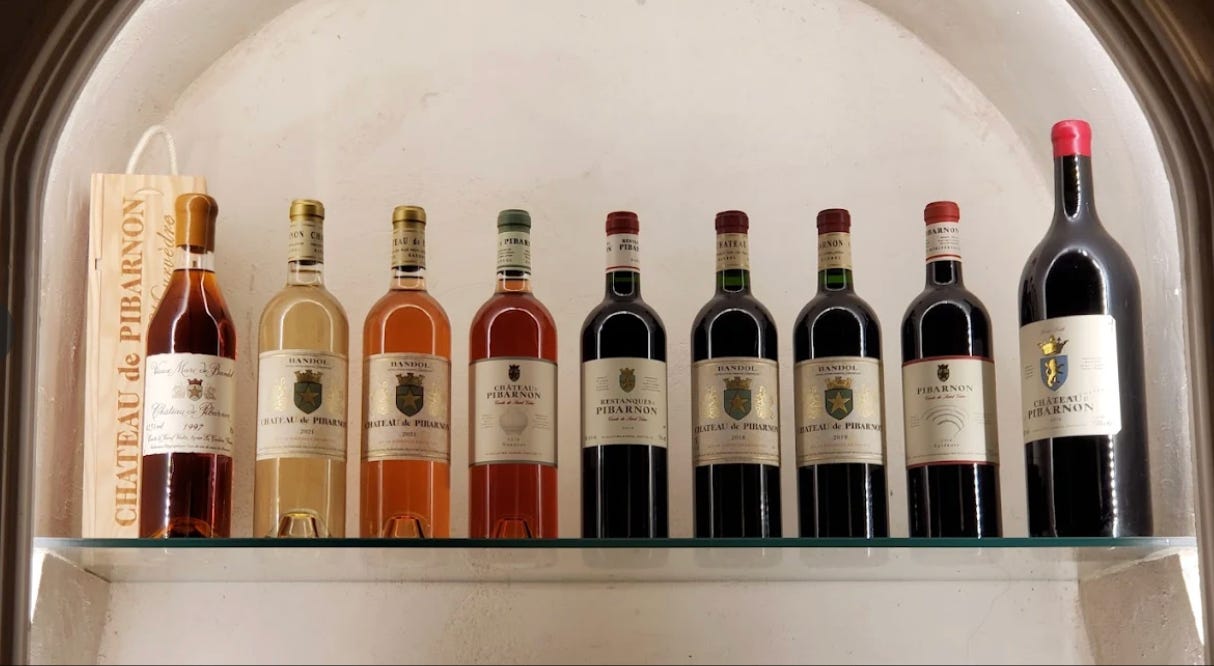
Finally, we went in to taste. Two reds, a rosé, and a Marc. Lauren, our spirits expert, lit up at the Marc, so we left with a few bottles of that alongside the reds and a rosé. As we tasted, I noticed another bottle on the counter — not in the Pradeaux style, with a different label entirely. That, Eric explained, was Plaisir Solidaire. A group of Provence vignerons had started the project after a bad hail season years back: each winemaker donates about a hundred kilos of grapes, the lots are blended into a single multi-varietal red, and it’s bottled only in magnums. A handful come out of each estate’s cellar every year. The proceeds go into a solidarity fund for other winemakers whose harvests have been wiped out by frost, hail, or drought. Wine-world mutual aid. Eric was matter-of-fact about it — this is what we do here — and it struck me, standing in the cool of the chais, that what I love about this region isn’t only the wine. It’s how the people who make it take care of each other. We loaded our wines into the car and drove off under a sky that still gave no sign of rain.
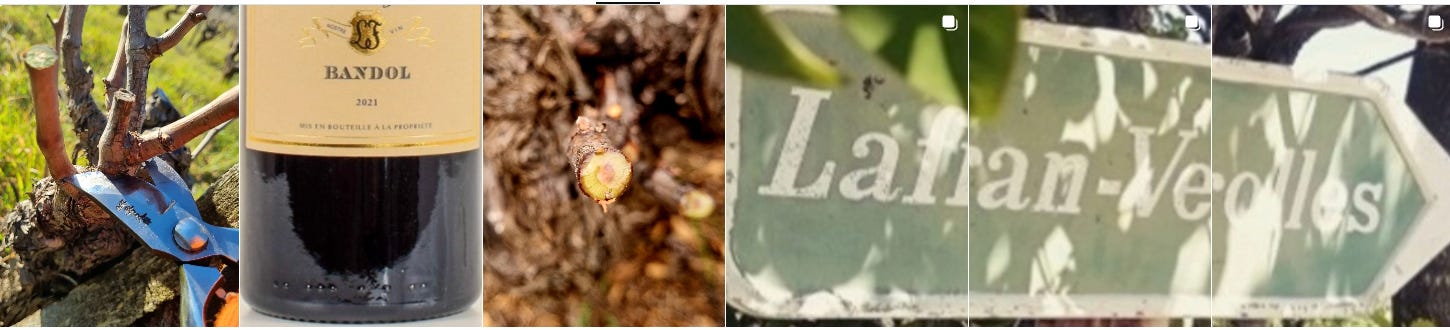
Lafran-Veyrolle was next. I’d made an appointment by email and gotten no response, but this was the domain where it had all started for me, nine years earlier, and I’d come back to show Lauren and Leah where I’d first fallen in love with Bandol. Lafran is a modest place. No gilded gate, no long view across a bowl of restanques — just a working family estate of the kind you could drive past and not notice. That’s part of the pattern too: in this appellation, the modest and the grand make the same kind of wine, and they welcome you the same way.
We pulled up and walked in to see if we could get a tasting, and there was Patrick, the bar owner from the night before, buying bottles and chatting with the owner and another man.
How did you find this place?” he asked, surprised.
He hadn’t recommended it. I told him the whole story, the 2016 accident, the red I couldn’t find at home, the quest that followed, and that I’d had to come back and bring my two friends.
We had our tasting, and when I asked if the three of them knew of anywhere open for lunch — it was Monday, half the good places would be closed — the debate began. They argued in rapid French about what would be open, what would be decent, what we might like, while I mentioned we had another tasting at two-thirty, but it wasn’t far. They kept debating. Lauren and Leah didn’t follow the French but watched the whole thing with growing amusement — three grown men taking the placement of three American women’s lunch more seriously than anything they’d seen all morning. They sent us to a small bistro on the beach. We went. We sat watching the waves lap the sand, and I realised Lauren and Leah had never had a café gourmand, so we ordered three. By the end of the meal, they had decided on two things: they were going to learn French, and from now on, when they saw café gourmand on a menu, they would order it.
We made a detour that afternoon to Domaine Bunan, in La Cadière-d’Azur. The woman pouring for us went through three wines before she casually mentioned that Bunan was a natural wine producer.
I stopped mid-sip. Lauren and Leah looked at me over the rim of their glasses with raised eyebrows — not because they thought I’d spit the wine out, but because by now they knew I wouldn’t keep my mouth shut. I’d once told a server at Noma I didn’t want grape kombucha as my pairing. They were starting to be honest about what they liked too, though they hadn’t yet reached the grape-kombucha stage.
But these three wines, whatever she’d just called them, were very good. Not cloudy, not funky, not fermented-in-a-garage, not the ‘natural’ wines that I knew about and don’t like.
I had a small piece of inside knowledge on this. Arthus, my caviste in Paris, had once told me that Americans walk into his shop asking for natural wine all the time, and usually don’t quite know what they mean. So I switched into French. Do you mean organic? Or biodynamic? — Oh yes, she said, we’re transitioning to biodynamic. I turned to Lauren and Leah and told them they could drink up. Something shifted after that. She hadn’t planned to pour the orange wine we had talked about — it wasn’t part of the tasting flight — but she opened a bottle for us anyway. We all liked it enough that a couple came home with us. Then she said they were labelling some of the whites in the back, if we wanted to see.
Of course we did. A man was working the bottling line. He looked up, saw three American women watching him with polite interest, and asked if we wanted to help. We did. For about five minutes, we stood in a row, placing bottles onto the belt and following them to where the label went on — and then a thunderclap, and the sky opened. The rain came down heavily enough that it almost blocked the view of the vines through the open door. He stopped the belt, and the four of us stood there watching it come. He said sometimes this happened, but not usually like this. We remembered that morning they’d cancelled school because of the forecast. They’d been right.
Eventually, it slowed. We ran for the car with our Bunan haul and tried to follow the GPS out of the property. It pointed us down a lane that ended in a wall of vines. We started to back up — and realised, when Leah turned around in her seat, that the way we’d come in had a drop on one side. She got out of the car, convinced we were going to die, and stood in the wet gravel directing us inch by inch until we were turned around and pointing the right way. The afternoon drifted after that. We tried Ray Jane, which none of us found much to love. We drove on to Domaine Garenne on Patrick’s earlier recommendation, but the place was closed with no one around.
We drove back into town, dropped the bottles at the hotel, and walked down to the harbour. The storm had passed. A rainbow was arching into the water. We stood on the harbour and looked at it for a long time.
A perfect day in Bandol — warnings, weather, kindness, confusion, and at the end a perfect rainbow.
Debra
Have you ever arrived somewhere for the wine and found yourself staying for something else entirely?
Introducing Contributor, Debra Fioritto:
Visit her Contributor Page — Explore more of Debra’s work
MyFrenchLife™ – MaVieFrançaise® is a reader-supported publication. To receive new posts and support my work, consider becoming a free or paid subscriber.
We remember that drive up and over and left and right. Well worth it in the end. We just finished our last bottle from that trip of 4 years ago. Great post.