

I spent most of the second half of the 1990’s in the company of a French writer who had been dead for close to a century. A few years later, I paid him a visit in Paris.
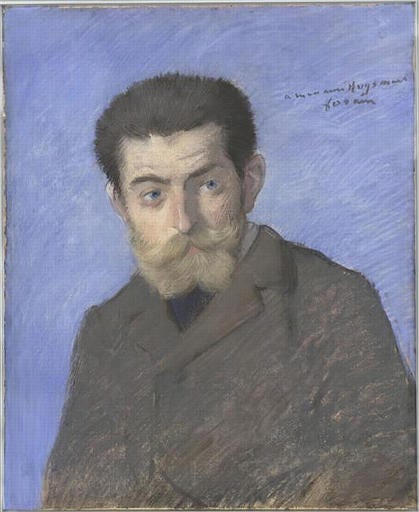
I read Joris-Karl Huysmans’ novel À Rebours (Against the Grain or Against Nature) in the spring of 1992, because it was on the reading list for my Master’s degree in French Literature. This “novel without a plot,” hailed as the ultimate masterpiece of decadent literature, blew me away. I fell in love with its quirky recluse protagonist and with Huysmans’s jeweled vocabulary, tortured syntax, vast erudition, endearing gruffness, and sardonic wit. Eager to know him better, I read two more of his novels for an independent study project. Soon, I decided to write my doctoral dissertation on the representation of temporality in his works.
A few years later, after having passed my doctoral exams, I began devoting my life to Joris-Karl Huysmans and the nine volumes of his complete works, on which I took copious notes. It took me four years to complete my magnum opus, but I received my doctoral degree in 1999. I never got bored with Huysmans, on whom I learned close to everything there was to know. But as much as I admired him as a writer, I was repulsed by his misogyny and virulent antisemitism. This may have caused my research interests to shift away from anything having to do with him soon after I had secured a tenure-track position at a university and published my revised dissertation as a book.
Every summer, from 2003 to 2019, I traveled to France, my native country, and always made sure to spend at least a few days in Paris. For the first few years, I stayed at a hotel in Montparnasse, a vibrant neighborhood, famed for having been a hotbed of artistic life between the two world wars. Renowned artists and writers, including American writers of the Lost Generation such as Ernest Hemingway, F. Scott Fitzgerald, and William Faulkner, would meet at La Coupole, Le Dôme, and La Rotonde, cafés that are still in business today.
More importantly to me, Montparnasse is the site of a very large and beautiful cemetery where many celebrities – writers, artists, singers, actors - are buried, among whom Charles Baudelaire, Jean-Paul Sartre and Simone de Beauvoir, Samuel Beckett, Susan Sontag, Agnès Varda, and… Joris-Karl Huysmans. My aunt Agnès, who was a Daughter of Charity and one of the first four women in the world ever to be appointed to a significant position in the Vatican, is buried there too.


I have a special connection to cemeteries, for a couple of reasons:
1. My father, his father, and his grandfather were stonemasons who made most of their living making and carving tombstones. My grandfather designed and built two World War I memorials for his town of Marcq-en-Baroeul, a suburb of Lille, where I was born. My mother owned a flower shop next to the local cemetery, where my father spent countless working hours. My brother and I often played hide-and-seek behind the graves, a number of which were those of family members.
2. I believe that there exists an intangible connection between the living and the dead that is felt most deeply in cemeteries, when we visit the graves of our loved ones who have died, or of those we never knew but admired because they were great artists, musicians, singers, actors, movie directors, historical figures, politicians, etc.
Knowing that Huysmans was buried in the Montparnasse cemetery, I decided that I had to visit his grave.
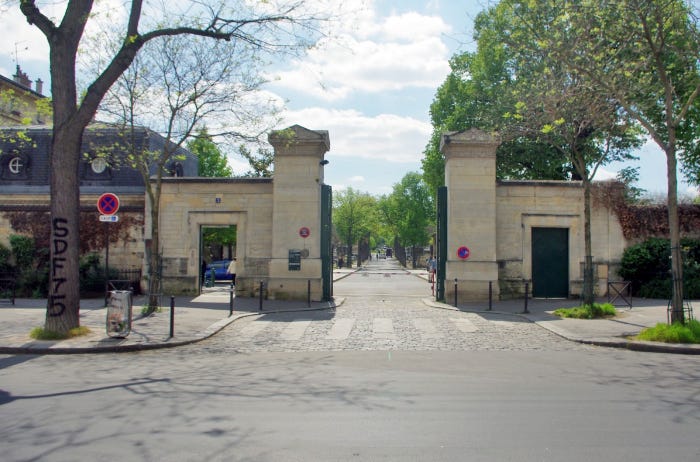
I entered the cemetery through its main gate, next to which there was a walk-through window where an attendant gave me a paper with a map showing the location of the tombs of about one hundred celebrities buried there. I immediately found Huysmans’s name and located his grave on the map.
Created in the early 19th century, the Montparnasse cemetery covers 47 acres. It is a lovely, peaceful, and meticulously landscaped green space, its twenty-one sections divided by alleys bordered by a variety of trees and the occasional bench that give it a park-like atmosphere. The older tombs tend to be monumental and quite ornate, often featuring large sculptures in an array of styles. Some wealthy families are buried in mausoleums that resemble small chapels.
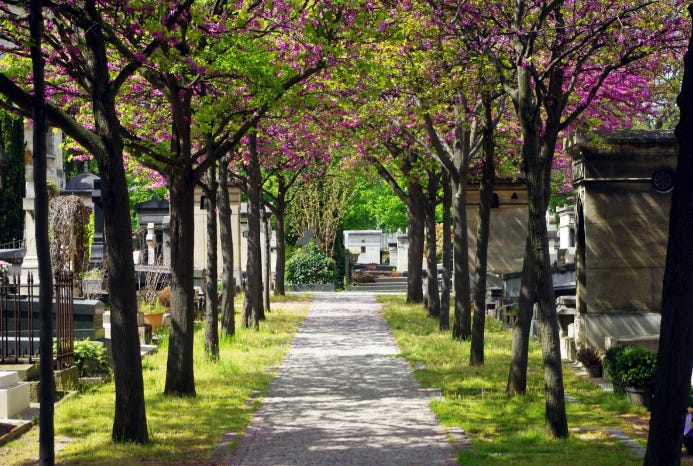
I proceeded to head for Huysmans’ grave, while not ignoring along the way those of many other famous people I knew and loved. I walked for quite a while through the many alleys, finally zeroing in on the area of Huysmans’ grave, undertaking a careful search that lasted at least forty-five minutes but led me nowhere. The “second division” of the cemetery, where he is buried, was a labyrinth. I asked a maintenance worker if he could help me, but to no avail. My quest remained fruitless, and I had to leave the cemetery because it was closing time. What made things worse was that I was leaving France the next day. I was crushed and vowed that I would return the following year and find J.-K.’s grave.
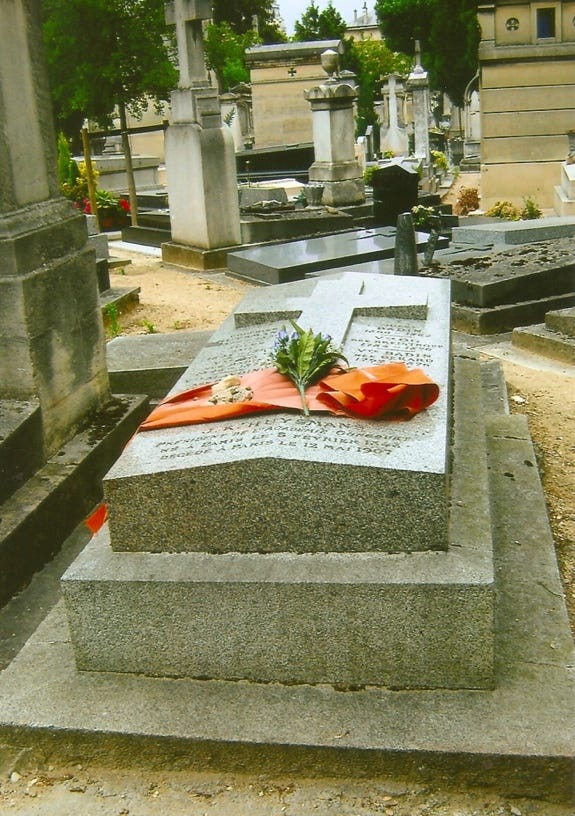
My second attempt the following year was a success.
Huysmans’ tomb turned out to be very plain. At the bottom of the gravestone, below the names of several people, including his mother, father, and stepfather, was carved his name, the dates of his birth and death, as well as the words “Président de l’Académie Goncourt,” acknowledging the fact that he had served as the first President of the jury for the Goncourt, France’s most prestigious literary award. There was an orange cloth strewn on the grave, weighted down by stones, on which had been laid a bouquet of artificial blue tulips. I had no clue what the orange cloth meant, except that the color orange is significant in Dutch culture, as are tulips. Huysmans’s father was Dutch, and he was quite proud of his Dutch roots.
I was very moved by the experience of being in front of Huysmans’ grave, closer than I had ever been to a writer whose works I had studied intensely for five years of my life. For a brief moment, I felt that I was communing with him. I thanked him, from the bottom of my heart, for having created exceptional literary works that had enthralled me, offered me a new perspective on late 19th-century Paris, made me discover new artists and literary works, and led me to perceive my surroundings and look at art in a different way. Of course, I also expressed my utmost gratitude to him for his invaluable contribution to my doctoral degree.
Some years later, in May 2014, I was staying in another Montparnasse hotel before the arrival of a group of University of Pittsburgh students enrolled in a study abroad program that I was directing. Sylvia, the program graduate assistant, was there with me, and I took her to the Montparnasse cemetery. She loved the idea of walking among the graves of great writers, musicians, and artists whom she admired. This time, there were no longer photocopied maps handed out at the cemetery entrance, but a few large, laminated, and rather fancy colored maps that visitors could use through the duration of their visit. Sylvia and I grabbed one, and I immediately looked for Huysmans’ name. To my dismay, it was not on the list of celebrities buried in the cemetery. I immediately walked into the nearby office to inquire about this terrible omission. A man was sitting at a computer, and I asked him very politely why Huysmans’ name was no longer on the map. He raised his head and replied, “Well, nobody ever asks for him.”
His response triggered in my mind a flashback to a brief conversation I had had at least fifteen years earlier with a man who had come to speak to graduate students in French literature at Pitt. He had worked for decades as an editor for Gallimard, a French publishing house, more specifically for its prestigious Pléiade edition. Having their annotated collected works published in Pléiade edition volumes is the utmost consecration for any writer, dead or alive. Bound in fine leather, printed in small Garamond type on very thin Bible paper, and easily recognizable by their gold-stamped spine, these books are exquisite. The Pléiade is the Panthéon of great literature into which only about 250 authors have been admitted. I asked this man why Huysmans had never been published in this prestigious edition. His immediate answer was “because nobody cares about Huysmans.” This felt like a heartless and possibly unfounded assertion to me. I certainly did care a great deal about him.
The Montparnasse cemetery clerk’s similarly disquieting pronouncement made me gasp. It had only come to confirm that Huysmans was not only dead and buried less than a quarter of a mile from the office in which we were standing, but that he was also metaphorically dead in the French collective memory. His works had gone through what the Italian literary scholar Franco Moretti calls “The Slaughterhouse of Literature,” a “terrifying place where literature goes to die,” as Bradley Gorski puts it.[1]
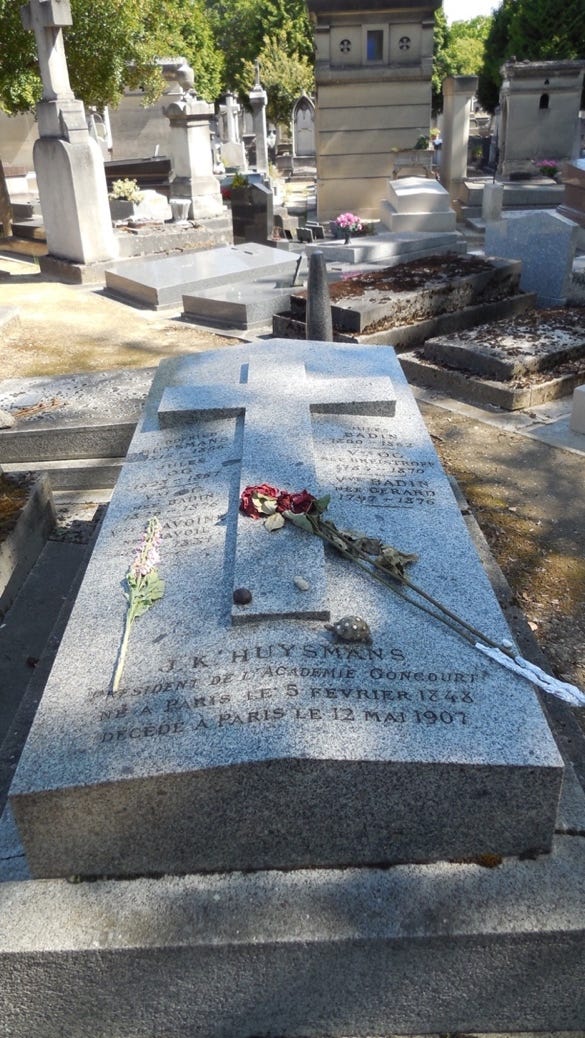
Yet, as Sylvia and I reached his grave, there were a few signs on it that Huysmans and his works were still alive, at least for a few people. A couple of roses and a wilted wildflower had been laid on it, as well as a few stones and a small carved turtle studded with sparkling faux gems. This last item was evocative of chapter IV of À Rebours, in which des Esseintes, the protagonist, a wealthy and eccentric aesthete, purchases a large turtle whose shell he has gilded and encrusted with precious gems. Before long, unable to withstand the weight of those gems, the turtle dies. I found this small token of recognition incredibly touching.
Another fleeting thought crossed my mind, connected to my utter revulsion when I had realized years ago that Huysmans was a staunch anti-Semite. He had stood against Dreyfus for more than ten years during the political scandal that had divided France in the aftermath of the unjust conviction for treason and deportation to Devil’s Island of Alfred Dreyfus, a French army captain who was Jewish. Dreyfus was tried and declared guilty a second time, but he was pardoned by the French President and finally exonerated by a military tribunal. He is buried in the old Jewish section of the Montparnasse cemetery, not very far from Huysmans’ grave. In an ultimate ironic twist of fate, they are now united in death in one of Paris’s most legendary graveyards.
As he rests, hopefully in peace, in the second division of the Montparnasse cemetery, Joris-Karl Huysmans remains very much alive in my memory and intellect, over thirty years after I first saw his name on a Master’s comps reading list.
À bientôt
Elisabeth
[1] Bradley Gorski, “Exit Plan from the Slaughterhouse of Literature,” author’s personal blog, 5/5/2015.
Introducing Contributor, Elisabeth Sauvage-Callaghan
Visit her Page — Explore more of Elisabeth’s work→
MyFrenchLife™ – MaVieFrançaise® is a reader-supported publication. To receive new posts and support my work, consider becoming a free or paid subscriber.