
Matisse’s new lease on life, 1941-1954
In Le Croissant, Baguette Gazette’s weekend special, we step into the world of Henri Matisse, from his gouaches découpées to the iconic Nus Bleus, and countless pinpricks holding it all together.

Today’s Le Croissant, Baguette Gazette’s weekend special, is devoted entirely to Henri Matisse. As of this week, you can visit the exhibition ‘Matisse 1941-1954’ at the Grand Palais in Paris and believe me, you’ll want to. In this final chapter of his life, Matisse was more creative than ever, producing many of his most iconic works, including the ‘Intérieurs de Vence’, ‘Les Nus Bleus’ and the gouaches découpées. The result is a rich exhibition, thoughtfully arranged by theme, that leads you from familiar classics to unexpected discoveries. Matisse is colour, and often scale too, so sensory overload is never far away. My advice: try to save a few oohs and aahs for the Nus Bleus right at the very end.
One small frustration, though, because can someone explain to me why the wall texts beside the works are printed so absurdly small? At times, it was a real squeeze just to read those size 8 captions. Grand Palais, you can do better! And even after deciphering the small print, I still felt some of the background was missing here and there. Matisse was, of course, already famous in his own lifetime, and not every great master gets to experience that, but just how successful was he in 1941? And what did his world look like at that moment? That’s what we’re diving into today.
Bisous,
Suzanne
‘J’espère qu’aussi vieux que nous vivrons, nous mourrons jeunes.’
Henri Matisse, 1950
Matisse, Chagall, Renoir, Picasso: just a few of the many celebrated artists who settled in the South of France for a time, and whose museums you can still visit in Nice, Cagnes and Antibes. I love visiting them, but if you’re used to the grand exhibitions of Paris, the South of France does require a slight adjustment. It happens, for instance, that the handful of star works are all out on loan, and you’ve turned up for what feels like very little. Then again, not for nothing exactly, because half the pleasure is in soaking up the atmosphere, and to catch a glimpse of what these artists once found in the light, the landscape and that unhurried rhythm of life.
The exhibition at the Grand Palais covers the years 1941 to 1954, a period Matisse spent entirely on the Côte d’Azur. So as I wander past his works inside the beautifully restored Grand Palais, I try to keep in mind that every one of them was made under the southern sun, in Nice and Vence. Matisse had his studio in the former Hôtel Régina, in Cimiez, the hillside neighbourhood of Nice, where you can now also visit the vivid red Musée Matisse. It was here, during the first years of the Second World War, that he became more prolific than ever. Matisse eventually left Nice with his assistant, Lydia Delectorskaya, when the city became too dangerous. They took refuge in the village of Vence, in the hills behind Nice. It was at Villa Le Rêve that his world-famous gouache cut-outs would eventually come to life.
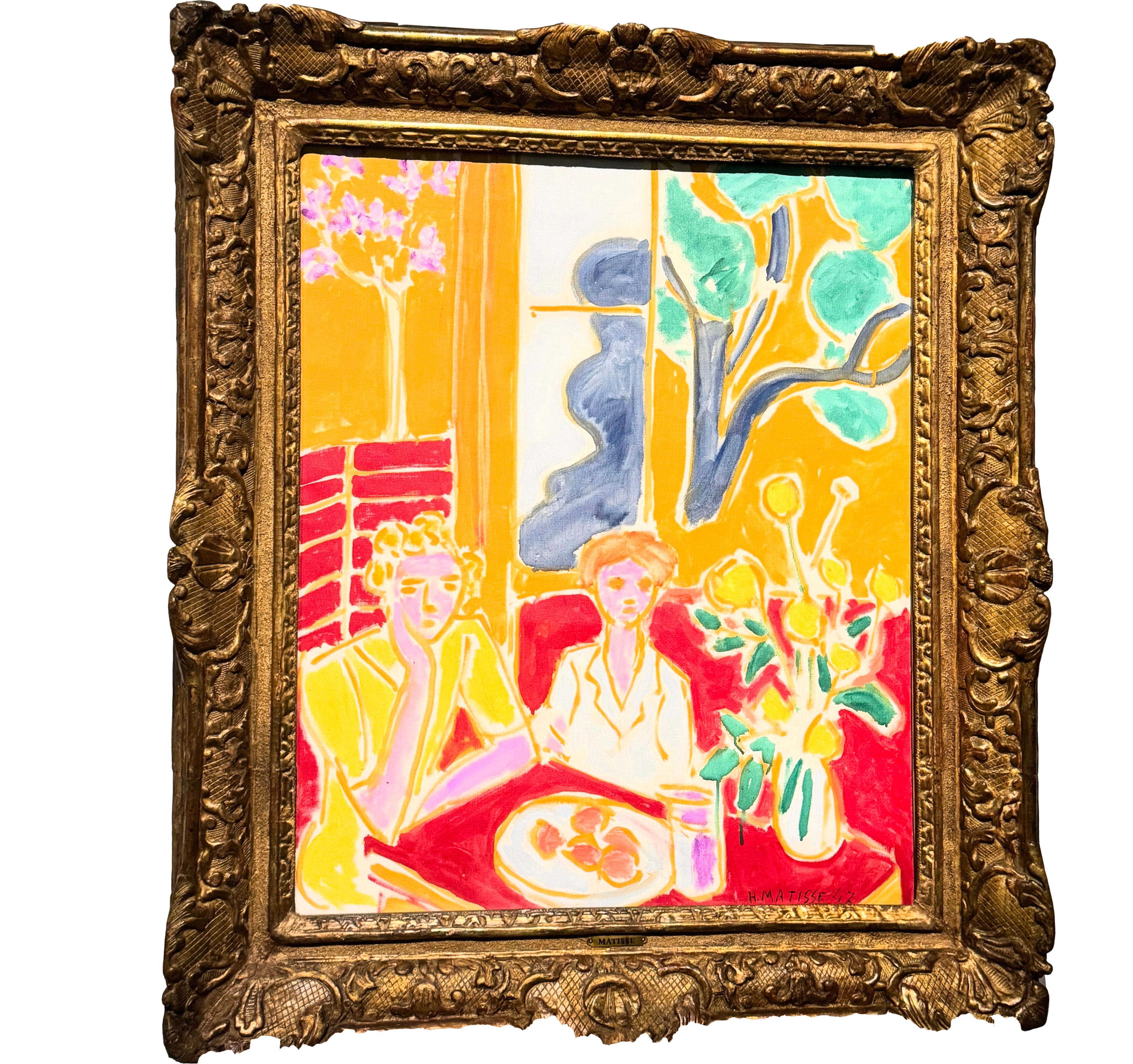
The law student
To understand where Matisse stood in his career in 1941, we need to step back for a moment. Henri Matisse was born in 1869 in Cateau-Cambrésis, in the north of France. Twice in his life, abdominal surgery would dramatically alter his path: once in his twenties, and again in 1941. Unlike successful contemporaries such as Picasso, he was no painting prodigy, and only began to paint in his early twenties. It was while the young law student Matisse was recovering from an appendicitis operation that his mother gave him a box of paints to pass the time. Painting felt like coming home, and he decided to change the course of his life.
Shortly before the turn of the century, in 1898, Matisse married Amélie Noellie Parayre, who adopted his daughter from an earlier relationship, Marguerite, and with whom he had two sons, Jean and Pierre. Marguerite was always hovering around her father’s studio and, in time, came to manage almost everything there, including negotiations with famous collectors such as Gertrude Stein and the Cone sisters.
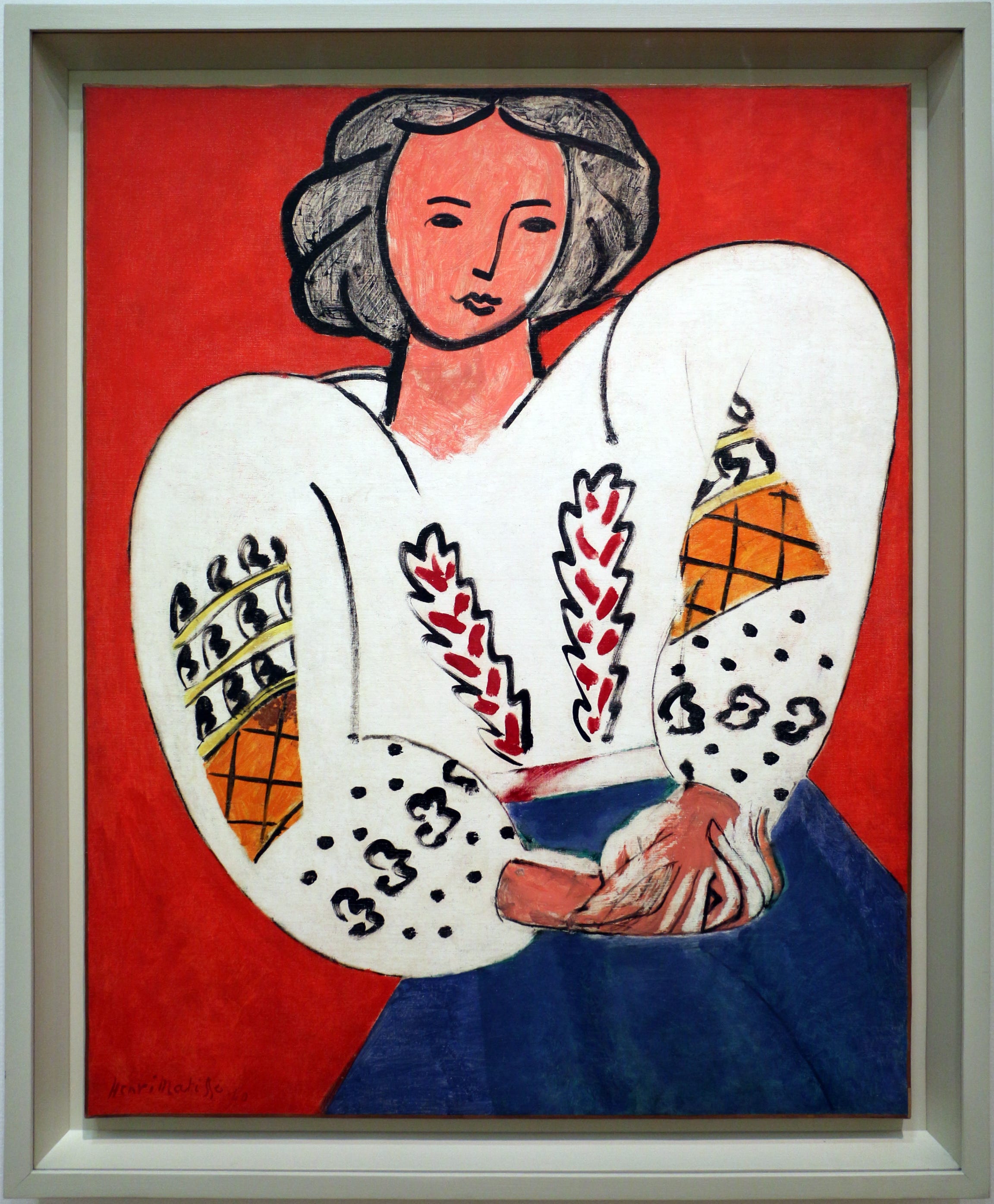
Yet another Matisse window
It was in 1905 that Henri Matisse made his breakthrough with a bold, colour-soaked style that immediately established him as the figurehead of a new movement: Fauvism. Important collectors increasingly found their way to him, and in his studio in Issy-les-Moulineaux, just outside Paris, he was constantly pushing at the boundaries of modern painting. Matisse’s style shifted regularly, from exuberant and vivid to sombre and at times almost dark in the works he made during the Grande Guerre, the First World War, in which both his sons were fighting. The end of the war brought colour back into his work. In the 1920s, he turned towards something more decorative and classical, still full of colour. Throughout the 1930s, those unmistakable Matisse colours remained, but the work itself became ever bolder and more abstract. By the end of the decade, Matisse was a celebrated artist, but he was also coming in for increasing criticism. He was said to have become predictable, repetitive. The writer André Breton, clearly unimpressed, wrote: ‘Un Nu de Derain, une nouvelle Fenêtre de Matisse, quels plus sûrs témoignages…’
By the late 1930s, Matisse’s artistic reputation was no longer quite what it had once been. He was no longer part of the avant-garde, and his family life was beginning to fall apart. Matisse is often described as restless and quick-tempered. He was always working, and during this period, he was often bitter too. The health of his wife, Amélie, who had for years struggled with depression and other ailments, declined so rapidly that the couple decided to hire a nurse. Enter the Russian Lydia Delectorskaya, who, a few years later, would become Matisse’s model, muse and even studio manager. Lydia’s presence caused such tension that Amélie eventually decided she wanted to divorce Matisse.
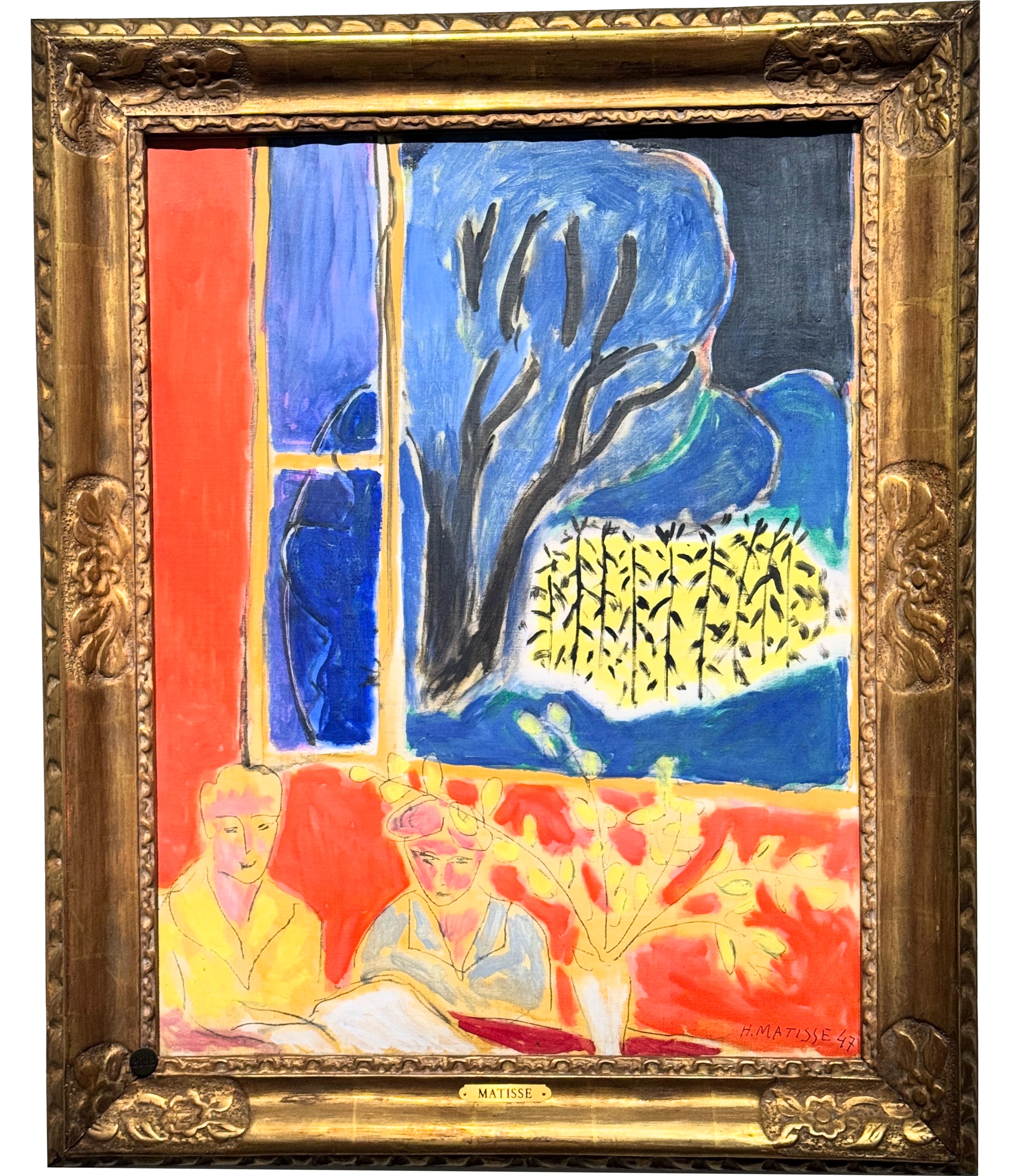
‘Degenerate art’
Privately, then, things were anything but rosy for Matisse when the Second World War broke out in the spring of 1940. Many artists were among those trying to flee Paris and France. Modern art was branded ‘Entartete Kunst’, or ‘degenerate art’, by the Nazi regime, and so-called degenerate artists were treated as enemies. Matisse, too, could have left, but chose to stay. His youngest son Pierre, had opened an art gallery in New York in the 1920s, and during this period, he helped many artists, including Marc Chagall, escape from France. Even the promise of a job in San Francisco and a visa for Rio de Janeiro failed to persuade Matisse to leave. By then, the artist was seventy, yet he decided not only to remain in France but to keep making art as well. A dangerous choice, not least for his Russian companion, Lydia. Of fleeing France, he said: ‘Il me semblait que je désertais. Si tous ceux qui ont une valeur quittent la France, que reste-t-il de la France?’
In May 1940, France was in chaos, and in the midst of it all, it took Matisse a full hundred days to travel from Paris to Nice through occupied territory. And anyone imagining Nice at that moment as some charming holiday destination would be mistaken. Mussolini had his eye on the city. Nice had, after all, once been Italian, and the hot breath of Fascist Italy was constantly felt here. More threatening still, however, was the artist’s health. Since the early 1930s, Matisse had been suffering from unbearable abdominal pain, but at the beginning of 1941, things took a serious turn. He was diagnosed with cancer of the duodenum, was admitted urgently to hospital in Nice and, after much difficulty, transferred to Lyon for emergency surgery. In the end, his daughter Marguerite came down from Paris and, together with Lydia, who by then had become Matisse’s muse and model, made sure he received the life-saving operation he needed in Lyon. The atmosphere between Marguerite and Lydia was still icy, but for once that hardly mattered. Matisse narrowly escaped death, but after two emergency operations and a life-threatening infection, he was at last able to leave the hospital in the spring of 1941. Writing during his recovery in 1942, he said: ‘J’avais tellement préparé ma sortie de la vie, qu’il me semble être dans une seconde vie.’
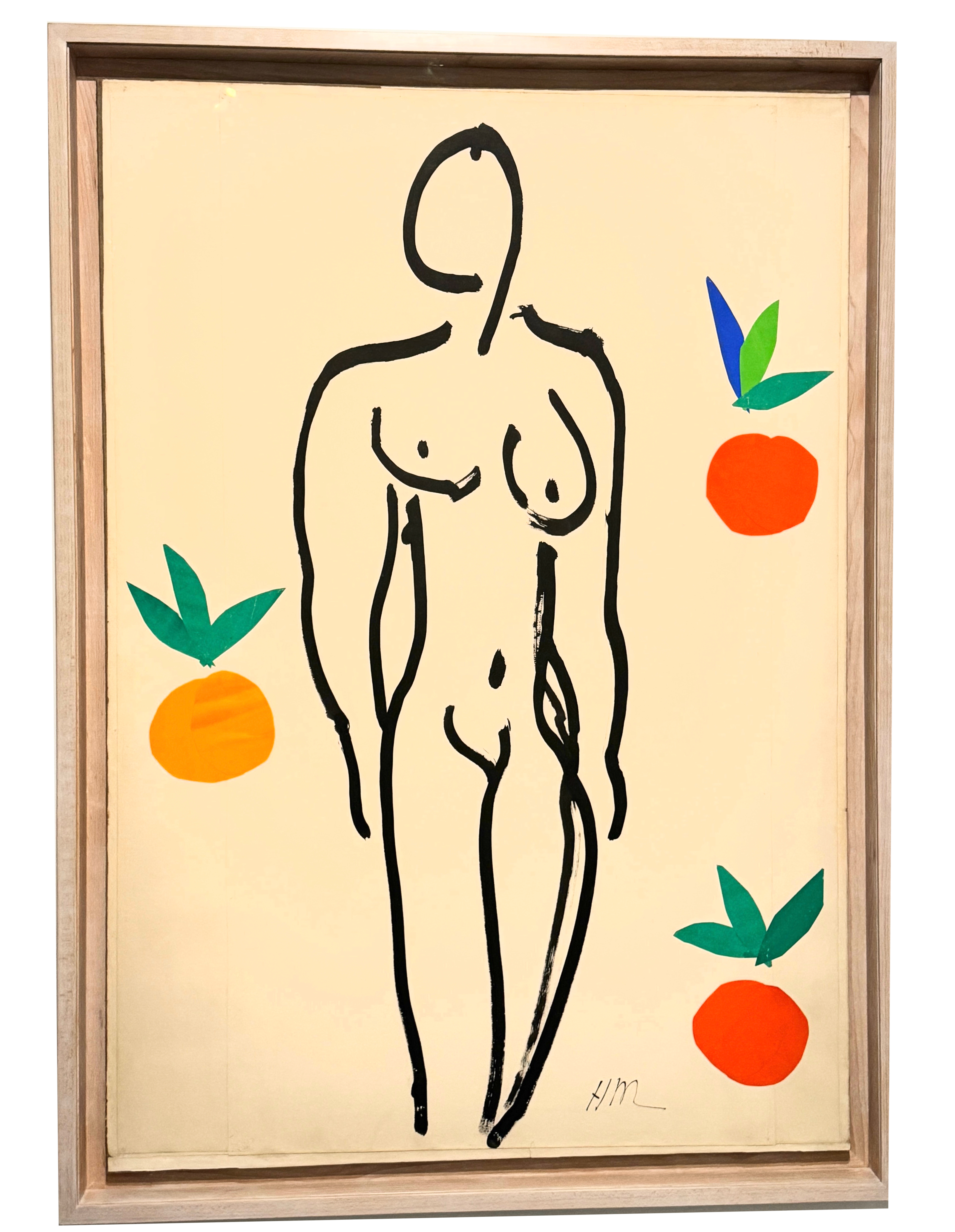
Creative rebirth
And that brings us to the starting point of the exhibition at the Grand Palais: 1941. Matisse had been given a new lease of life, but he was more fragile than ever. Lydia cared for him, as he was too weak to stand at his easel. And yet the artist was more positive than ever, deeply grateful for this ‘second life’, and in the midst of a creative rebirth. Never before had he been so productive or worked with such a wide range of techniques and materials. The great highlights of this chapter of his career are given generous space in this impressive exhibition at the Grand Palais: the transformation the artist underwent, at nearly eighty, through his gouache cut-outs, but also the series of paintings ‘Intérieurs de Vence’, the iconic ‘Les Nus Bleus’ and of course the Chapelle du Rosaire in Vence, for which he designed everything, from the stained glass windows to the roof and the furniture.
Jazz
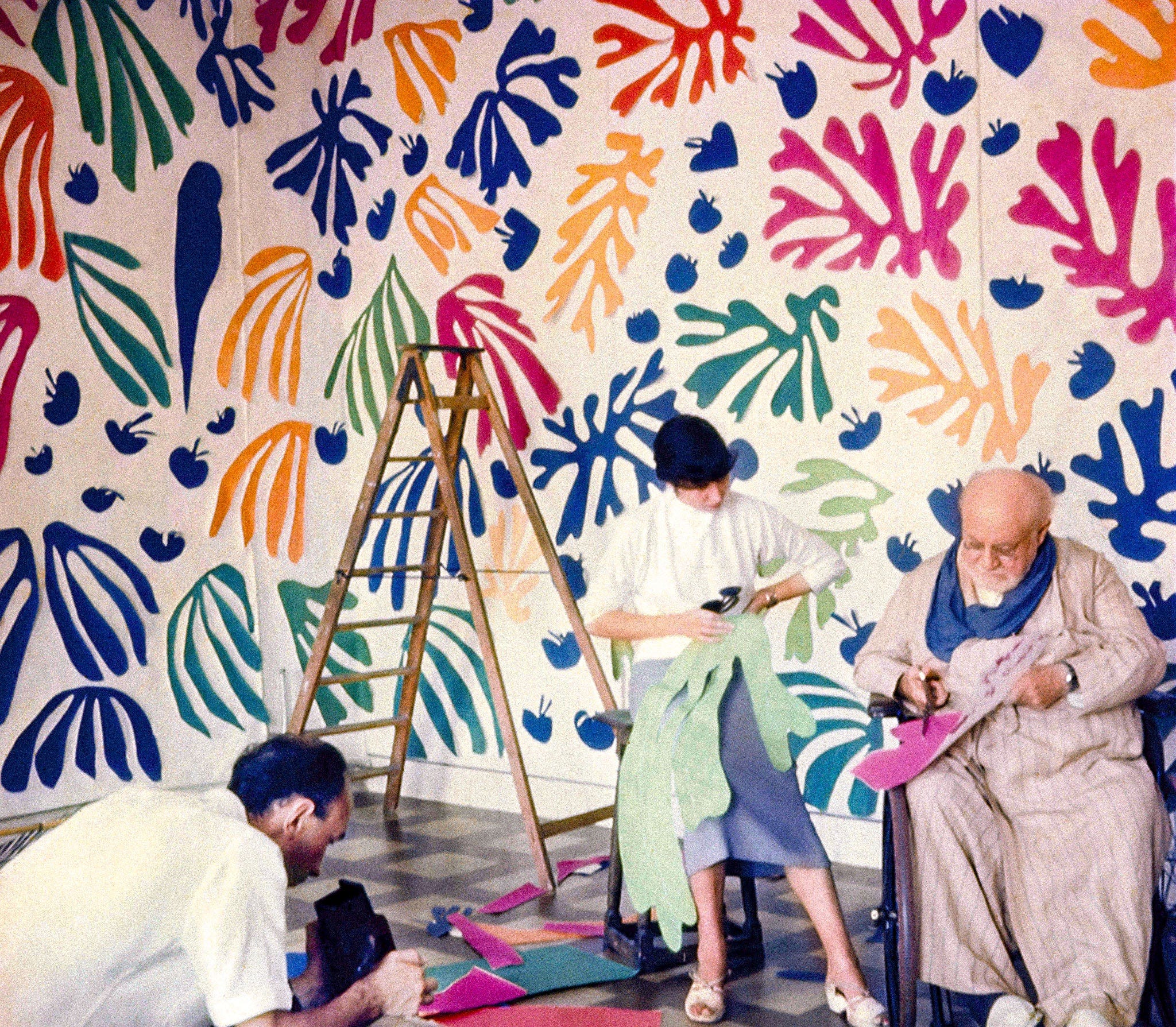
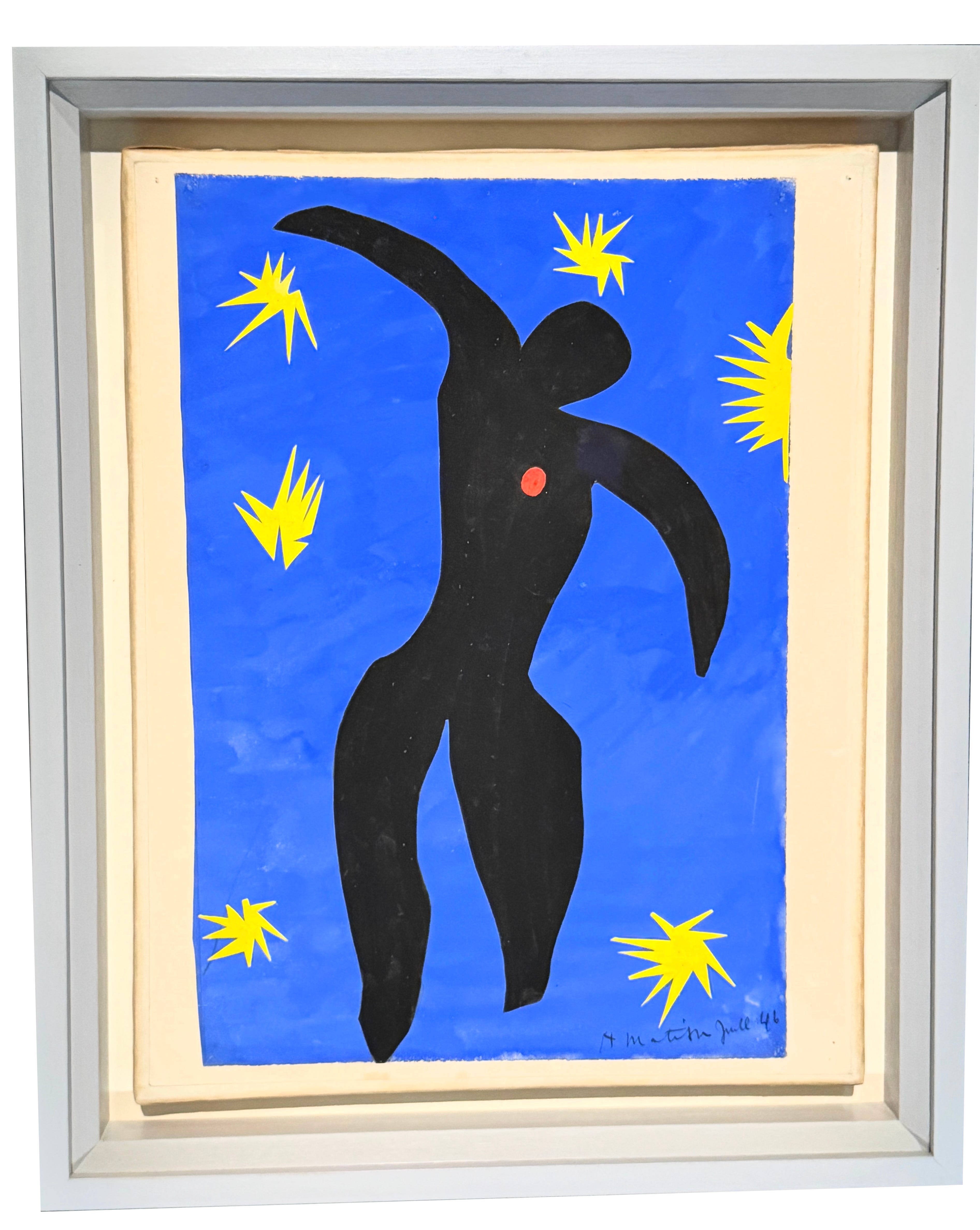
In 1943, Matisse began work on one of the most important projects of his career: the collages for what would later become his book Jazz. Painting had become too exhausting, so he came up with a new way of working. He had thick sheets of paper painted in flat, solid colours with gouache, an opaque water-based paint similar to watercolour. He then used tailor’s scissors to cut shapes from those coloured sheets. With Lydia’s help, he pinned the shapes to the wall. This allowed him to shift, turn and rebuild his compositions without having to draw or sketch. You can still often see traces of that process in the works themselves, in the form of countless pinholes. What began as a practical solution for an artist recovering from illness and often confined to bed soon grew into a fully fledged artistic method.
At first, Matisse wanted to call the series Le Cirque, a title that nodded to the colourful but also marginal world of circus performers, but he later chose Jazz instead, a deliberate reference to the improvisation and freedom of the musical form, which the Nazis despised. One of the most striking images is Le Cauchemar de l’Éléphant Blanc. It shows an elephant balancing on a ball, like something from a circus act. When Matisse was asked what it meant, he replied simply: ‘C’est moi.’
La Résistance
During the war, Matisse managed fairly well to stay in touch with Marguerite, who was living in occupied Paris, but in the spring of 1944, while he was staying with Lydia at Villa Le Rêve in Vence, he suddenly stopped hearing from her. Naturally, he was deeply worried. At the age of fifty, Marguerite Matisse had joined the Resistance and was working as a courier, carrying information from Paris to Normandy and Brittany. Her mother, Amélie, incidentally, was also active in the Resistance, as was his eldest son, Jean, who helped the Allies with acts of sabotage. In May 1944, Matisse received the dreadful news that his wife and daughter had been arrested. In a letter to his good friend and fellow artist Charles Camoin, he wrote: ‘Mon cher Charles, je viens d’avoir le plus terrible choc de ma vie. Ma femme et ma fille ont été arrêtées. Aucun détail, aucune autre nouvelle. Déchire ma lettre après l’avoir lue.’
What Matisse would only discover after the war was that Marguerite had been tortured in Rennes prison and then deported, though she was fortunately liberated in Belfort. Amélie, for her part, was arrested by the Gestapo and spent six months in Fresnes prison, just outside Paris. She survived, as did her adopted daughter Marguerite and her sons Jean in the South of France and Pierre in New York.
Everything at once
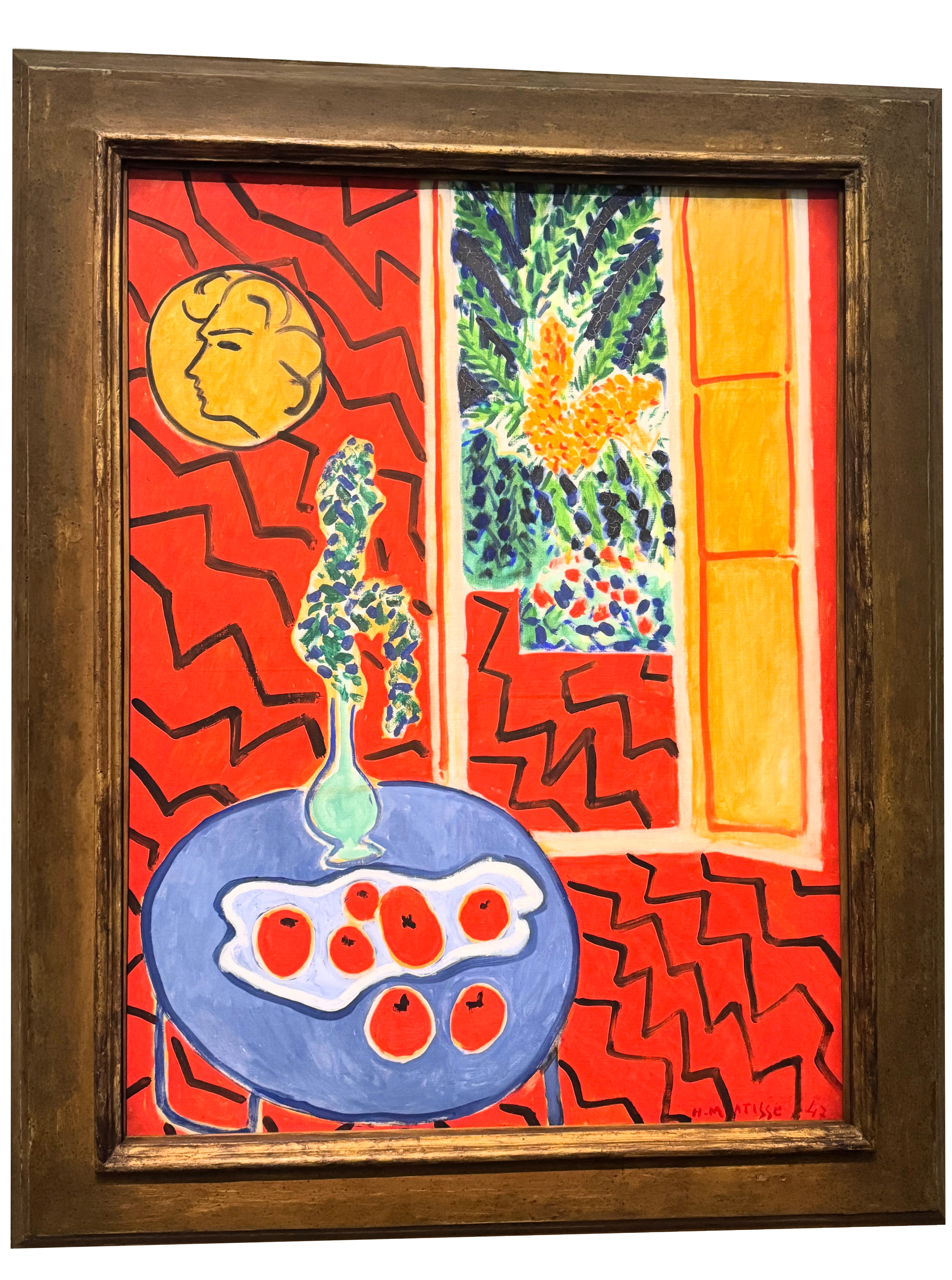
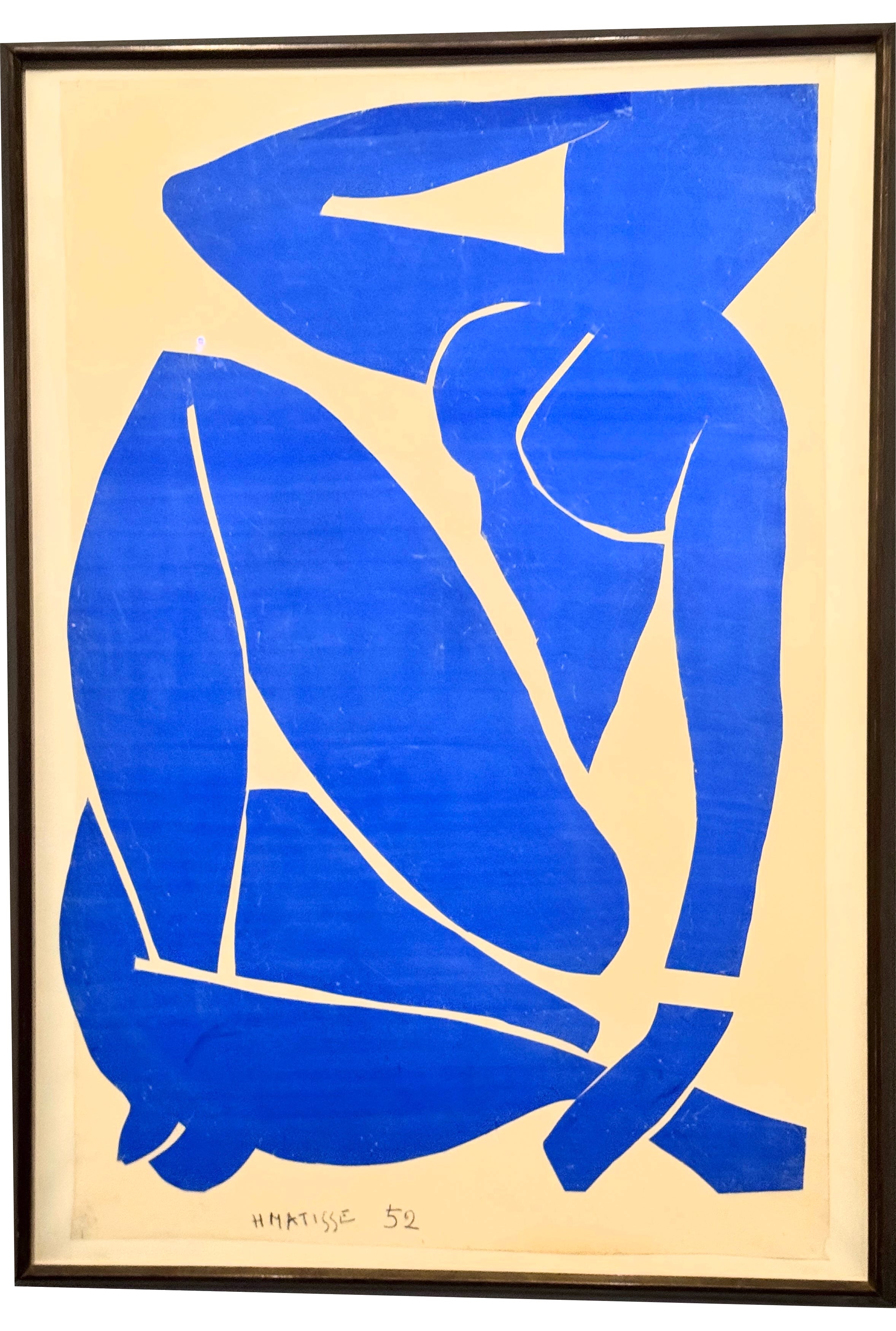
In the years after the war, Matisse and Lydia divided their time between Le Rêve in Vence and the studio in the former Hôtel Régina in Nice. You have to imagine those studios with cut-out gouaches scattered and pinned up everywhere, an oil painting or drawing resting on an easel nearby, and Matisse moving between all these different projects, doing everything at once, constantly shifting gears. Between 1946 and 1948, for instance, he produced the series ‘Intérieurs de Vence’, which can be seen as a farewell to painting. From 1948 to 1951, he designed the Chapelle du Rosaire in Vence, and in the spring of 1952, he created Les Nus Bleus, all four of which you can admire as the grand finale at the end of the exhibition. And yes, you could probably name five friends who have, or once had, a reproduction of one of the Nus Bleus on their wall, but they’re still stunning.
Mentor and muse
On 3 November 1954, Matisse died in Nice, in the presence of his daughter Marguerite and his muse and assistant Lydia. The New York Times wrote of him: ‘One of the young rebels who lived long enough to be regarded as an old master. His life was an integral and important part of what has come to be known as the Modern Movement.’
After his death, Lydia quietly slipped from view, grateful for her years with the artist, yet also painfully aware that Matisse’s children were only too glad to see her gone. She was not welcome at the funeral and left with nothing but her suitcase, without a single work or keepsake from all those years of working alongside Matisse. And when she herself died in 1998? Her wish was that one of Matisse’s shirts be placed in her coffin.
→The exhibition ‘Matisse, 1941–1954’ is on view at the Grand Palais until 26 July.
→Curious to explore more of Matisse in wartime? Then read Matisse in War: Art and Resistance in Nazi-Occupied France by Christopher C. Gorham.
Have you seen this particular Matisse exhibition yet? Tell me in the comments.
Introducing Contributor Suzanne Rietmeijer
Visit her Contributor Page — Explore more of Suzanne’s work
Such an interesting article. Thank you for sharing Suzanne.
Wow, so much great information! I was at the exhibition and yes, the organizers could learn from you.