

It was a Thursday in 1950, at the Musée de l’Homme. Lunch was ending. Claude Lévi-Strauss — anthropologist, rising star of French intellectual life, the man who would go on to reshape how the world thought about myth and kinship and the structures hidden inside everything — turned to his trilingual translator and asked: Vous êtes libre à déjeuner jeudi prochain? [Are you free for lunch next Thursday?]
She said yes.
Et tous les autres jeudis? [And all other Thursdays]
She said yes to that, too.
“Mariés soixante ans et très heureux,” she says now, from the Paris apartment where she grew up and where they lived. Married for sixty years, and very happy. “Ce n’est pas rien.” That is not nothing.
She is 100 years old. She is Monique Lévi-Strauss. And if you think you already know who she is, I would like to gently suggest that you start again. Yes, I thought I knew who she was, too. But I was wrong.
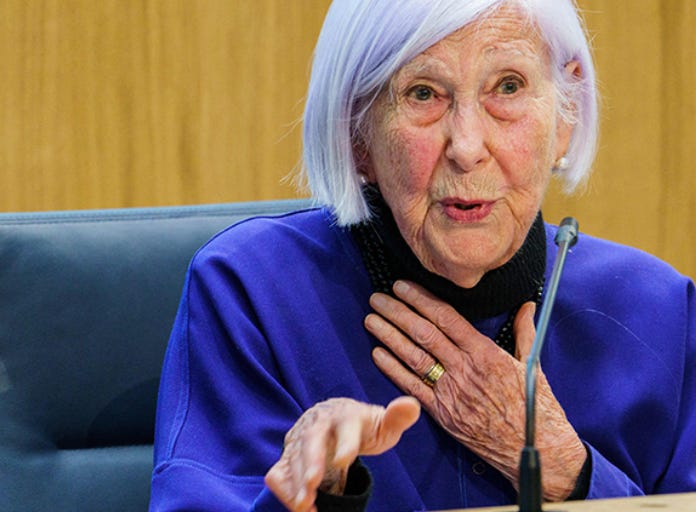
The easy version goes like this: she was the wife of Claude. She was there. She was supportive. She was, in the way that so many brilliant women of the 20th century were described by history, adjacent.
That version is wrong in almost every particular.
Here’s what I found to be true. Monique Lévi-Strauss, born Monique Roman, in Paris, on 5 March 1926, spent five years of her adolescence hiding her Jewish identity inside Nazi Germany, with the Gestapo searching her bedroom. She arrived in post-war Paris as a polyglot so fluent in English, German and French that Jacques Lacan, yes, that Lacan, recruited her to retranslate Freud for him on Sunday mornings. She became one of France’s foremost specialists in the history of textiles, curating exhibitions at the Palais Galliera and writing the first French monograph on American textile artist Sheila Hicks. She transcribed Tristes Tropiques from beginning to end, flagging passages she found obscure or ponderous, and Claude Lévi-Strauss rewrote them. She considers that her proudest intellectual contribution to his work. She had no university degree.
In March 2025, at her 99th birthday, the Académie française named her an honorary 41st member. The Académie has exactly 40 seats. They made a new one for her.
She turned 100 in March 2026. Ce n’est pas rien.
The Thursday lunches are just the beginning. What Monique built — in cloth, in language, in the margins of a masterpiece — is the part history forgot to write down. It's below the fold, for Mighty Supporters and Annual subscribers.
If you've read this far, you're exactly who I wrote this for.