
The €4 Billion Nose: When Private Equity Discovered French Perfume Smells Like Money
How a Boston buyout firm, a French luxury conglomerate quietly exiting beauty, and a tripling valuation are rewriting who owns "French" scent. A French perfume mini-series 2/3

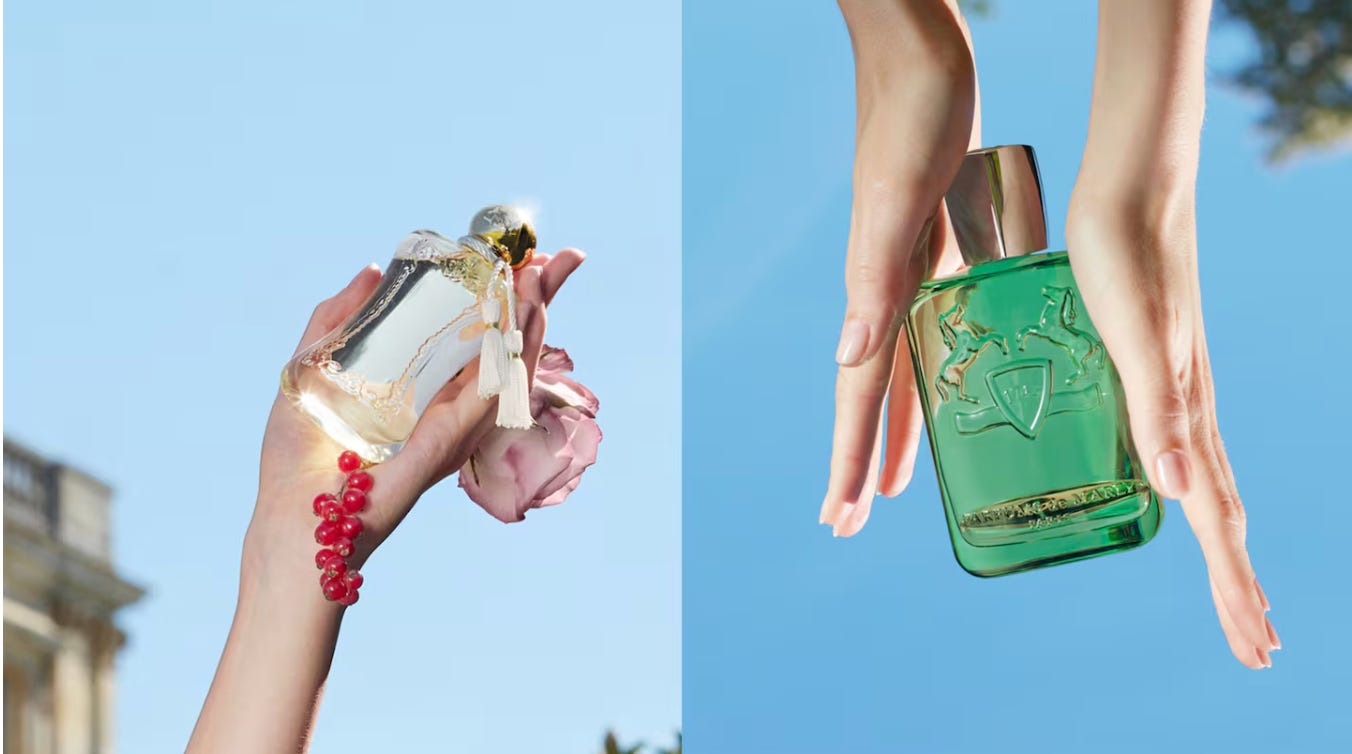
Remember Parfums de Marly? Named for Louis XV’s horse-mad hideaway at Château de Marly, launched in 2009 by Julien Sprecher, and somehow, within a decade, sitting in every department store and half of Instagram. Bottles running from €200 to €300. Scents named for royal horses, which I find both ridiculous and completely effective: Delina, Layton, Pegasus.
I don’t own a bottle. I’ve smelled Delina on someone else’s wrist at a dinner and thought about it for ages, which is probably the whole business model right there.
In 2023, Boston private equity firm Advent International took a majority stake. Industry sources put the deal at around $700 million.
Two years later, Advent is reportedly shopping it around at a valuation north of $2 billion.
I read that number three times. Not because I didn’t believe it. Because I was hunting for the trick in it.
I’ve had a few careers before this one, fashion and fund management among them, and between the two I seem to have developed a slightly unfortunate radar for exactly this kind of moment. The one where a beautiful, particular, small thing gets noticed by people who think in multiples and exit strategies. I’ve sat on both sides of that desk now. It rarely ends the way the founder pictured it when they started. Rarely.
A near-tripling in two years. For perfume. While LVMH and Kering post the kind of quarters that make headlines for the wrong reasons. While every luxury conglomerate on earth blames China for something, anything. And here’s niche fragrance, unbothered, quietly making Boston bankers very happy.
Nobody saw this coming from a bottle of eau de parfum. Or maybe everybody did, and I’m just the one who wasn’t paying attention.
Bienvenue to the new French gold rush.
The Numbers That Made Finance Notice
Here’s what actually caught the attention of the private equity crowd. And, fine, what caught mine too: premium fragrance is beating the category it’s supposed to belong to, and not by a little.
The wider cosmetics market grew something like 4% in 2024. Perfectly respectable. Forgettable, even. Niche and premium scent posted double digits. Some segments touch 11 to 12%.
Parfums de Marly’s US department store sales jumped 73% between 2021 and 2022. Asia was up 60% in the same window. By 2022, the brand alone was doing $280 million in retail, $366 million combined with sister label Initio. By the year to March 2025, that combined figure had climbed to $775 million. A 41% jump. Parfums de Marly carries $586 million of it on its own.
I keep waiting to find the asterisk. The weak quarter, the correction, the thing that makes this all ordinarily make sense. Haven’t found it yet.
The whole category is en feu, and has been for a while now. Market research firms can’t agree on where “niche” ends and “luxury” begins, so the growth estimates wander, but they cluster somewhere between 8-14% annually, with the market forecast to go from roughly $2.5-4 billion in 2024 to $6-10 billion by 2033.
Set that against mass-market fragrance limping along at 4%, and you understand why every analyst in New York and Boston is asking the same question I keep circling back to at odd hours. What is it about a niche? What does a $300 bottle have that a $50 one doesn’t, besides the obvious?
Has a perfume ever felt like more than a purchase to you? Closer to an identity than a scent? I’d love to know which one, and why it stuck.
What’s so special about niche is exactly what I go into next: the margins, the loyalty, the deliberate smallness that keeps these brands desirable. And then the bigger story: a Boston private equity firm, a French luxury conglomerate quietly giving up on beauty altogether, and a deal that makes Advent’s numbers look almost modest.
The rest, the why behind the numbers, the Kering-L’Oréal sale, and what it means for who actually owns “French” luxury now, here as a stand-alone article, and is over in the Deep-Dive Collection.