

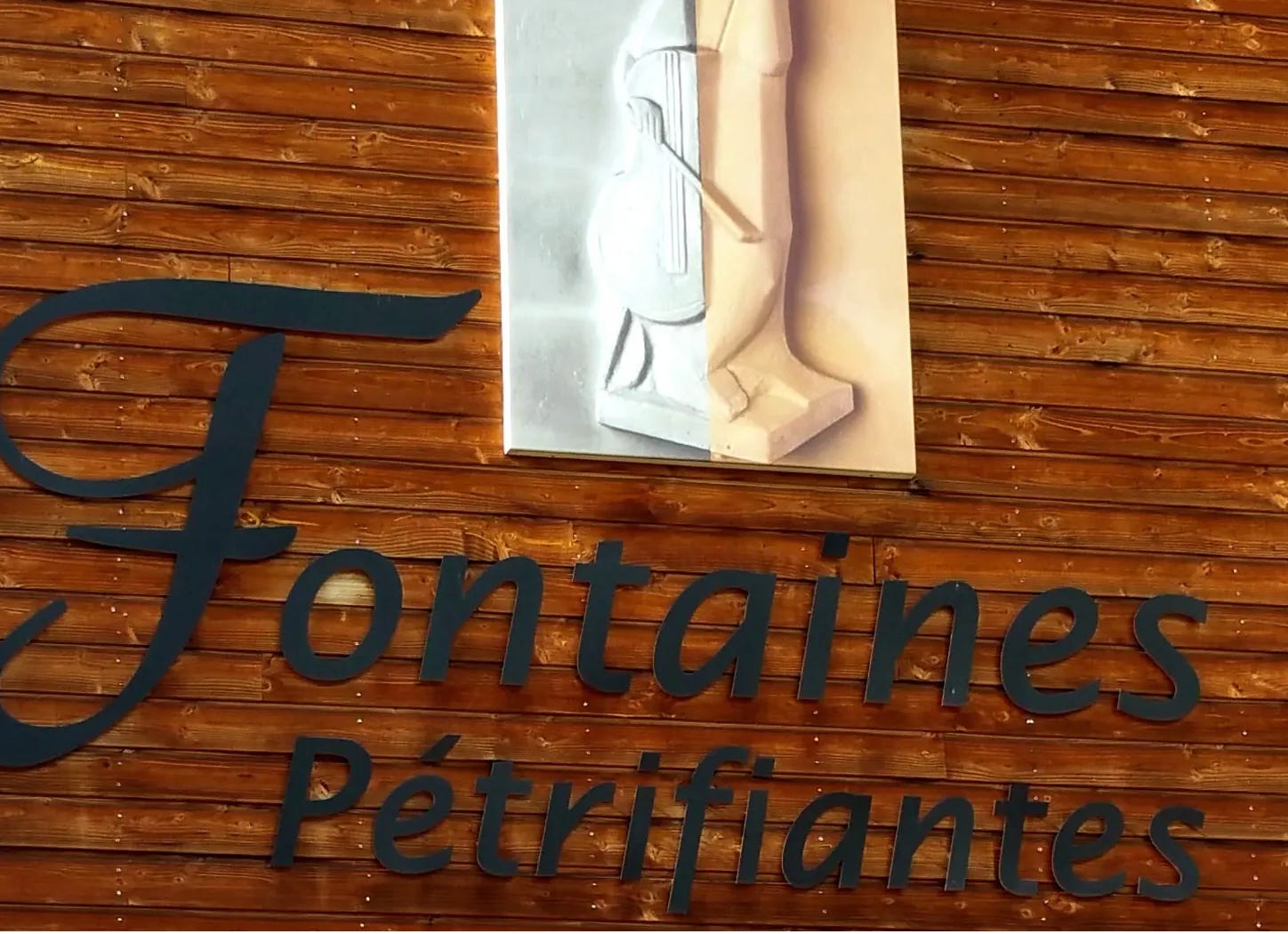
We were on our way to a cheese farm — Kathy and I had been driving since morning, a quiet route through the Auvergne, the kind of country drive we’d been taking together for twenty years. Then we came around a bend and saw the sign.
Fontaines Pétrifiantes
We tried to translate it as we slowed down. Pétrifiantes. Petrifying fountains? Fountains that turn things to stone? Frozen fountains, perhaps? Whichever way I tried, I couldn’t picture what it would actually look like. Kathy and I looked at each other. We always end up at these off-the-wall places. We pulled off the road.
The building appeared just beyond the bend, a stone front set back from the road with a small parking area in front and the same words painted above the door. We went in to see if we could get a tour. The lobby was quiet — posters on the walls, photographs in cases, and a woman at the desk who told us the next one started in fifteen minutes. We took the tickets, looked at each other again, and decided to wait.


Posters along the walls told the history of the place — that it had been here since 1821, that it was a family operation now in its seventh generation, that the current Maître Artisan en Pétrification, Eric Papon, was the only person in the world officially recognized in the craft. There were photographs in cases: workers kneeling at cascades, hands shaping molds, finished pieces held up for the camera.
Kathy and I read everything. We looked at the pictures. We still didn’t quite understand. The facts were there — seven generations, an unbroken family, water that turned things to stone — but the how of it was still missing. None of it added up to a picture we could hold in our heads.
The door at the back of the lobby opened. The guide gestured for us to follow, and we went through.
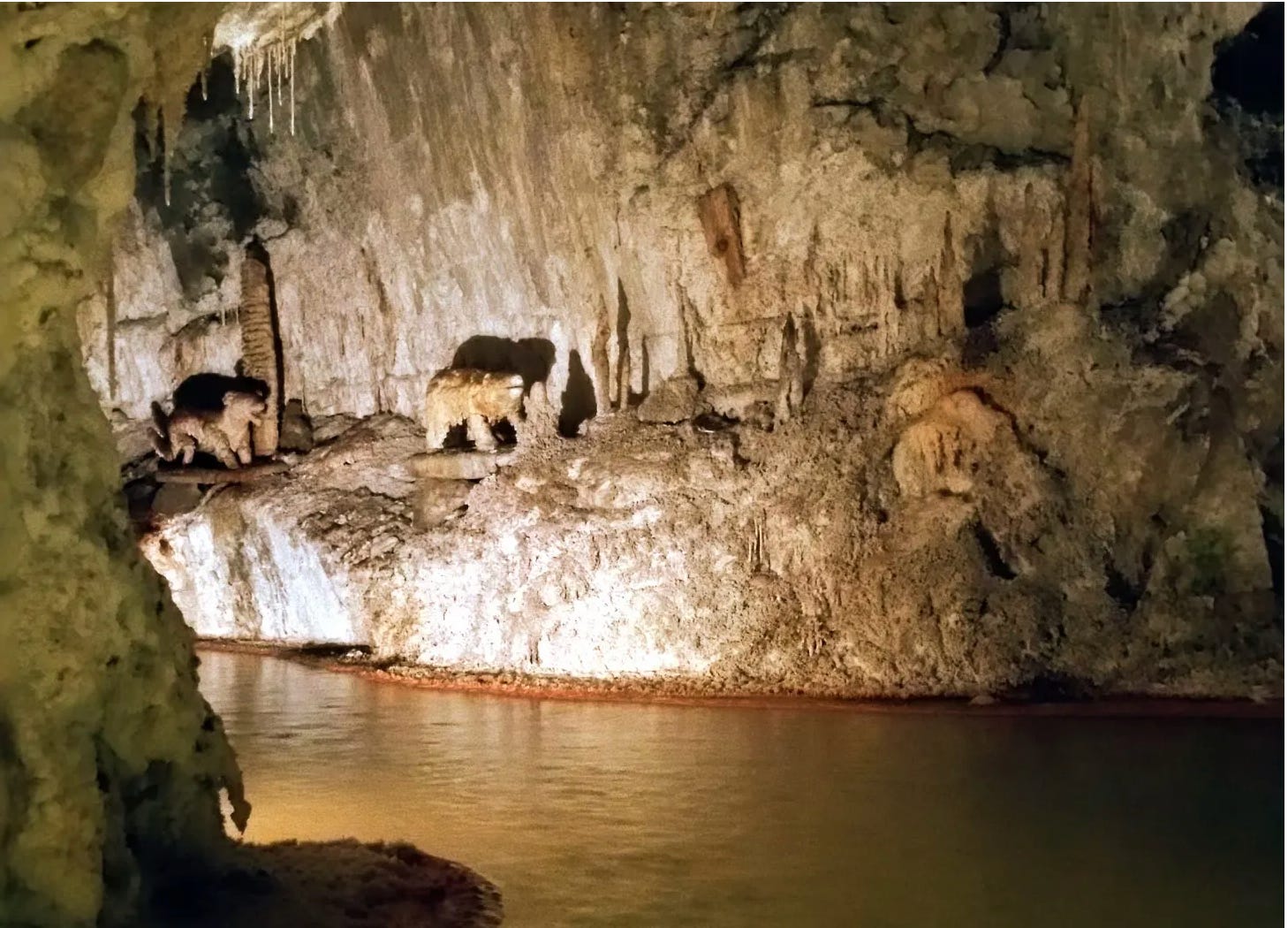
The first room held an underground lake. We walked around it on a wooden walkway, and long, pale stalactites hung from the ceiling. The cave was warm — the same warmth as the lobby, no shift in the air. I had expected a chill, and there was none.
Our guide explained that the water rose from underground springs heated by the volcanoes of the Auvergne, that it came up at a steady twenty degrees year-round, that it carried enough calcium from millennia of volcanic activity that it could lay stone down on anything it ran across.
Then she pointed to the animals.
A larger cat, whole. Something that looked like a pig, also whole. Both white against the rock at the edge of the lake. There were no labels and no explanation in writing. This, she said, was where it had started. Animals had been found in this water already turned to stone, and someone, some generations ago, had stood where we were standing and wondered whether the same thing might happen to other things, with help.
She used a word like crystallize for what the water did, or close to it. I couldn’t tell you the exact term now. What I remember is what landed: nobody had invented this craft. The water had been doing it on its own. A human being had only watched, recognized what was happening, and asked whether they could do the same thing on purpose.
We walked out of the lake room and into the next chamber, where the ladders were. The walkway here was high — we were halfway up the wall, and below us the wooden rungs of the cascade descended further than I could easily see. Perched on the rungs were molds in various sizes, in various stages of being coated in white crystals. Some had been there a while and looked nearly solid. Some were barely starting. The water moved in a thin sheet over the molds, very gently, almost without sound.
The guide talked about the molds — that they were made from a substance called gutta-percha, a natural gum from a Southeast Asian tree, the same material that had once insulated the first underwater telegraph cables. The gutta-percha in their workshop, she said, dated to the 1870s. It was kneaded by hand each year, mixed with fresh material to keep it usable. They were the only people in the world still using it — and the only people left who had any.
The next room was the workshop. The tools they used were laid out — hand tools mostly, very few of them new — but no one was working that day. We didn’t get to see how the molds were made, or how a finished piece was cleaned and polished. We did see the finished pieces themselves, arrayed along the walls: bas-reliefs and small sculptures in soft white stone. The guide explained that most of them had taken six months to make. The larger ones took longer.
Six months for a small piece. A year or more for a larger one. You couldn’t speed any of it up. You had to plan a piece months ahead — make the mold, set it under the cascade, leave it for the water to form, then remove it and clean and polish it. There was no way to hurry the water.
There were pieces for sale at the end of the tour, smaller versions of the workshop bas-reliefs and a few sculptures. We looked at them for longer than we should have. Kathy checked her watch. We were going to be late for our appointment at the cheese farm.
We didn’t buy anything. We thanked the guide and walked back out through the lobby, past the posters that had made no sense to us less than two hours before, and into the parking area where we’d left the car. The sign above the door read the same as it had on the way in. Fontaines Pétrifiantes. This time, when I read it, I could picture exactly what it meant.
We got back on the road. We talked about the cat and the pig, calcified and whole and on display without explanation. We talked about the person who had stood at the lake one day, generations ago, and looked at those animals and thought: maybe I could do this with my own hands. Mostly, we talked about the inventiveness that had to be in a person’s head to land on that thought in the first place.
Debra.
Have you stumbled on a place in France that made no sense until suddenly it made perfect sense? Tell me in the comments.
Fontaines Pétrifiantes
Where it is
Fontaines Pétrifiantes de Saint-Nectaire
— 1 avenue du Docteur Roux, 63710
Saint-Nectaire, in the Massif du Sancy of the Auvergne,
about 45 minutes from Clermont-Ferrand
When to come
Open year-round except select Mondays in the off-season and a closure from mid-November through mid-December. Plan 60–90 minutes for the underground tour and workshop visit. Winter visits offer something the summer crowds miss — the contrast between the warm twenty-degree springs and the frozen surroundings.
Prices
€6.50 for adults, €3.50 for children aged seven to fifteen.
The label
The Fontaines have been awarded the Entreprise du Patrimoine Vivant — France’s official recognition of exceptional artisan know-how. Eric Papon is the only living Maître Artisan en Pétrification in the world.
What to combine it with
The village of Saint-Nectaire holds two more visits worth making on the same day. The twelfth-century Romanesque church just up the hill is one of the most beautiful in the Auvergne. And the village’s famous cheese caves are a five-minute drive — the volcanic terroir that feeds the springs is the same terroir that gives Saint-Nectaire cheese its character.
If you fall for a piece
The workshop sells finished works at the end of the tour and ships worldwide. The larger pieces take a year or more to complete and are priced accordingly.
Introducing Contributor, Debra Fioritto:
Visit her Contributor Page — Explore more of Debra’s work
MyFrenchLife™ – MaVieFrançaise® is a reader-supported publication. To receive new posts and support my work, consider becoming a free or paid subscriber.