
The Queen Who Wore Her Underwear in Public
A white dress that looked like underwear sparked outrage, collapsed industries, and helped fuel a revolution. Marie Antoinette proved fashion has consequences. We keep forgetting.

So I read Alexander Fury’s piece in the Financial Times recently comparing Marie Antoinette to Kim Kardashian, and honestly, I think he’s being too kind to both of them. Because what Marie Antoinette did with fashion wasn’t just about being famous or controversial or excessively wealthy. She accidentally changed the entire world through what she wore. And two hundred and thirty-two years after her execution, we’re still so dazzled by the pretty dresses that we miss what actually happened.
The V&A is currently showing a massive exhibition about her, which closes in March 2026. Manolo Blahnik is launching a whole collection. When a diamond that passed through her hands came to auction in June, it sold for nearly fourteen million dollars: double the estimate. We cannot stop looking at her, talking about her, buying things connected to her.
But we keep telling ourselves the wrong story.
The Scandal Nobody Understood
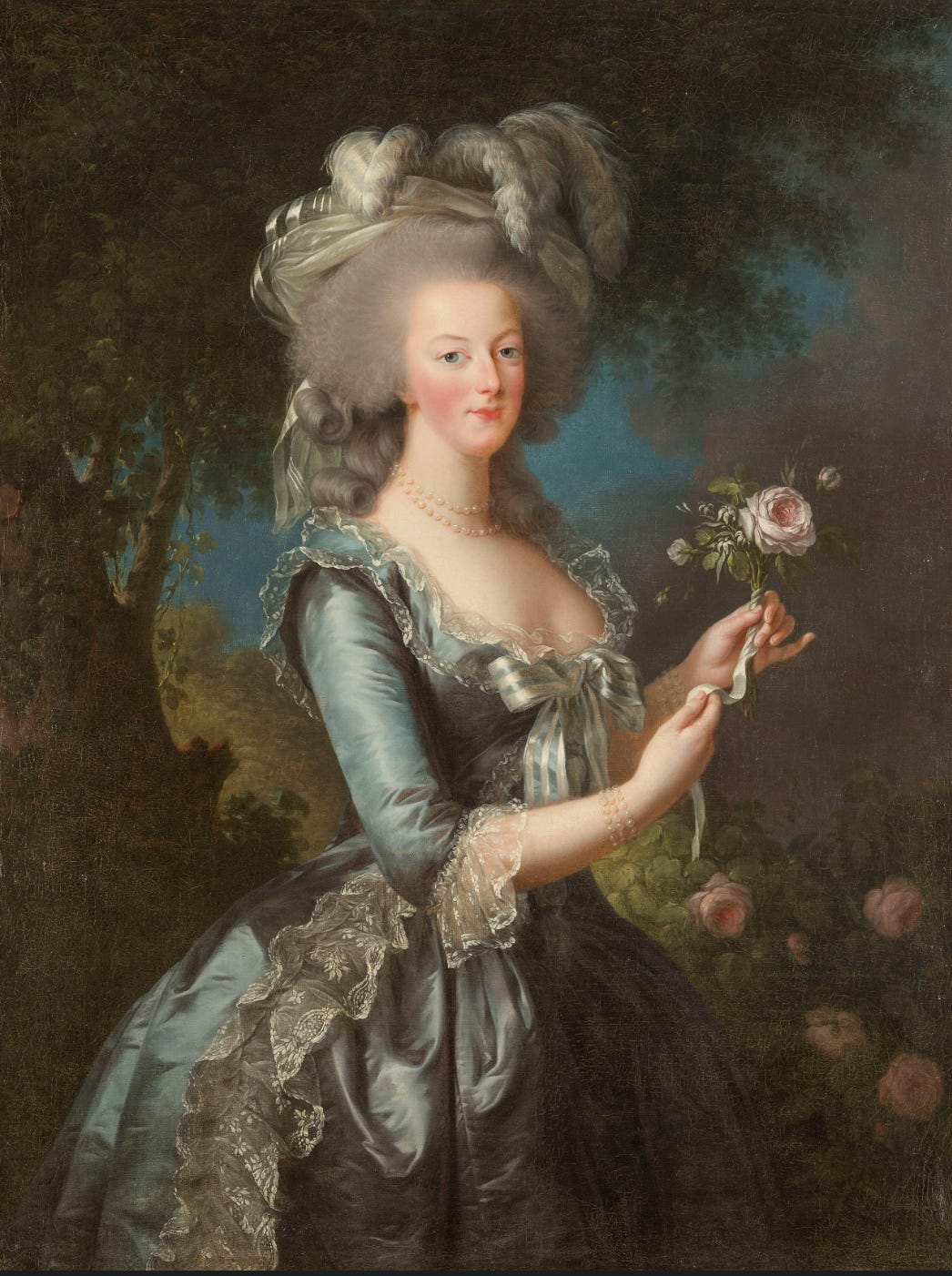
You know that portrait by Élisabeth Louise Vigée Le Brun? Marie Antoinette in a simple white dress, looking relaxed and natural, almost modern? That painting caused such an uproar that it had to be pulled from the Salon and repainted.
The dress was a chemise à la reine, it looked exactly like the undergarment women wore beneath their proper clothes. For the Queen of France to appear publicly dressed like that wasn’t just shocking. It was a complete rejection of how French queens were supposed to exist.
Here’s what people don’t realise: French queens had a very specific job. Be dowdy. Produce heirs. Stay invisible. The king’s official mistress, yes, that was an actual court position, maîtresse-en-titre, with apartments and estates; well, she got to be fashionable. Madame de Pompadour had perfected that role under Louis XV. It was a system that worked because everyone understood the rules.
Marie Antoinette looked at those rules and said non.
She wanted the power of being queen and the visibility of being fashionable. That white dress? It was her claiming autonomy over her own body, her own image, in a way queens simply weren’t allowed to do. The outrage wasn’t really about modesty or appropriateness. It was about a woman refusing to stay where she’d been put.
Which makes her considerably more interesting than any celebrity comparison suggests.
The Dress That Destroyed an Industry
But here’s where it gets properly strange. That innocent white cotton dress wasn’t made from French silk. It was imported ‘muslin from England’.
When it became wildly fashionable, because of course it did, she was the queen; everyone across France and Europe wanted cotton muslin. English cotton. Not French silk. The French silk industry, which had been the backbone of luxury fashion for centuries, started to collapse.
She literally helped destroy her own country’s economy by making the wrong fabric desirable.
They called it unpatriotic. They weren’t wrong. The painful irony is that she probably thought she was being progressive. Natural fabrics, simple lines, retour à la nature. All those Enlightenment ideals about authenticity and simplicity. Instead, she was accelerating her own destruction and taking French industry down with her.
Her fashion choices didn't just destroy French silk—they influenced American slavery, inspired revolutionary symbols, and proved fashion has consequences that ripple far beyond the wardrobe. Want to know the full story? How a white dress changed three industries, killed women who wore it, and became the symbol of revolution? Subscribe for €45/year →