
Thrift and Flavor: A Guide to the French Pantry
Cheap calories, clever flavor: the thrifty logic for French cooking at home

French food has a reputation for being fancy, but most of it was born out of thrift and availability. Before the cookbooks and Michelin stars, it was about making lentils, onions, stale bread, and wild greens stretch as far as possible. Or whatever you had on hand.
TL;DR
French food isn’t expensive by default—it’s built on cheap pantry staples, repetition, and thrift. Think diner logic: same few ingredients, shuffled around, create endless meals. This is a great basic pantry for a lot of flexibility.
(Really, you can just skip to that & stop reading-it starts about halfway down. - k)
Survival to Luxury
Much of France’s sense of terroir was born first out of necessity. Until the mid-20th century, what you ate was what grew, grazed, or could be stored nearby. People refined dishes from what they had, not from some national plan. Like everywhere in the world.
Even the term terroir was almost never applied to food until the 1930s & the development of AOCs.
“Traditional” foods were about limits: cabbage because it lasted through winter, chestnuts in places too poor for wheat, salt cod where preservation met geography.
Many dishes France reveres today are just peasant staples in disguise. Onion soup, cassoulet, coq au vin all began as ways to stretch scraps or tough cuts.
In Brittany, buckwheat thrived where wheat failed, becoming the base for galettes now inseparable from Breton identity. The same pattern played out across the country: chestnuts in the Cévennes, lentils in Auvergne. The brilliance was in stretching a few basics into endless variations.
France stayed mostly separated and agrarian until after World War II, when the Trente Glorieuses (1945–1975) turned scarcity into abundance. Suddenly many “luxury” foods—cream, butter, fine pastries—went from occasional indulgence to everyday fare.
And plenty of marketing helped.
Diner Logic
When I first started thinking about how to cook French food cheaply, I kept circling back to a Long Island diner. If you’ve ever sat in one, you know the trick: a few base ingredients, shuffled around, suddenly become Greek, Italian, or Mexican. Swap in feta, now it’s Greek. Switch to mozzarella, Italian. A different sauce, a sprinkle of oregano, and our omelette is on another continent.
This pantry isn’t endless: it’s a short, sharp list of cheap, everyday ingredients — with repetition and variation —that can become hundreds of dishes.
Ten French pantry staples
with a couple of cheap Carrefour or Leclerc brand examples, a nod to history, and a few ideas for how you might use them without blowing your budget.
I mean, you can always go fancier. Fois gras & lentils is an option.
The French Pantry 10 Cheap Ingredients That Built a Cuisine
French cooking on a budget was never magic — just calories and clever flavor. Bread, lentils, flour, and eggs filled the stomach; onions, vinegar, butter, and scraps made it taste good. From that mix, a cuisine was born.
Here are the staples that shaped it and still sit on every supermarket shelf today.
1. Lentilles Vertes / Green Lentils
Protein base. Hearty, filling, absurdly cheap. Puy lentils get the glory, but store-brand green lentils work well. Elizabeth David called them the “quiet backbone of peasant cooking,” which is a little strange to say, but the point is made. Near me, €2 for 500g. Ideas:
Warm lentil salad with shallots (or sweet onions) and mustard vinaigrette
Potage de lentilles (rustic lentil soup with carrots and onions)
Braised lentils with lardons
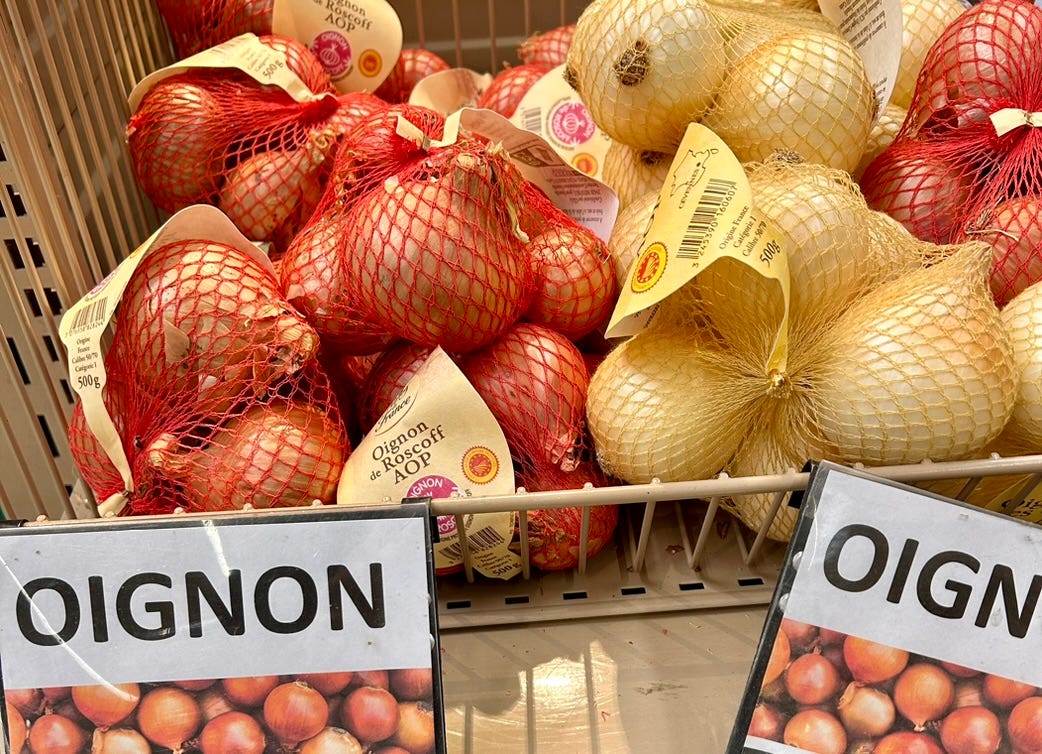
2. Oignons / Onions
Always there. Soups, stews, and sauces all begin here. A sack for under €2 is halfway to dinner. Sharper, more sulfurous here than back home—a quick soak in cold water takes the edge off. Curnonsky swore France’s best dishes came from onions and butter. You can get a 5kg bag for €5-7.
Soupe à l’oignon (cheap version: broth, toast, time)
Confit d’oignons (slow-cooked with butter and vinegar)
Stuffed onions with breadcrumbs and herbs
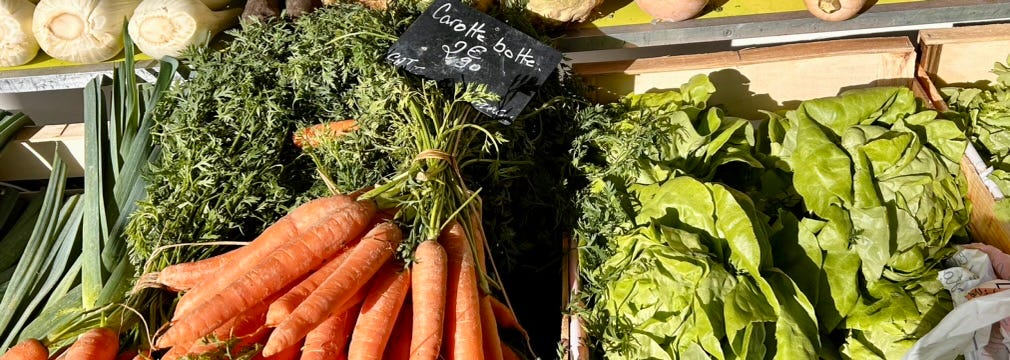
3. Carottes / Carrots
Not just for stock. Here, they grate them raw, dress them with lemon or vinegar, and call it lunch. Larousse Gastronomique lists carrots as a pillar of mirepoix. In the U.S., I mostly knew them as “baby” carrots in plastic tubs. €2.50 for 2kg
Carottes râpées (raw carrot salad)
Glazed carrots with butter and vinegar
Velouté de carottes (puréed carrot soup)
4. Beurre / Butter
Even the supermarket basics have depth. Melt it into beurre noisette and suddenly rice or pasta is more complex. Normandy and Brittany built whole economies on butter. American butter, by contrast, tastes waxy to me. Or you’re spending a lot of money on it. €5 for 500g near us.
Beurre noisette over vegetables, fish, or pasta
Potatoes with butter and parsley
Gâteau au beurre (Breton butter cake)
5. Farine / Flour
Type 55 is the workhorse: bread, roux, crêpes, soups. Buckwheat flour stretched suppers for poor families, but now it’s easy to get. Flour meant survival—wars and shortages turned on bread.
In the U.S., “all-purpose” flour fills the pantry but rarely leads to dinner. Varies wildly, but you can get a 2kg of Type 55 for €2 in most big markets.
Galettes (crêpes, often with an egg inside)
Roux for soups and sauces
Gougères (savory cheese puffs)
okay, you need some skills for those.
(Note: French T55 flour sits between U.S. all-purpose and bread flour. It makes better crusts and lighter doughs than U.S. AP on its own.)
6. Vinaigre de Vin / Wine Vinegar
The €1 bottle that transforms greens or deglazes a pan. French cooks leaned on vinegar for centuries—for flavor and preservation. In the U.S., we reach for balsamic or cider vinegar, often pricier and likely sweeter.
Classic vinaigrette with Dijon and shallots
Poached eggs stabilized with a splash of vinegar
Quick pickled carrots or onions
7. Pain Sec / Day-Old Bread
A baguette tradition hardens in 24 hours, but it’s doesn’t have to be wasted. Croutons, pain perdu, thickened soups—frugality in action. In France, old bread can be raw material; in the U.S., it’s usually the trash. €1.20, but you were going to throw that old bit away, no?
Pain perdu (French toast, sweet or savory)
Soupe au pain (broth thickened with bread)
Salade lyonnaise (croutons, lardons, vinaigrette, greens)
8. Œufs / Eggs
Cheap, rich, and flexible. Omelette aux fines herbes turns a box of six into real meals. Brillat-Savarin called the omelet “the most distinguished way of eating eggs.”
In France, they’re breakfast, lunch, dinner, binding agent, and sauce. €0.25-80 an egg, depending. It really varies more than anything else. I like to get mine from a local farmer at the weekend markets
Omelette aux fines herbes
Œufs cocotte (eggs baked in ramekins)
Quiche campagnarde
9. Lardons / Bacon Cubes
Smoky little cubes of pork belly. A small packet adds depth to greens, quiches, and stews. Scraps turned into flavor. Bacon is almost infrastructure in France. You can eat pork in every single meal of any day. Again, quality varies widely, but you can get basics at 400g for €2.
Salade de pissenlits aux lardons
Quiche lorraine
Braised leeks with lardons
10. Herbes et Feuilles Sauvages / Wild or Cheap Greens
Dandelion, nettle, sorrel. Sold in markets or for free by the roadside. Pistou, nettle soup—survival foods that never left the table.
Foraging here is continuity, not a trend. Less than it used to be, and it’s still more rural than urban; you won’t catch most Parisians (or most folks from cities) gathering nettles by the périphérique if you can find them in markets, €2-3 a bunch.
Soupe d’orties (nettle soup)
Pistou (like pesto, with wild greens)
Salade de pissenlits with vinaigrette and egg
I know people will disagree with this.
Lemme hear it.
How to Use This
Think like the diner cook: take your short list, swap an ingredient, and you’ve got a different dish. Onions + carrots + lentils = soup. Swap carrots for lardons, less water, it’s a salad. Replace vinegar with butter; it’s a warm side dish or a base for your meat and veg.
Same pantry, new meal.
Cooking French cheaply isn’t magic—it’s calories plus flavor. Bread, lentils, and flour carried the bulk; onions, vinegar, scraps, and greens built the taste.
The same thrift runs through cucina povera in Italy, Spanish chickpeas, Trini roti, Chinese congee, and even Depression casseroles.
France just wrote it down—turning survival cooking into recipes still taught, still cooked, still praised.
Musical Interlude
Les oignons Claude Luter (1967)
Les oignons performed by Claude Luter in 1967, straight out of the New Orleans jazz tradition, which had a popular influence in France after World War II. Sidney Bechet, the American clarinetist/soprano saxophonist, moved to Paris in 1949 and became a star; his first recording of Les Oignons in the same year turned the tune into a French jazz standard. Luter, who often played with Bechet, carried that style into the 1960s and beyond.
Bonus Basic Recipes
1. Warm Lentil Salad (Salade de Lentilles Tièdes)
Simmer lentils, onions, and carrots until tender. Toss warm with wine vinegar, mustard, salt, pepper, and oil (or butter). Finish with herbs if you’ve got them.
Cheap protein + acid + aromatics = a full meal.
2. Dandelion & Lardon Salad (Salade de Pissenlits aux Lardons)
Fry lardons, toss in bread cubes to soak the fat, then deglaze with vinegar. Pour warm over wild greens and top with a poached egg.
Peasant food dressed up as bistro: scraps and weeds turned into a showpiece.
3. Onion & Carrot Soup (Soupe Paysanne)
Cook onions and carrots slowly in butter. Stir in flour, then water or stock. Simmer until thick, serve over bread slices.
Pure diner logic: swap lentils, add lardons—same pantry, new soup.
Bonus Bit: Lettuce in Soup
A surprising amount of lettuce shows up in French soups, at least the paysanne variety.
Outer leaves of romaine or batavia? Don’t toss them—French cooks simmered them into soups for centuries. Bitter, sturdy greens add depth. A few classics:
Soupe à la Romaine – broth with shredded romaine, peas, or rice.
Soupe de Laitue à la Française – puréed lettuce, onion, carrot, butter, finished with cream or yolk.
Potage Saint-Germain – pea soup brightened with lettuce.
Omelette à la Laitue – yes, lettuce folded into eggs.
Old-school thrift: outer leaves → soup pot, inner leaves → salad. No lettuce wasted.
Introducing Contributor, Keith Christiansen
Immerse yourself in all of Keith’s articles→
Thanks for reading MyFrenchLife™ – MaVieFrançaise®! This post is public so feel free to share it.
Loved this Keith / what you say and suggest is so true.