

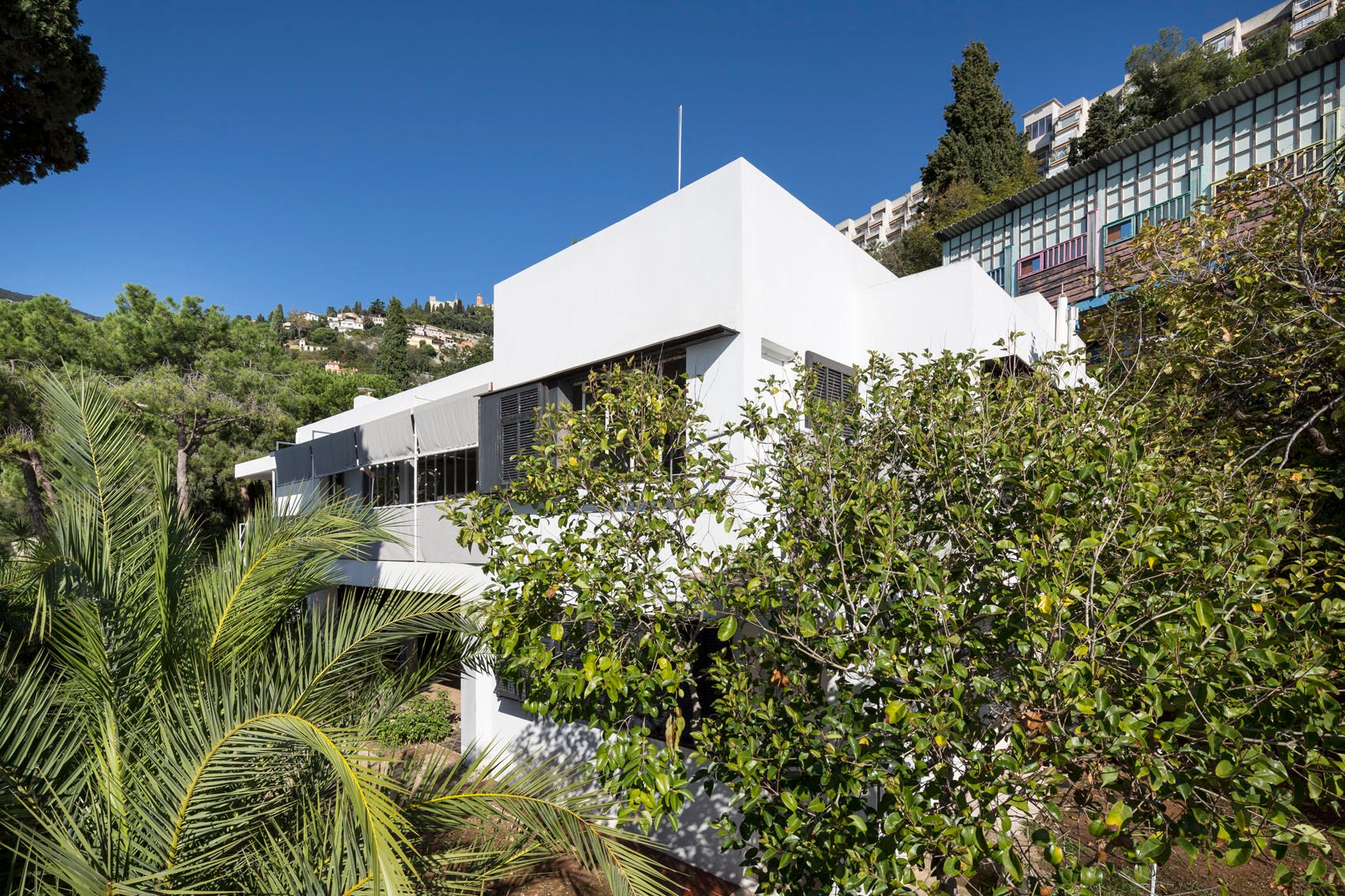
Eileen Gray was a pioneer in the world of design and architecture, at a time when very few women were able to make their mark in either field. Long before the Second World War, she had already made a name for herself with her distinctive designs and furniture. But Gray was more than a designer. On the Côte d’Azur, she also created one of the most remarkable modernist houses of the twentieth century: Villa E-1027. How did she manage to carve out such an exceptional place for herself? And what about Le Corbusier: did he play a part in her success, or is that a misunderstanding that has lingered for far too long?
Just a ‘functional holiday home’
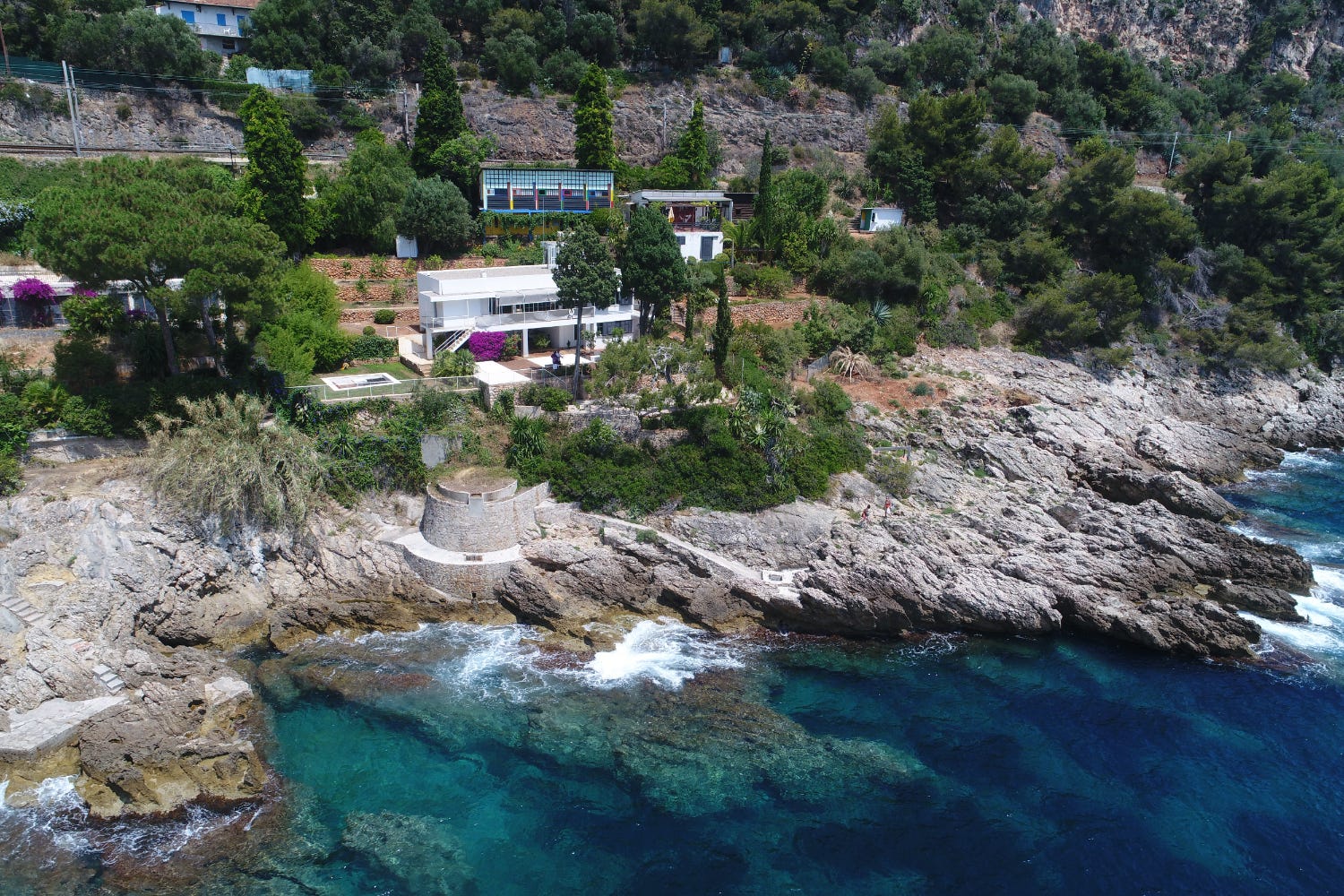
Not far from Monaco, in Roquebrune-Cap-Martin, stands Villa E-1027. Construction began in 1926 under the direction of designer Eileen Gray, marking her first venture into architecture. That same year, Gray and her mentor and companion, the architect and critic Jean Badovici, fell in love with the landscape of Roquebrune-Cap-Martin. Together, they envisioned a functional holiday home: a retreat perched on a cliff above the Mediterranean, far removed from the bustle of Paris. The villa’s unusual name is a code combining their initials: E for Eileen, 10 for the J of Jean, the tenth letter of the alphabet, 2 for the B of Badovici and 7 for the G of Gray.
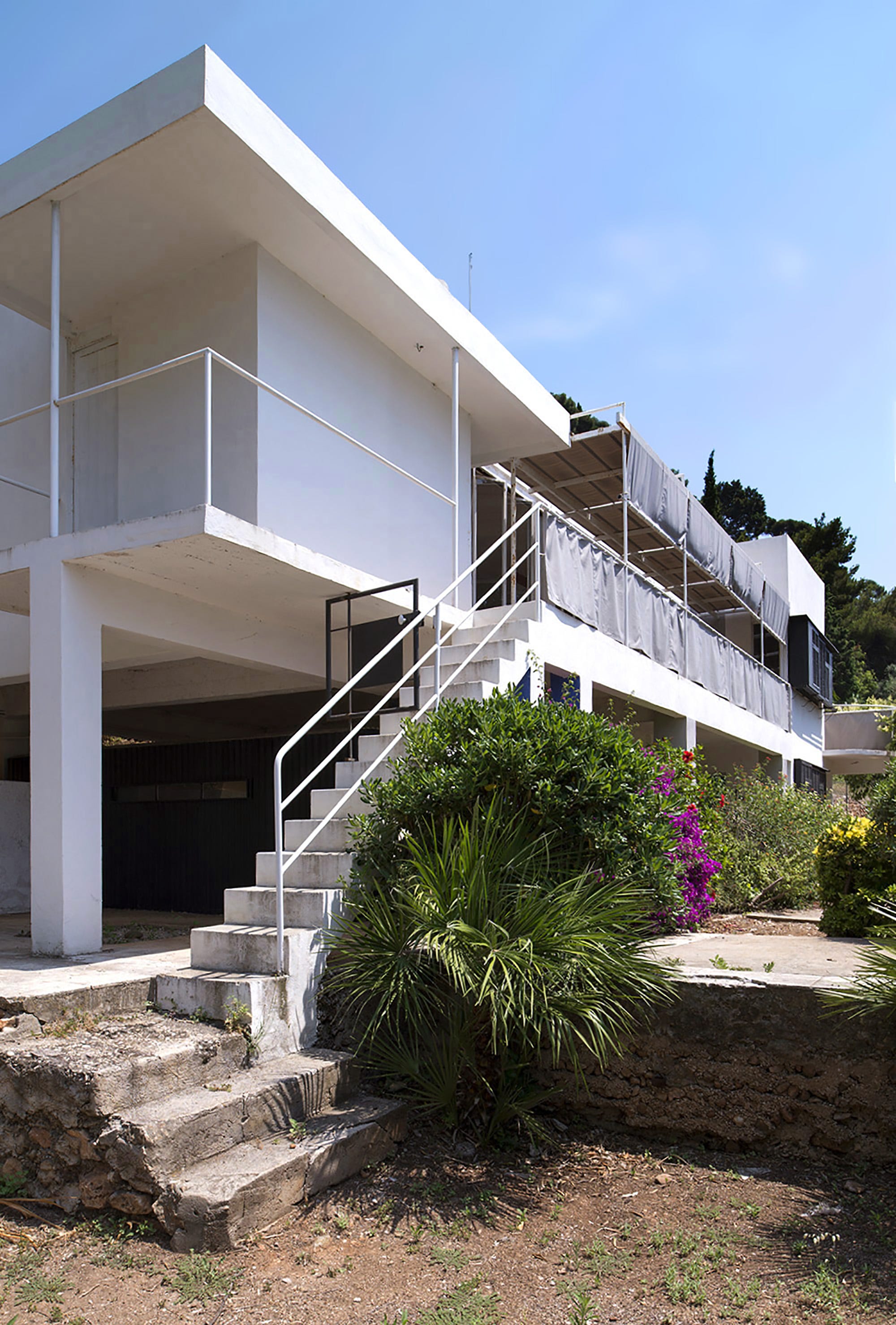
Modern villas were still a rarity in the 1920s, particularly along the Mediterranean coast. Encouraged by Badovici, Gray spent three years developing the plans, designing the furniture and overseeing the construction. The result? A new architectural language that placed her well ahead of her time. The villa was completed in 1929, but the couple did not enjoy it together for long. Gray and Badovici separated in 1932. Fortunately, the end of their relationship did not mean the end of their collaboration. They continued to work together, and Gray remained a regular visitor to Cap-Martin, while Badovici retained ownership of the villa until he died in 1956.
In an artistic world largely dominated by men, Gray embodied a distinctly avant-garde femininity. It may be hard for design and architecture enthusiasts to imagine today, but she struggled to establish herself within the cultural establishment of her time. This even though her tubular steel furniture, including the Transat and Bibendum chairs, and the Centimetre rug, are now regarded as design icons. Villa E-1027 was her own interpretation of modernist architecture and today forms part of Cap Moderne. The site also includes Le Corbusier’s Cabanon and L’Étoile de Mer, the restaurant once run by Thomas Rebutato, where Le Corbusier was a regular visitor.
But who exactly was Eileen Gray?
What shaped her early life, and why did a Dutch artistic movement end up having such a profound influence on her work?
From Smith to Gray
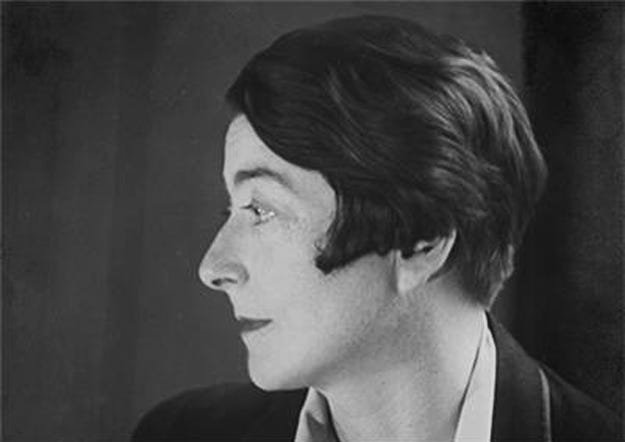
Eileen Gray was born Eileen Smith in Ireland in 1878.
Raised in a wealthy Protestant family that divided its time between a country estate in Ireland and Kensington in London, she grew up with art and culture close at hand. Although her parents eventually separated, the influence of her artistic father remained strong. When her mother inherited a noble title, the family took on the name Gray.
A first visit to Paris with her mother for the 1900 Exposition Universelle made a deep impression on the young, artistically minded Gray. Back in London, she knew exactly where she was heading: into the arts. Her first great love was Oriental lacquerwork, a demanding craft she set out to master in the years before the First World War. Travel, too, had been part of her world from the start. As a young woman, she saw Africa and many corners of Europe, and later developed a taste for the freedom and speed of motoring. During the 1920s, Gray lived a strikingly free and modern life, never hiding her bisexuality. She was independent, determined and remarkably adept at sidestepping the social expectations of her time, including marriage, which she avoided all her life. That same spirit ran through her work. Before turning to design and architecture, she explored a wide range of artistic techniques. In 1922, she discovered De Stijl, the pioneering Dutch movement founded in 1917 that sought harmony through radical abstraction, using geometric forms, straight lines and a limited palette of primary colours, and black and white. De Stijl would fascinate her deeply for years to come.
Her move towards modernism was sealed in 1923, when she met Jean Badovici. Gray and the young Romanian architect, editor of L’Architecture Vivante, soon became a couple. Through him, she encountered the ideas and projects of early modern architects such as Adolph Loos, Gerrit Rietveld and Le Corbusier. Gray eagerly took up their fascination with geometric abstraction and their rejection of frivolous, unnecessary ornament. In 1926, she bought a plot of land in Roquebrune-Cap-Martin in Badovici’s name for her first architectural project: Maison pour un ingénieur.
Architecture totale
Villa E-1027 still feels remarkably modern today, making it easy to forget just how unusual it must have seemed in 1929. The grounds are arranged in terraces planted with lemon trees and cypresses, while the house itself, tucked slightly away from the road, looks out towards the Cap de Monaco. Yet despite its imposing presence, it was conceived as a true holiday home, designed for:
un homme aimant le travail, le sport et aimant recevoir des amis.”.
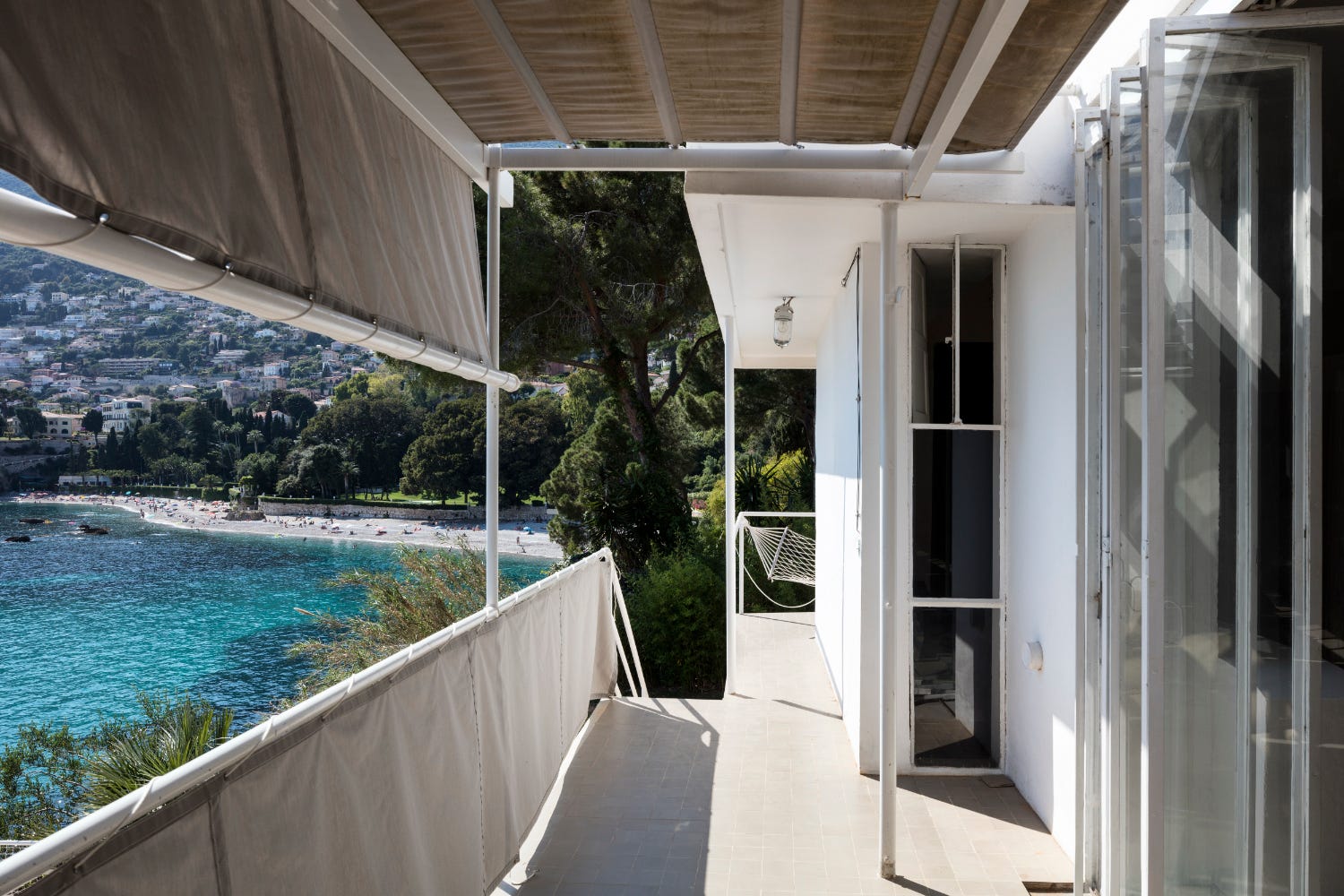
When designing the villa, Gray drew inspiration from the Swiss-French architect Le Corbusier, who would later leave an even greater mark on both the house and its surroundings. Le Corbusier influenced Gray with the ideas he set out in his “Five Points of Architecture”. The main structure of a building, for instance, should be lifted off the ground on columns, known as les pilotis. The flat roof was to be used as an outdoor space, often as a roof garden, or le toit-jardin. A structural frame then allowed for an open layout on each level, le plan libre. The façades were no longer load-bearing walls, la façade libre, and horizontal ribbon windows, la fenêtre à longueur, brought in generous stretches of light and views. In Villa E-1027, these principles can be seen in the use of columns, the roof terrace and the horizontal bay window. Modern materials such as reinforced concrete were also used. But Gray did not only design the house itself. She also created the entire interior. This approach is known as architecture totale: from the first sketch to the final door handle, everything was designed by Gray.
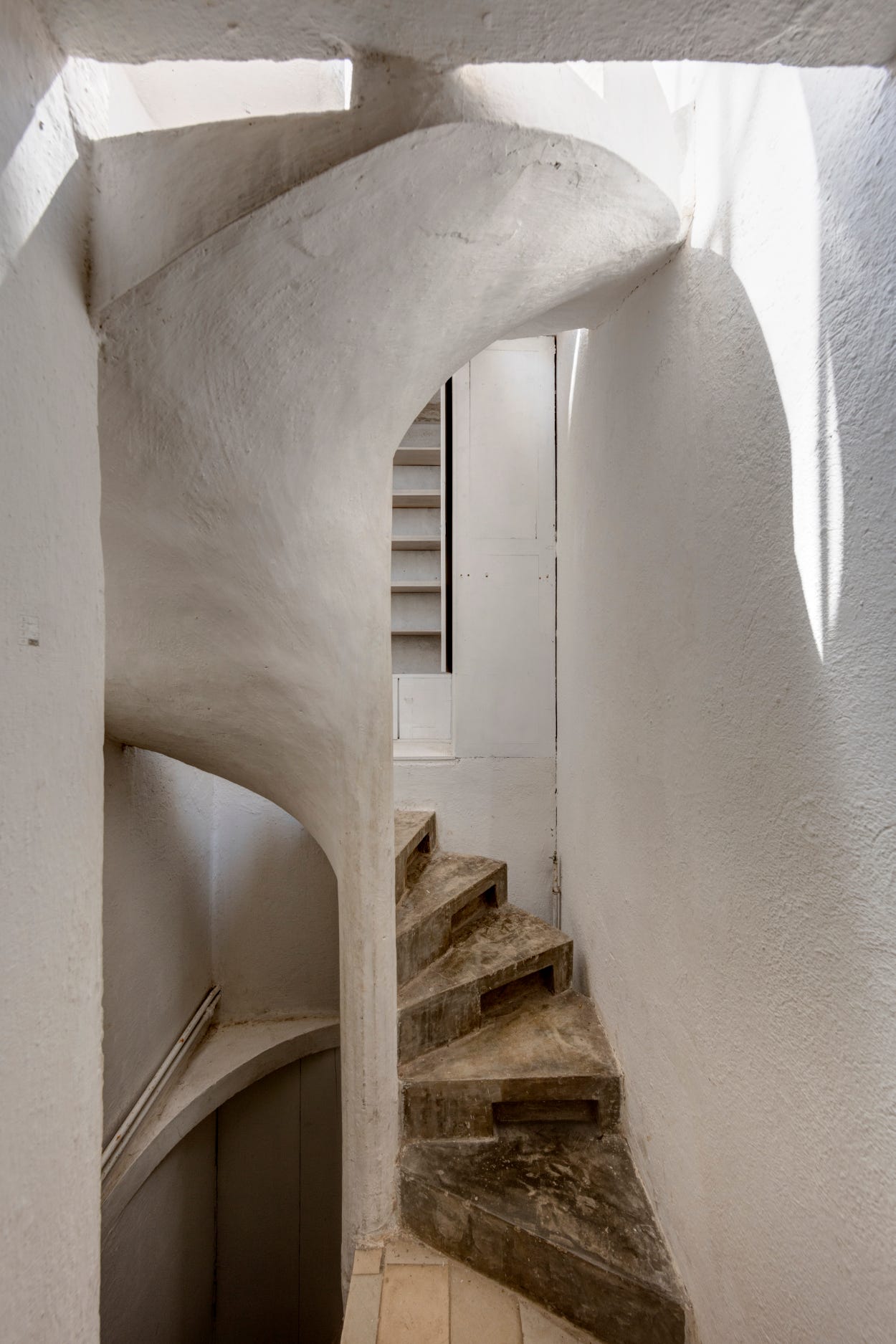
Eileen’s body of work reveals a great deal about the way she moved through the world. She was a modern woman who readily embraced her freedom, but also someone who valued her privacy and liked to withdraw. The same spirit runs through the open plan of Villa E-1027, with its almost uninterrupted views of the Mediterranean and its many small corners where you can briefly retreat. Autonomous, yet still connected to the whole: that was Gray’s vision. Here and there, she borrowed from other traditions, such as the wooden shutters that open in the Italian style, keeping out the sun while letting in the light.
An interior by Eileen Gray
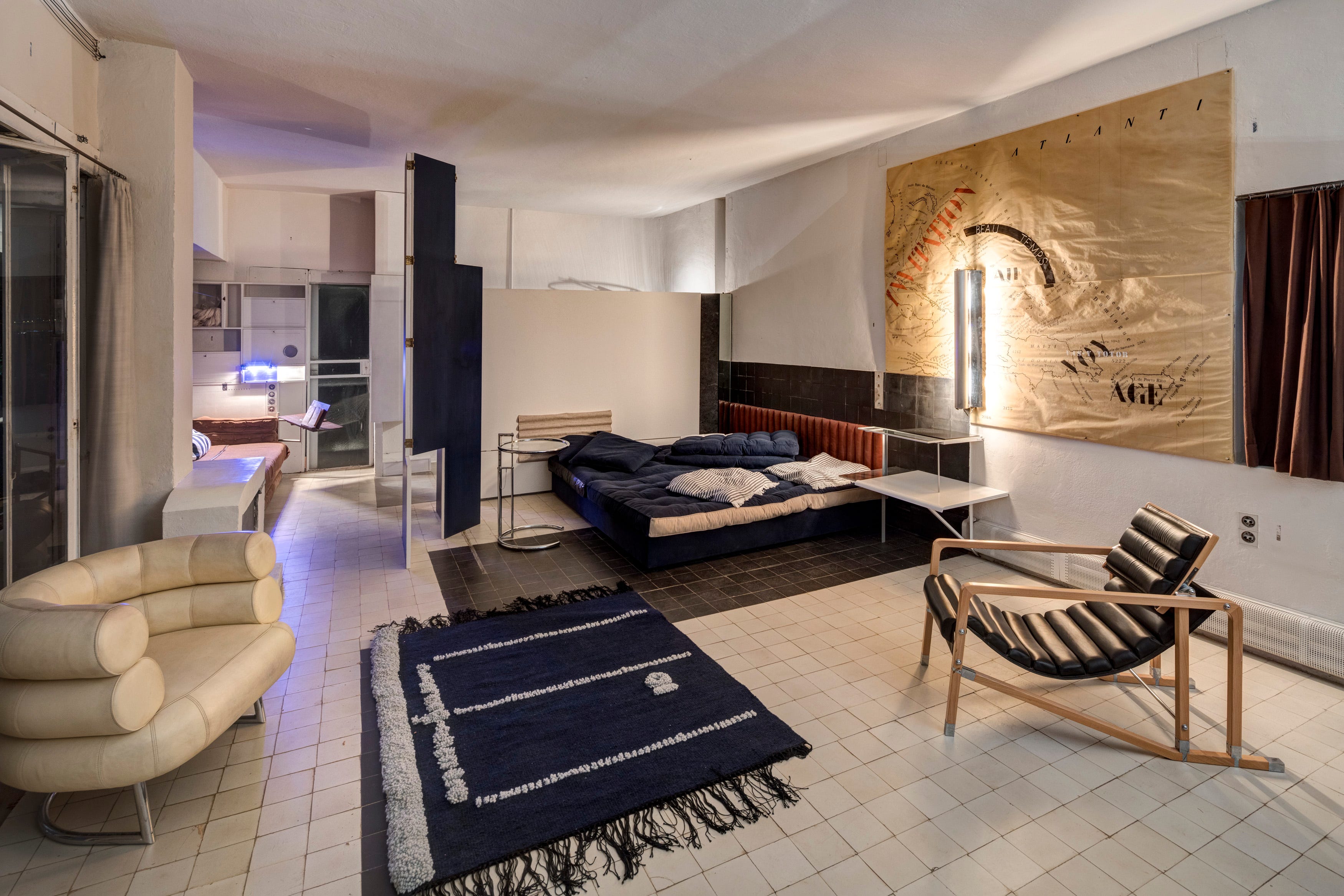
While Villa E-1027 was Gray’s first venture into architecture, the same could certainly not be said of the design inside. Thanks to her successful career as a designer, she had no trouble making the furniture and objects fit seamlessly into the villa’s spatial concept. Every room in the house is autonomous, and each has access to a small terrace. The strength of the interior lies in the built-in furniture, designed by Gray herself. As a result, the living room, for example, can be easily reconfigured, while the kitchen even has movable partitions.
Gray once summed up her vision as follows:
Everyone, even in a small house, needs to feel free and independent. They must have the feeling they are alone.”
To achieve this, she used pieces that were already for sale in her Paris gallery, Jean Désert. Jean Désert was not a real person but a fictional male persona invented by Eileen, partly because a man’s name carried more authority in the male-dominated design world of the 1920s.
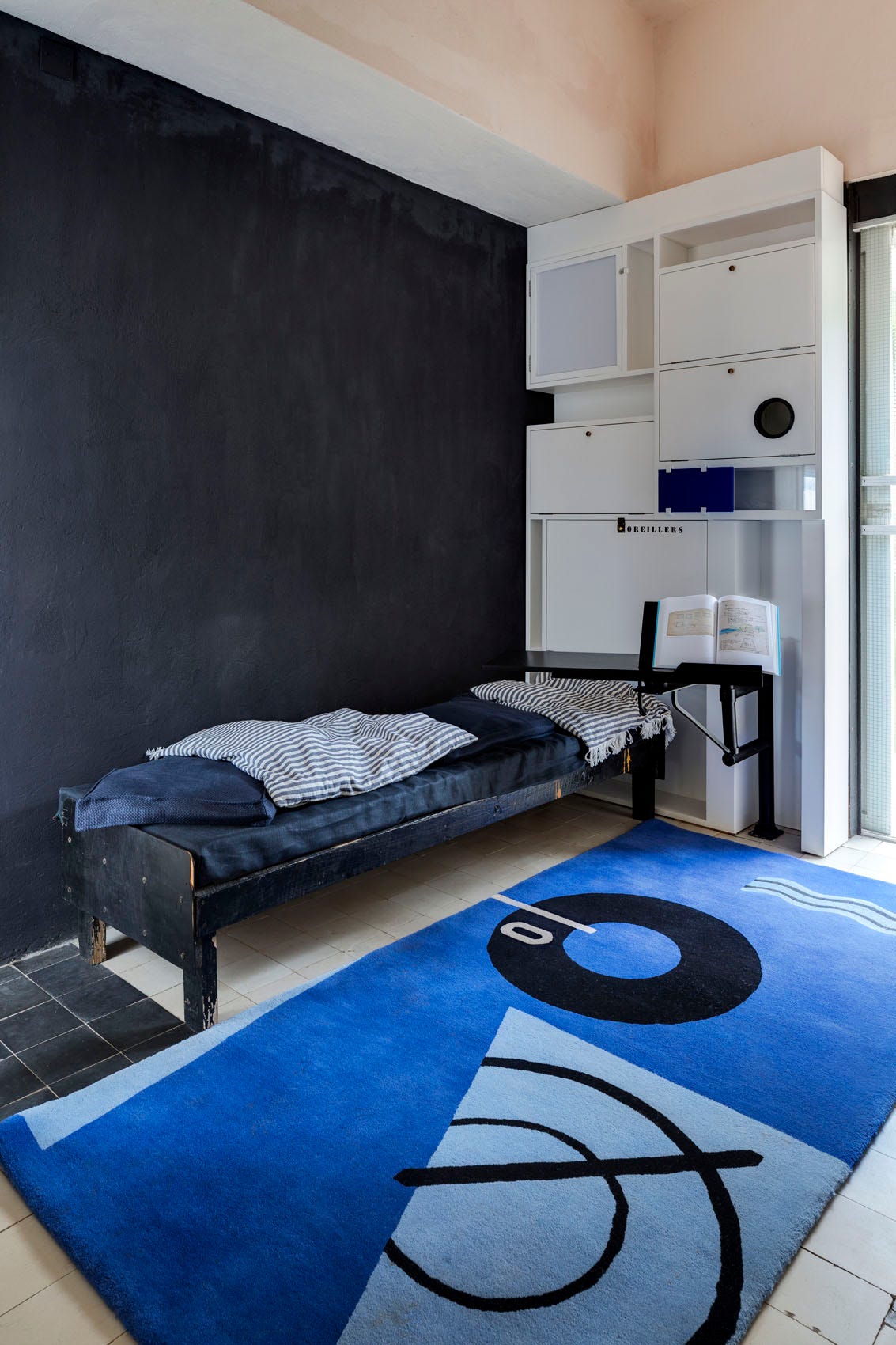
Gray also designed clever, functional furniture especially for the villa, which would later become iconic. Among the best-known pieces are the Transat and Bibendum chairs, as well as the ingenious round bedside table known as the Table E-1027. In the bedroom, the tall, narrow mirrored cabinet acts as a screen between the washbasin and the studio, while a rotating chest of drawers stands in one corner. The furniture she created for the villa was designed for different, and often more complex, uses than traditional furniture. Gray often experimented with industrial materials, too: tabletops made of glass or metal, cork coverings, and frames made from nickel-plated metal tubing or lacquered wood.
Le Corbusier
It is a persistent myth that Charles-Édouard Jeanneret, better known as Le Corbusier, was in fact behind the design and concept of Villa E-1027. The fact that he denied this several times during his lifetime did little to stop the story from spreading. Although his actual contribution to the villa was limited to several frescoes, the presence of those rare murals did play a real part in the building’s preservation and recent restoration. In that sense, Gray does owe something to Le Corbusier after all.
Le Corbusier discovered Cap-Martin in the 1930s and went on to spend almost every holiday there. In April 1938, he stayed at the villa at the invitation of his close friend Jean Badovici. During that visit, he painted the frescoes that, according to the story, Gray disliked intensely: they were said to clash completely with her architectural vision. During another stay in August 1939, he painted five more. The murals were damaged during the war, but in 1949, it was Le Corbusier himself who restored them.
Enchanted by the place, Le Corbusier built his “château sur la Côte d’Azur” in 1952 on a plot of land right beside the villa and the restaurant L’Étoile de Mer. He became a regular at the restaurant and, over the years, painted several murals inside. Today, L’Étoile de Mer is a must-see for lovers of modern architecture. As for his own “château”, his wife certainly would not have called it that. In reality, this Spartan cabanon, designed according to his famous Modulor system, measured less than fifteen square metres (161 square feet) and was sparsely furnished. Le Corbusier had long been fascinated by fishermen’s huts, a modest form he combined here with the functionalism of modern architecture. The result was a success, and one that helped feed his myth. By the end of his life, Le Corbusier was living here almost exclusively. His story at Cap-Martin came to an end nearby, on the beach at Cabbé, where he drowned during his daily swim on 27 August 1965.
Recognition at last
After Villa E-1027 in Roquebrune-Cap-Martin, Gray built several other houses for her own use, including:
- Villa Tempe à Païa in Menton (1931-1934) and
- Villa Lou Pérou in Saint-Tropez (1954-1958).
After the war, she moved back to Paris and was seen on the Côte d’Azur only rarely. In 1968, Gray returned to the spotlight thanks to an article by the architectural historian Joseph Rykwert in the influential magazine Domus. This led to several distribution deals and recognition from the Royal Society of Arts in London. Gray died in Paris in 1976, at the age of 98.
Over the past twenty years or so, there has been renewed interest in Eileen Gray, her life and her remarkably varied body of work. In 2009, her Fauteuil aux Dragons went under the hammer in Paris and sold for €21.9 million. A major retrospective at the Centre Pompidou in Paris followed in 2013; in 2015, her paintings were shown in London; and in 2020, the Bard Graduate Center in New York turned its attention to Gray’s extraordinary career. Since then, smaller exhibitions and projects, from Roquebrune-Cap-Martin to Milan and Paris, have continued to revisit her work and legacy.
Cap Moderne
Not only Villa E-1027 but also the other buildings on the site, including Le Corbusier’s Cabanon and the restaurant L’Étoile de Mer, fell into decline in the second half of the twentieth century. And although these buildings were gradually restored over the years, the same could not be said for the villa where the story had begun.
That changed in 2014 with the creation of Cap Moderne.
Thanks to this association, Villa E-1027 has been almost entirely restored to its former glory and can now be visited. Visits must be booked in advance; more information can be found at capmoderne.com.
Have you ever visited Villa E-1027 or seen any other of Eileen Gray’s work? Let me know in the comments.
Introducing Contributor Suzanne Rietmeijer
Visit her Contributor Page — Explore more of Suzanne’s work
Thanks for reading MyFrenchLife™ – MaVieFrançaise®! This post is public, so feel free to share it.
Thanks for the great recommendations!
A few years ago, filmmaker Scott Peterson made a fun little film called We Eat Socca Here. You can watch the trailer here: https://www.youtube.com/watch?v=UWTwRu_cGSI
And while I'm sure you can get the Niçois arguing about who makes the best socca, you can equally see fireworks if you pit socca against its chickpea-based cousins panisse (Marseille) and cade (Toulon.)
That would be an interesting visit. I love that era of architecture.