
Leavers Lace and Cité de la Dentelle et de la Mode, Calais
Lace, Fashion and Lingerie at the City of Lace and Fashion, Calais

Traditionally, Lace can be described as a natural textile made of fine threads of silk, cotton, linen or wool, interwoven into a net tulle and typically decorated with patterns.
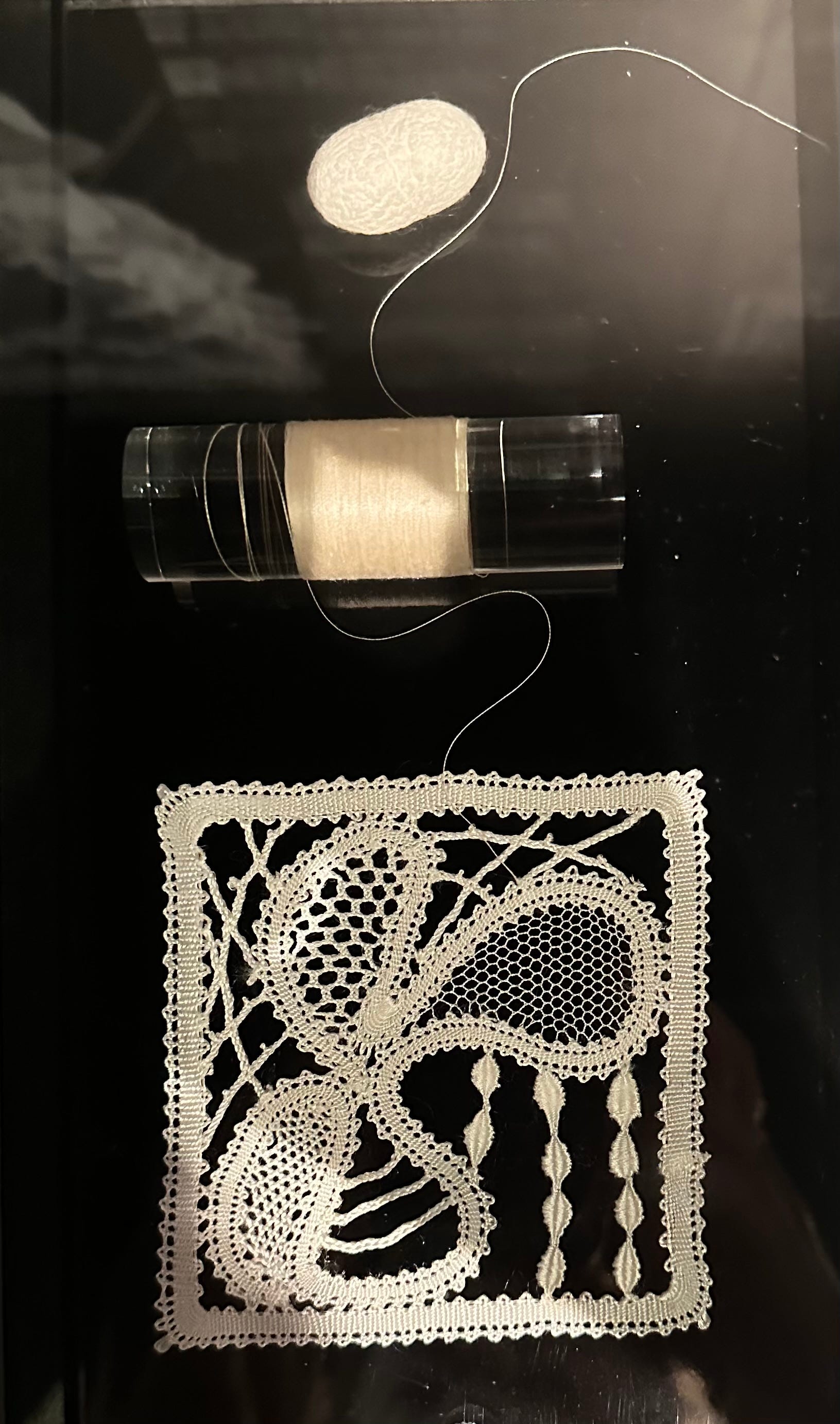
Photo: author, Lace made from Silk
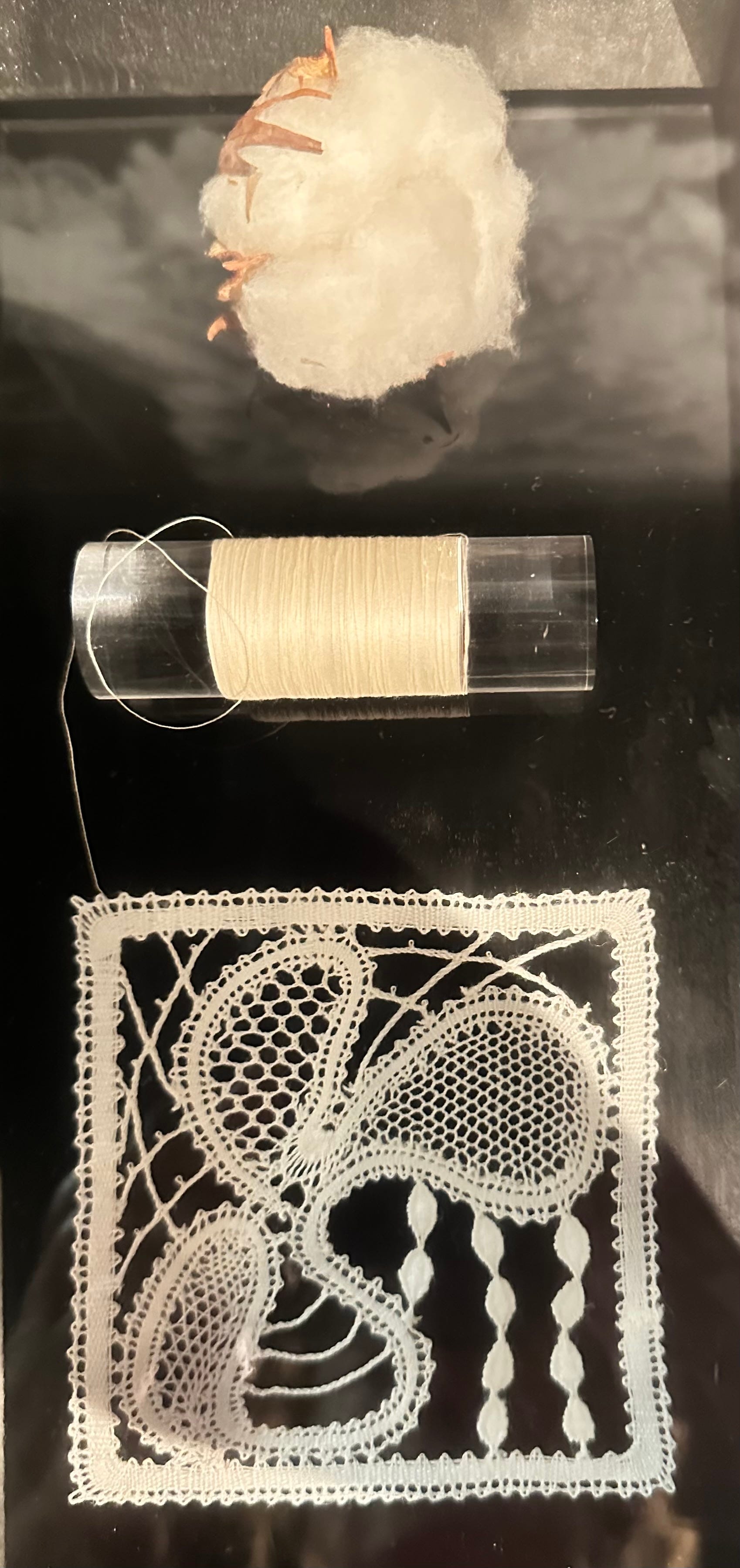
Photo: author, Lace made from Cotton
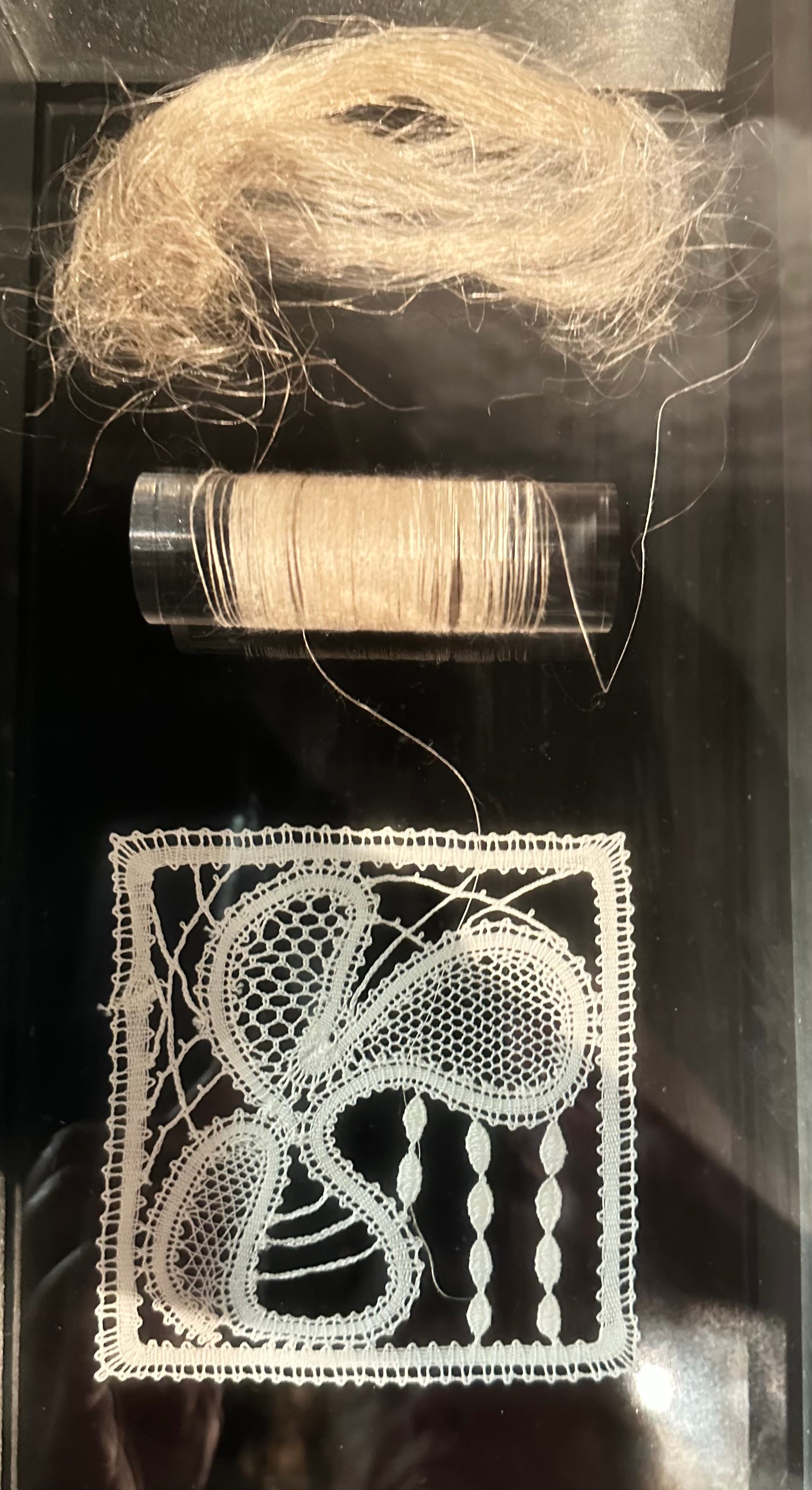
Photo: author, Lace made from Linen
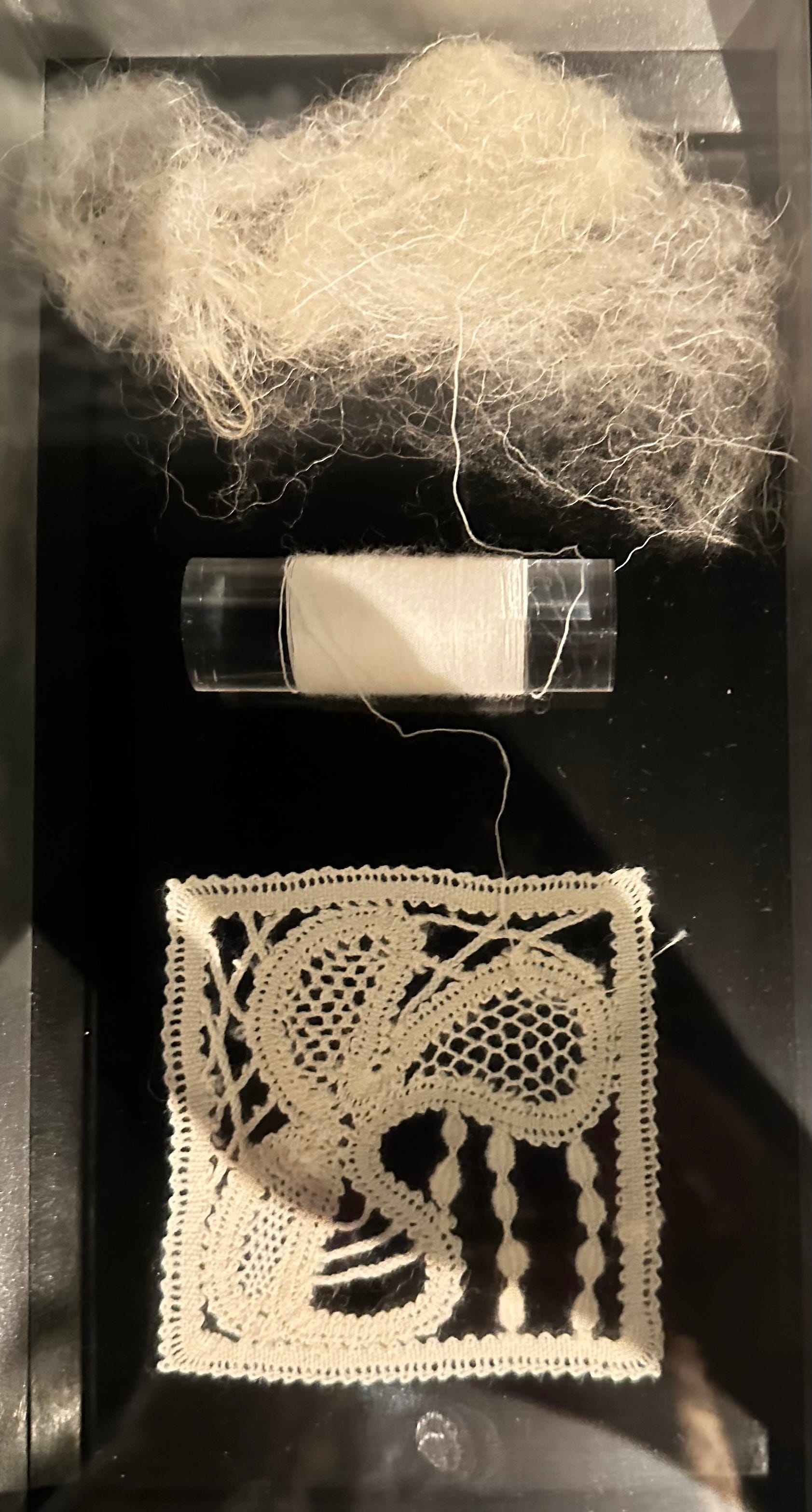
Photo: author, Lace made from Wool
Before the 19th century, lace was created by hand, a laborious and very time-consuming process.
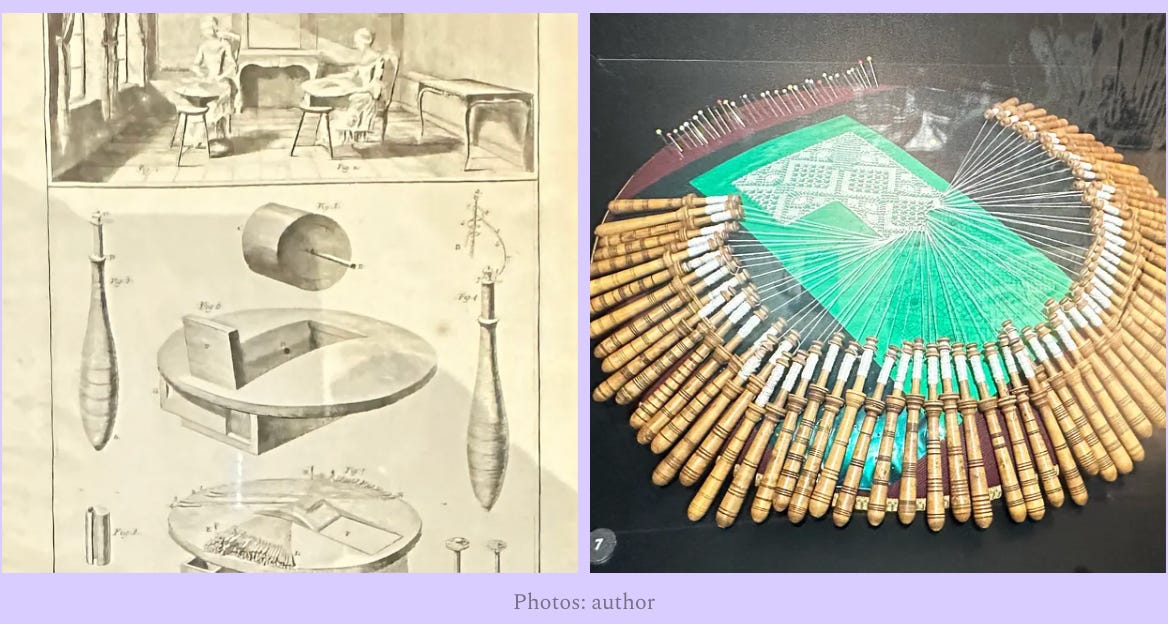
From the 1500s, during the blossoming of the Arts in the Renaissance period in Europe, ladies cultivated the craft of hand-making lace on a cushion with pins as posts and two threads as bobbins. They would cross or twist the yarns around the pins and knot, then remove and reset the pins to continue their design. Different styles of handmade lacework developed in different areas in Europe.
It could take one full day to create a yard of a narrow trim of lace. Lace was therefore an incredibly expensive textile - only accessible to the most elite and privileged in society - mainly royalty and the ecclesiastical hierarchy.
Then in the early 19th century, machine produced Leavers Lace was invented in Nottinghamshire, England. This broadened access to the upper middle classes in society.
Today, Lace is still a luxury, expensive, haute couture fabric, used by many designers in France and further abroad. Yet, it is also more accessible to much broader cross sections of society, thanks to the invention of Leavers Lace.
90% of the world’s woven lace is produced in the Hauts-de-France region, on the century-old looms conserved in Calais and Caudry. There are only six lace factories left in northern France. Four are in Calais and two in Caudry. Three-quarters of this production is destined for export.
The Dentelle de Calais® appellation is a registered and protected trademark, reserved exclusively for luxury lace made on Leavers looms by the master lacemakers of Calais and Caudry, using a unique method of knotting between the warp and weft yarns that dates back to the early 19th century.
But what is the connection between Leavers Lace, which originated in England in the nineteenth century and France? And more specifically, Calais?
To find out more, I took myself off to visit the Cité de la Dentelle et de la Mode museum in Calais at the northern tip of Hauts de France.
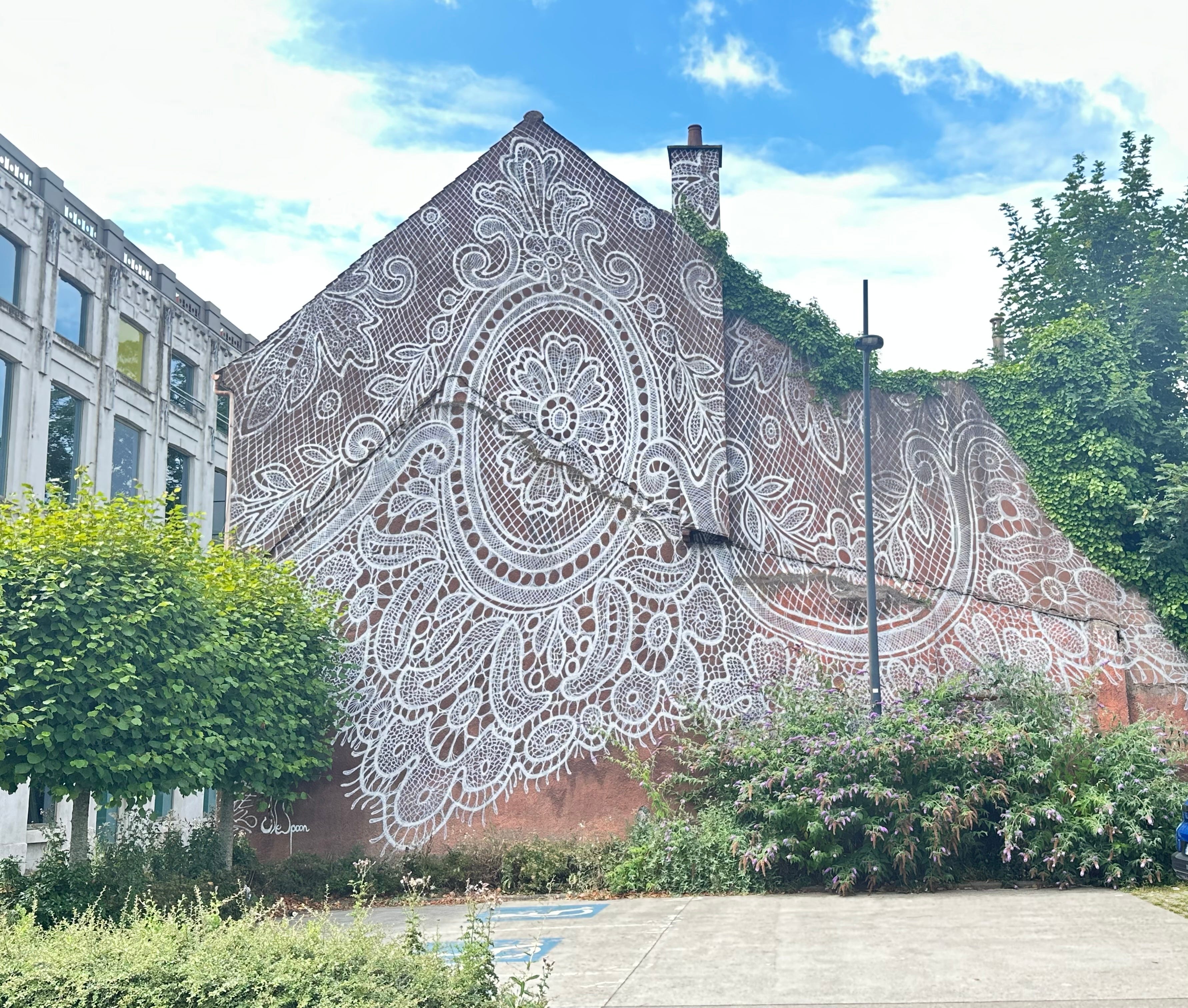

Photos: author, Street Art in the Museum car park
The museum is housed in the former 19th century U shaped four storey Boulart Lace factory, which housed 80 Leavers Lace machines at the start of the 20th century.
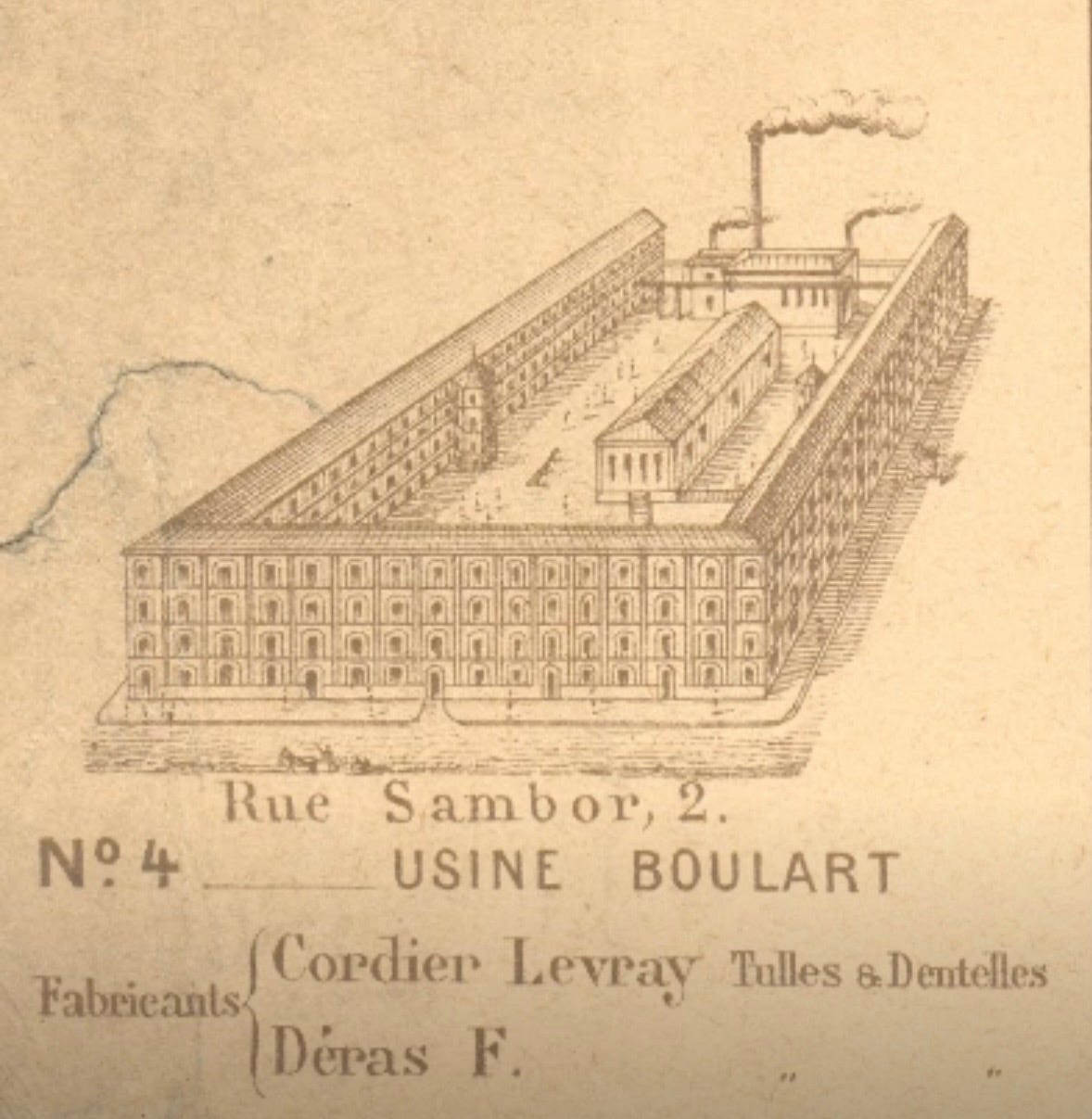
Photo: Cité de Dentelle Calais
The conversion and extension, completed in 2009, were designed by architects Alain Moatti and Henri Rivière.
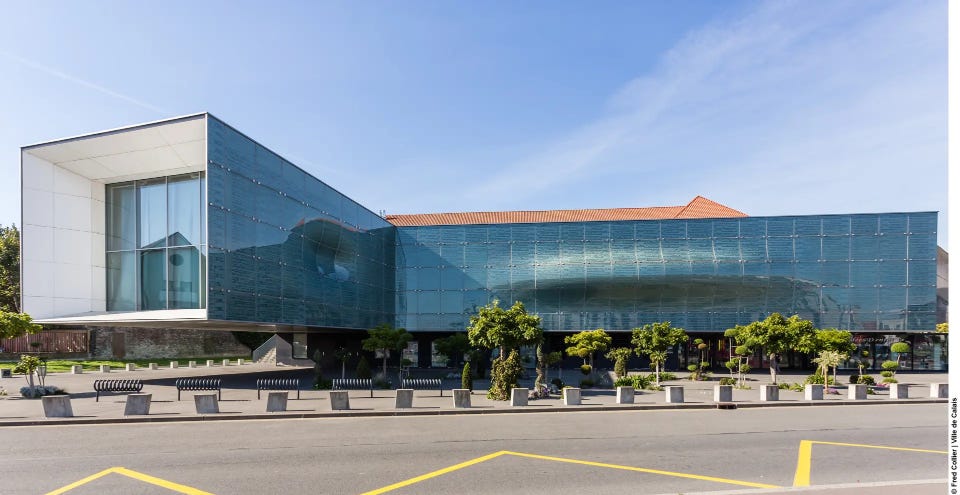
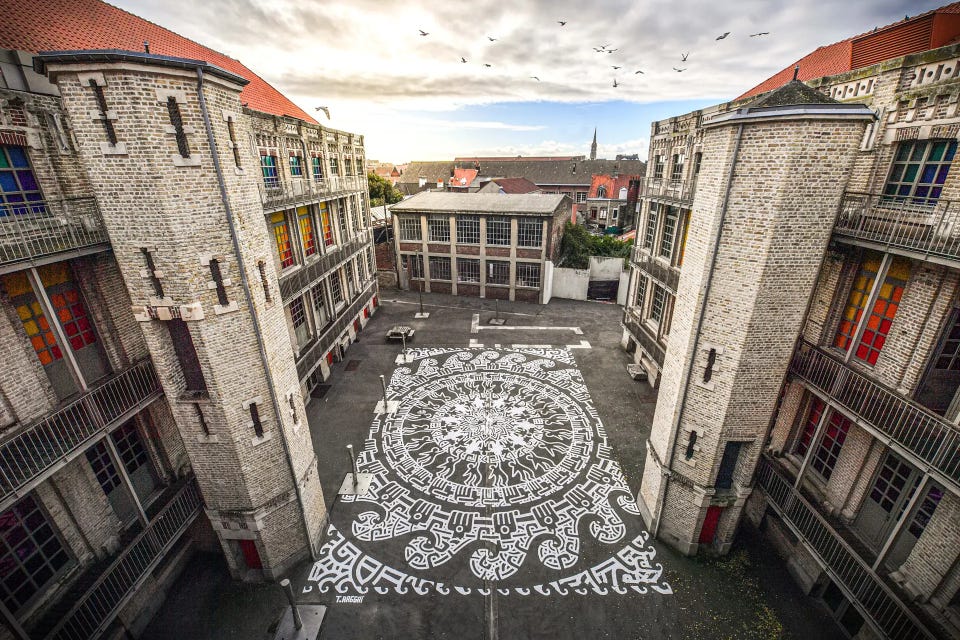
Photos: Cité de Dentelle Calais
The building not only contains the museum, but very importantly houses the Centre de formation des apprentis des métiers de la dentelle (Apprenticeship Training Centre for Lace Trades), which trains future professionals in the sector
Leavers Lace and Fashion through time:
Today, in the twenty-first century, fashion plays on contrasts with lace. The lace woven on Leavers looms is a highly iconic product; heir to a unique know-how with part artisanal, part industrial roots; the image of a certain creativity à la française. An expression of luxury, it inspires designers and stylists in the sphere of Haute Couture as well as high-end prêt-a-porter.
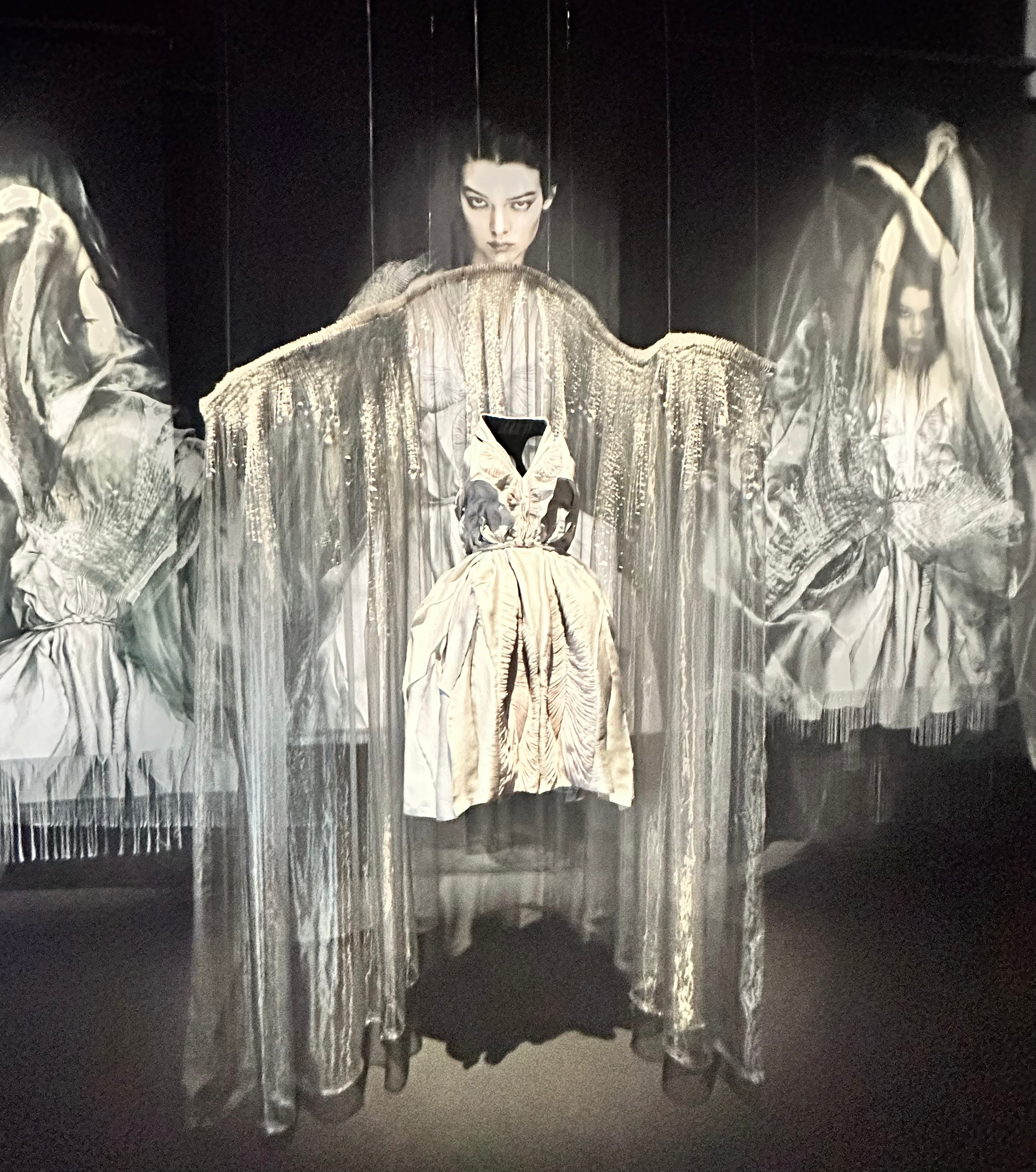
Photos: author, ORCHIDÉE, Yiqing Yin, Collection Spring of Nuwa, Haute couture Autumn-Winter 2012-2013, Dress with topstitching, a three-dimensional effect and panel inserts, made of double duchess sole satin and sole crepe.
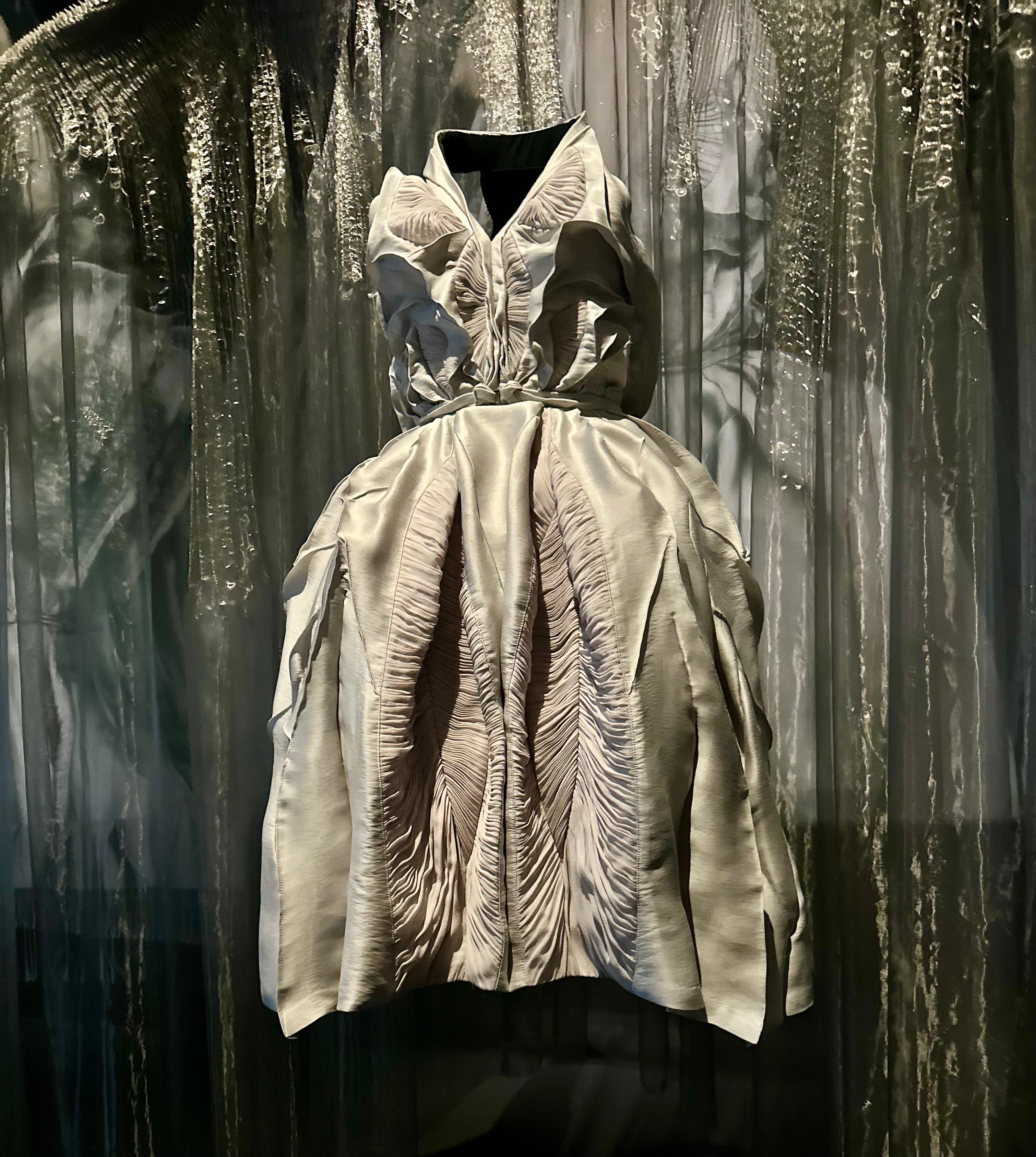
In the twenty-first century, this emblematic material lends itself to every trend and desire.
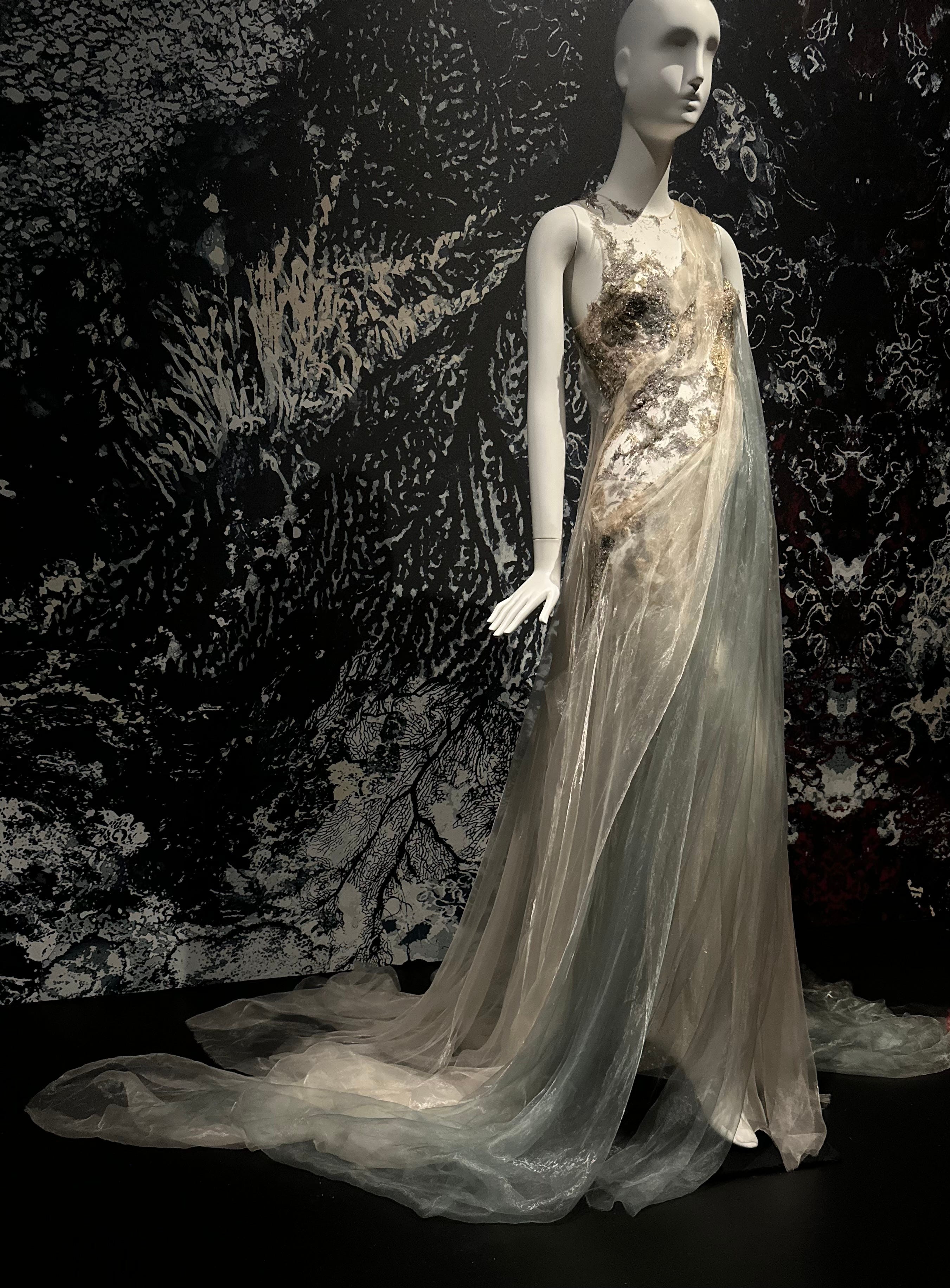
Photo: author, SHALIMA, Yiqing Yin, Collection Les Rives de Lunacy, Haute couture Autumn-Winter 2013-2014, Dress in beaded resin tulle and organza, embroidered with fragments of Sophie Hallette Leavers Lace and crystals.
The dress above was created for the short advertising film for Guerlain’s Shalimar perfume: The Legend of Shalimar, directed in 2013 by Bruno Aveillan and starring actress and model Natalia Vodianova. A process of deconstruction, fragmentation and repositioning of tiny beaded elements, gold sequin appliqués and lace fragments evokes the same components as the perfume: water, gold, and light.
Leavers Lace is just as likely to be found adorning androgynous, sporting, minimalist and casual designs as fluid, dreamlike and even futuristic ones. Lending itself to desires for transparency, in turn classic or iconoclastic, it has also become a medium for visual research and for fashion that is in constant flux of reinvention.
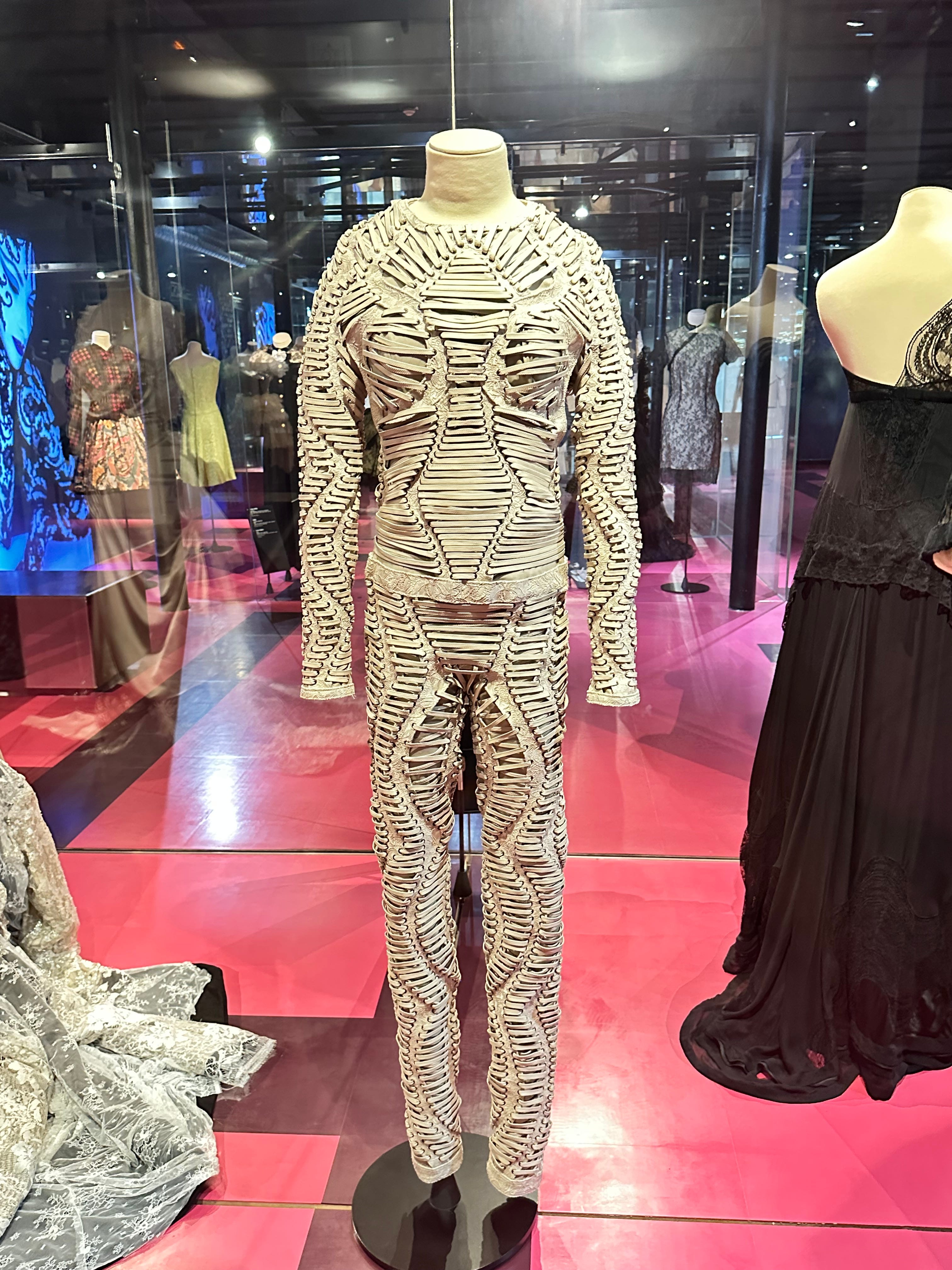
Photo: author, Iris VAN HERPEN, Jumpsuit 2013, Leather, Leavers Lace and metallic eyelets. You will need to look closely to identify the lace.
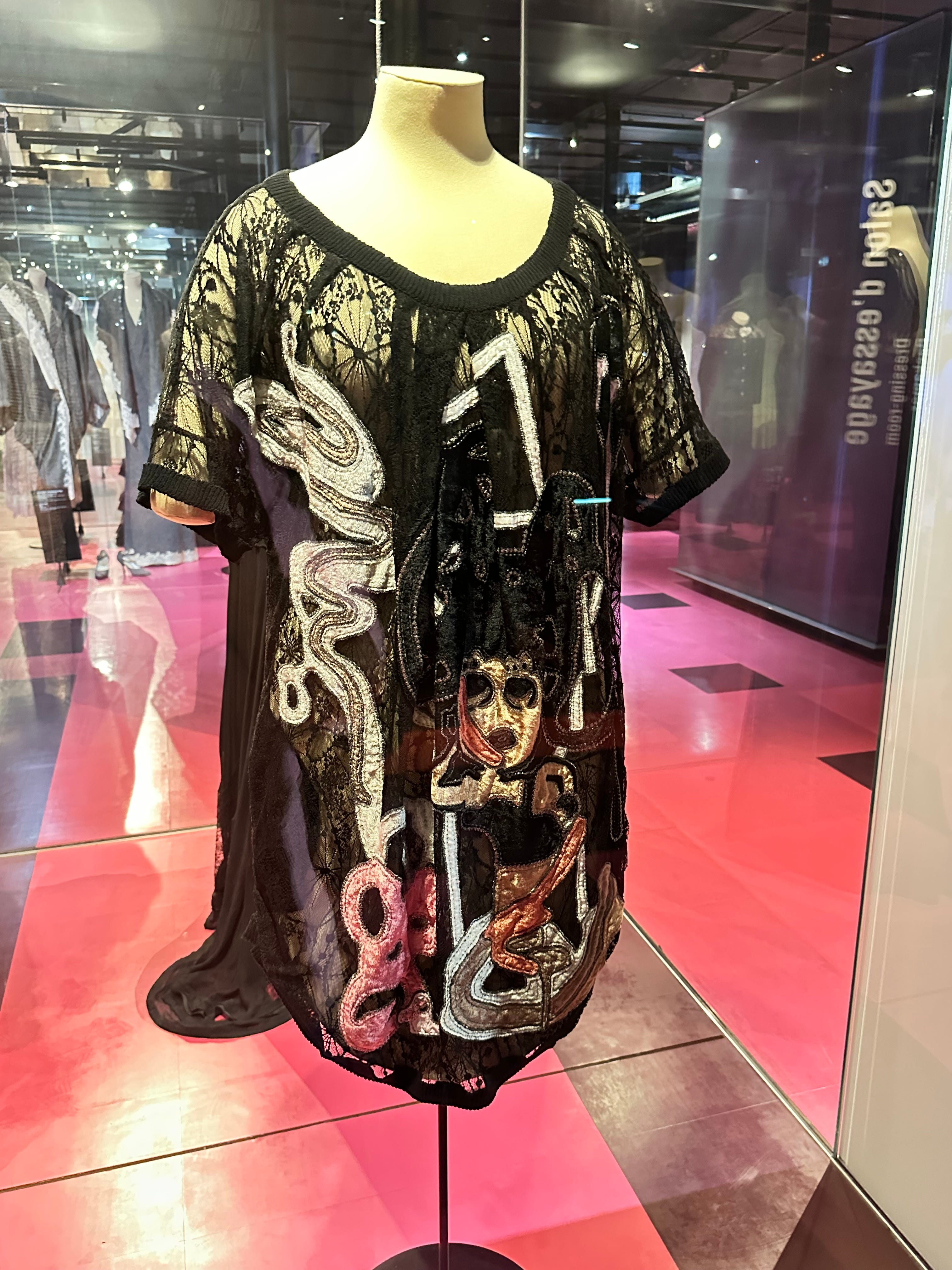
Photo: author, Sonia RYKIEL, Robe T-shirt, 2007, Velours de sole, Leavers Lace
Historically, lace production for outer garments was primarily centred in Caudry, while Calais focused on intimate lingerie. But both production centres are now seeking to diversify what they offer, and so the distinction between them is becoming less clear-cut.
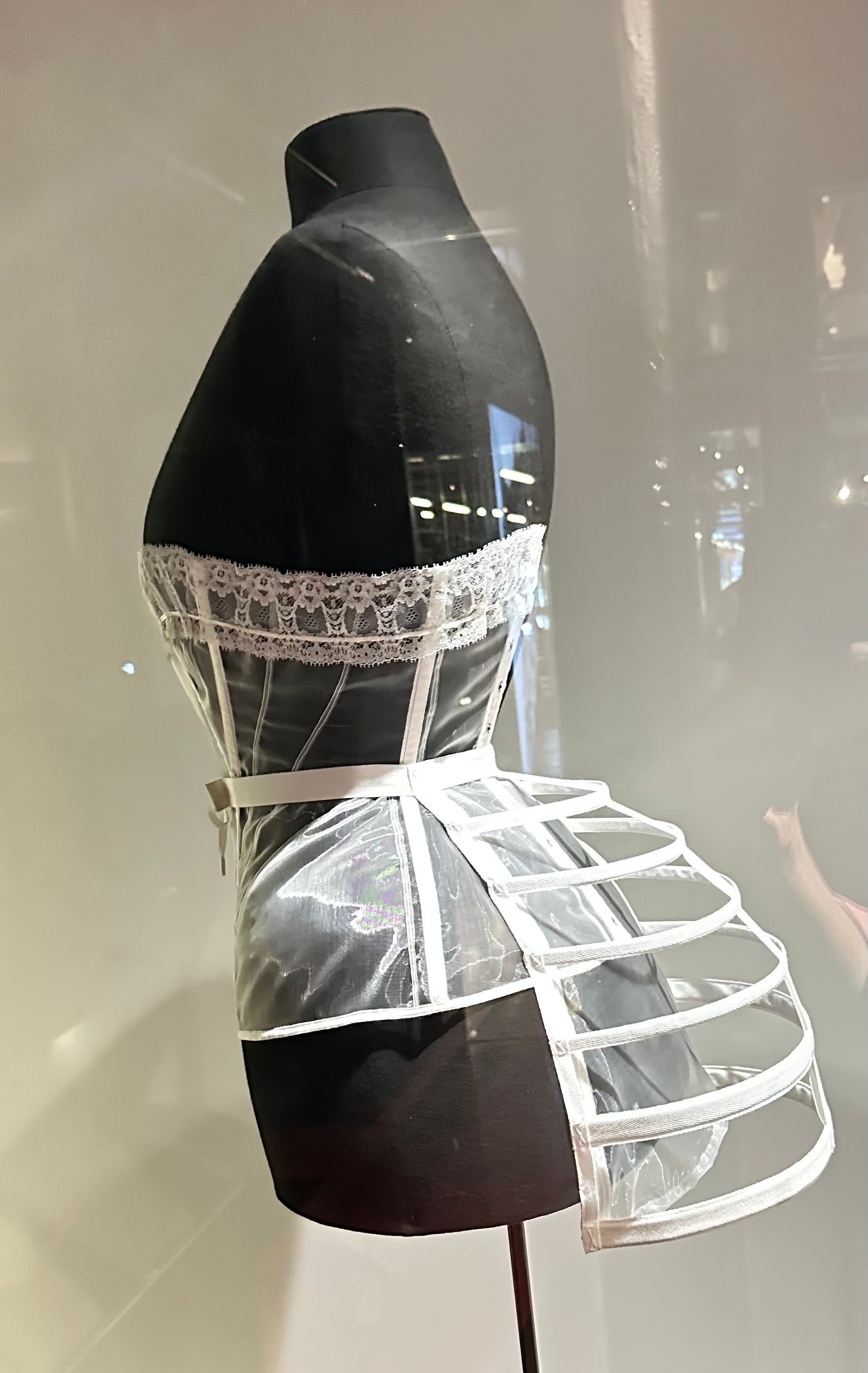
Photo: author, 19th-century formally structured lingerie scaffolding with Leavers lace
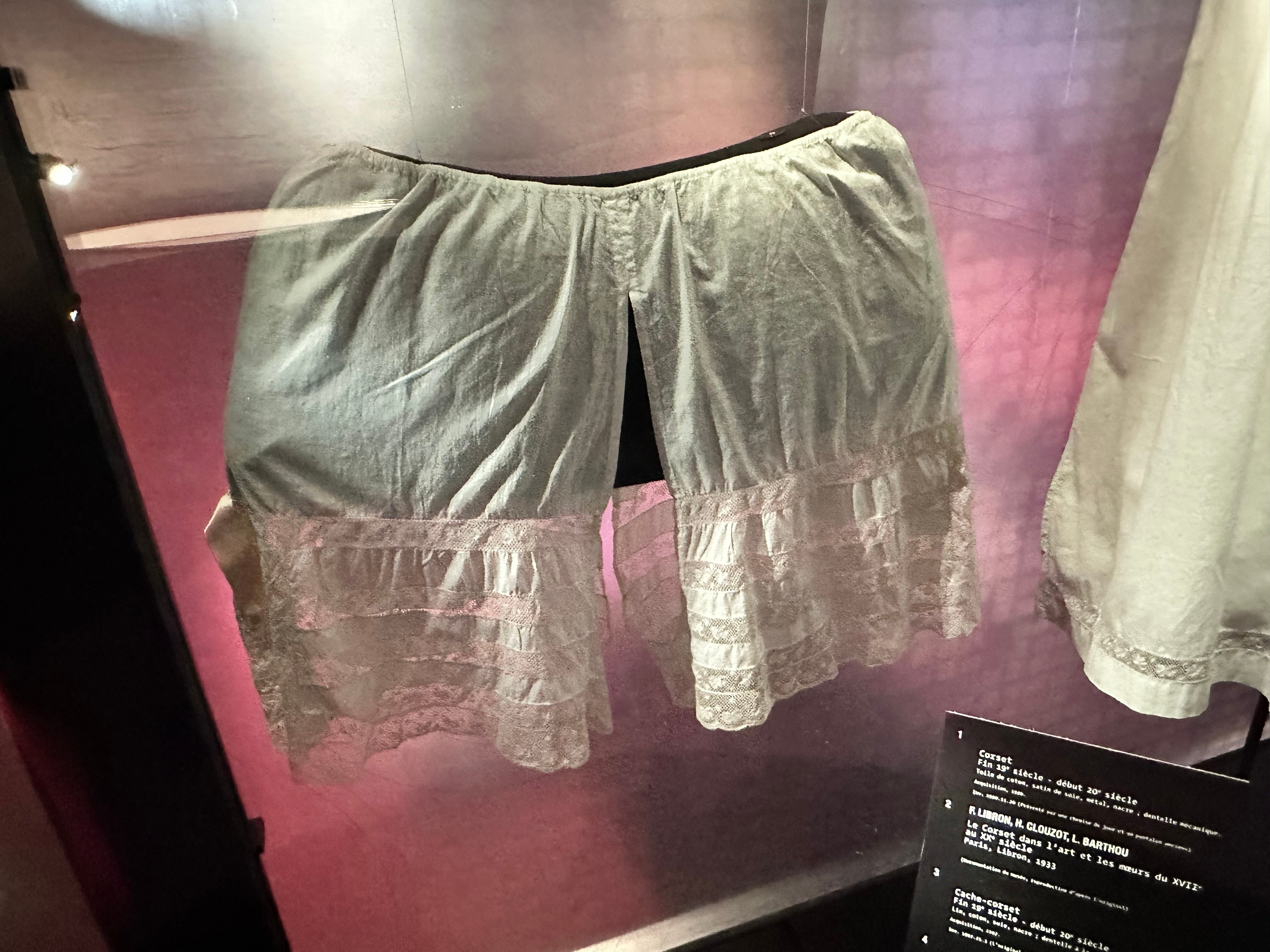
Photo: author, late 19th-century bloomers with Leavers lace.
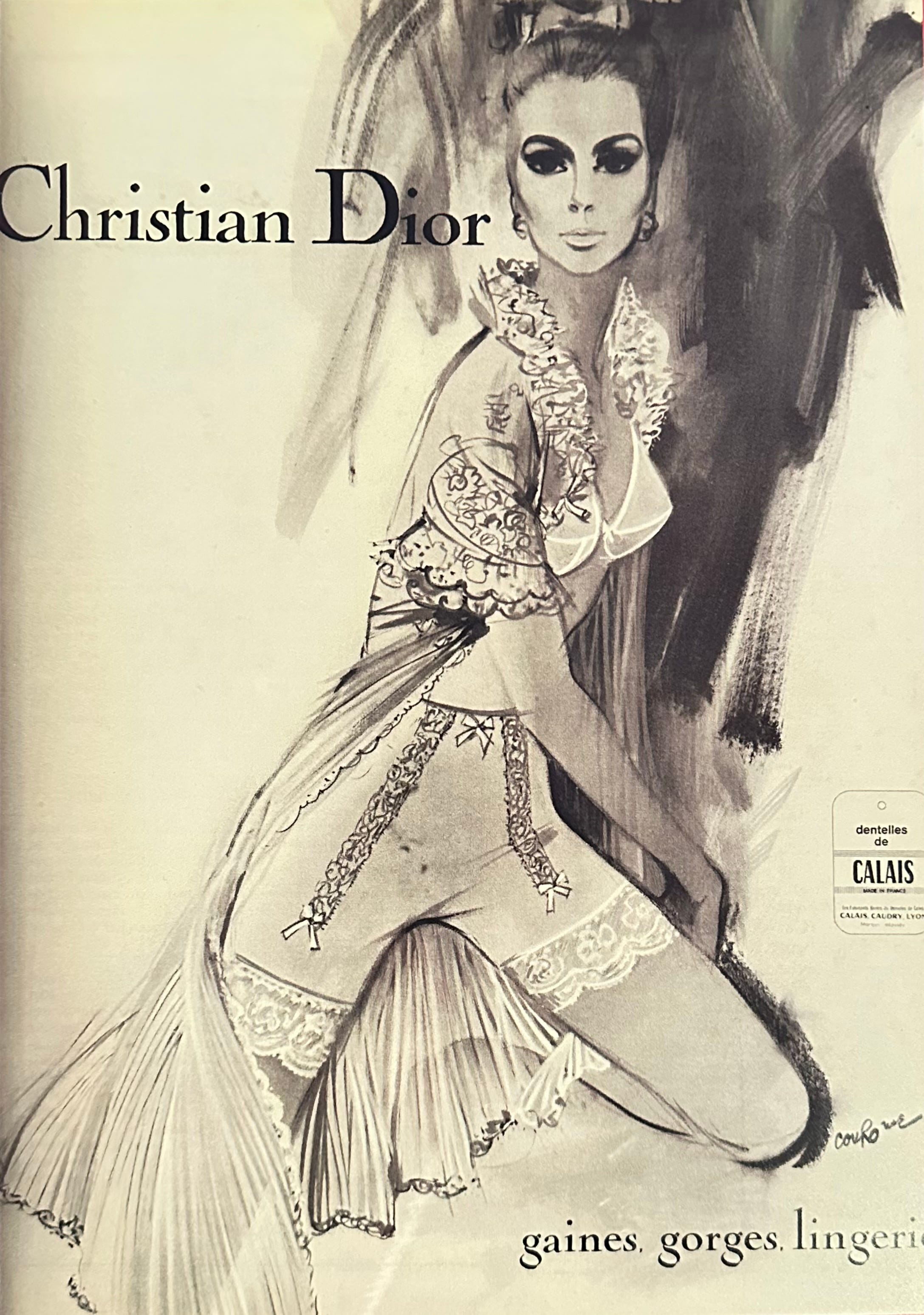
Photo: author, Advertisement for Christian Dior, mentioning Calais Lace, 1967, Revue Votre beauté
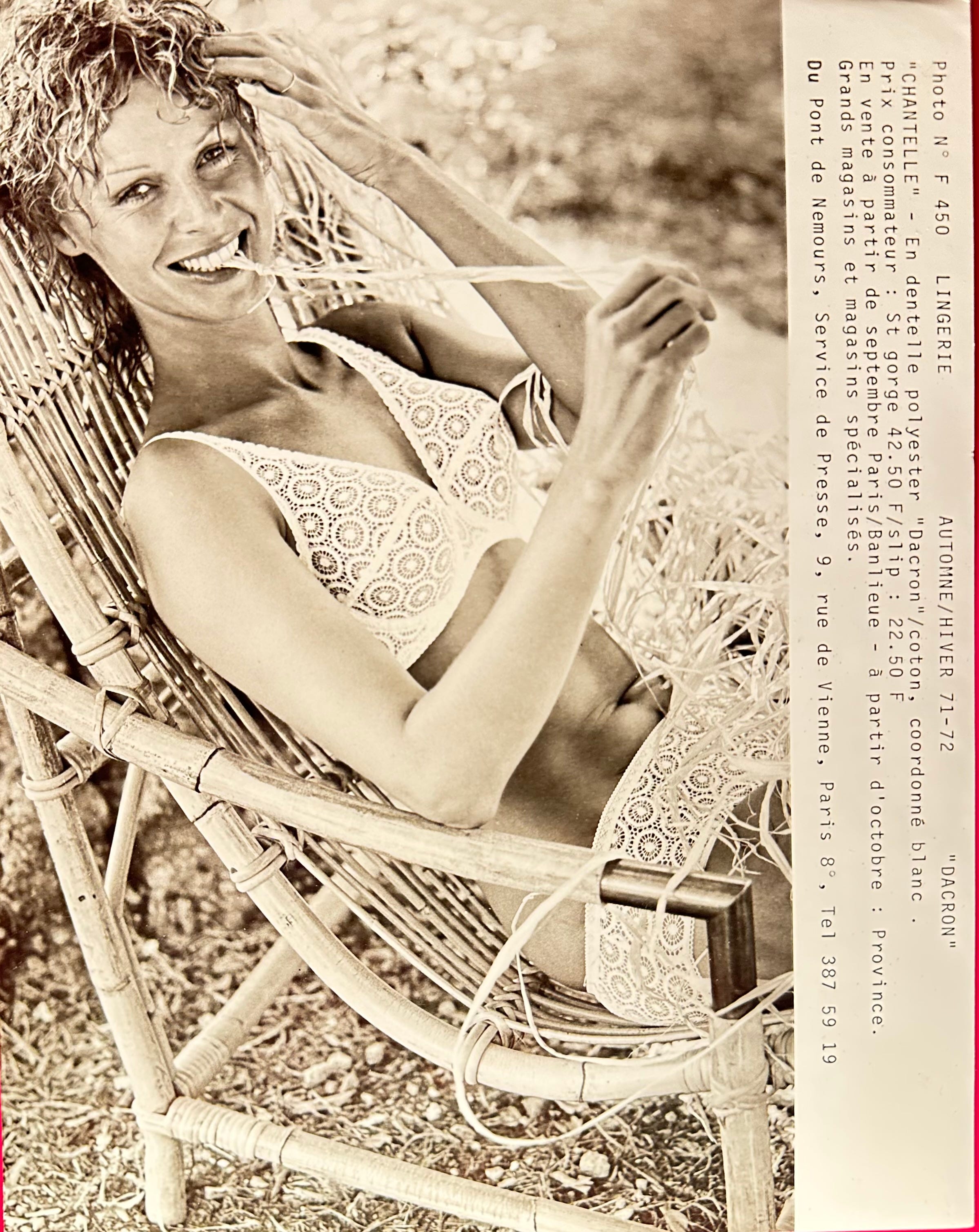
Photo: author, Advertisement for Chantelle lingerie with Peeters & Perrin lace, circa 1971
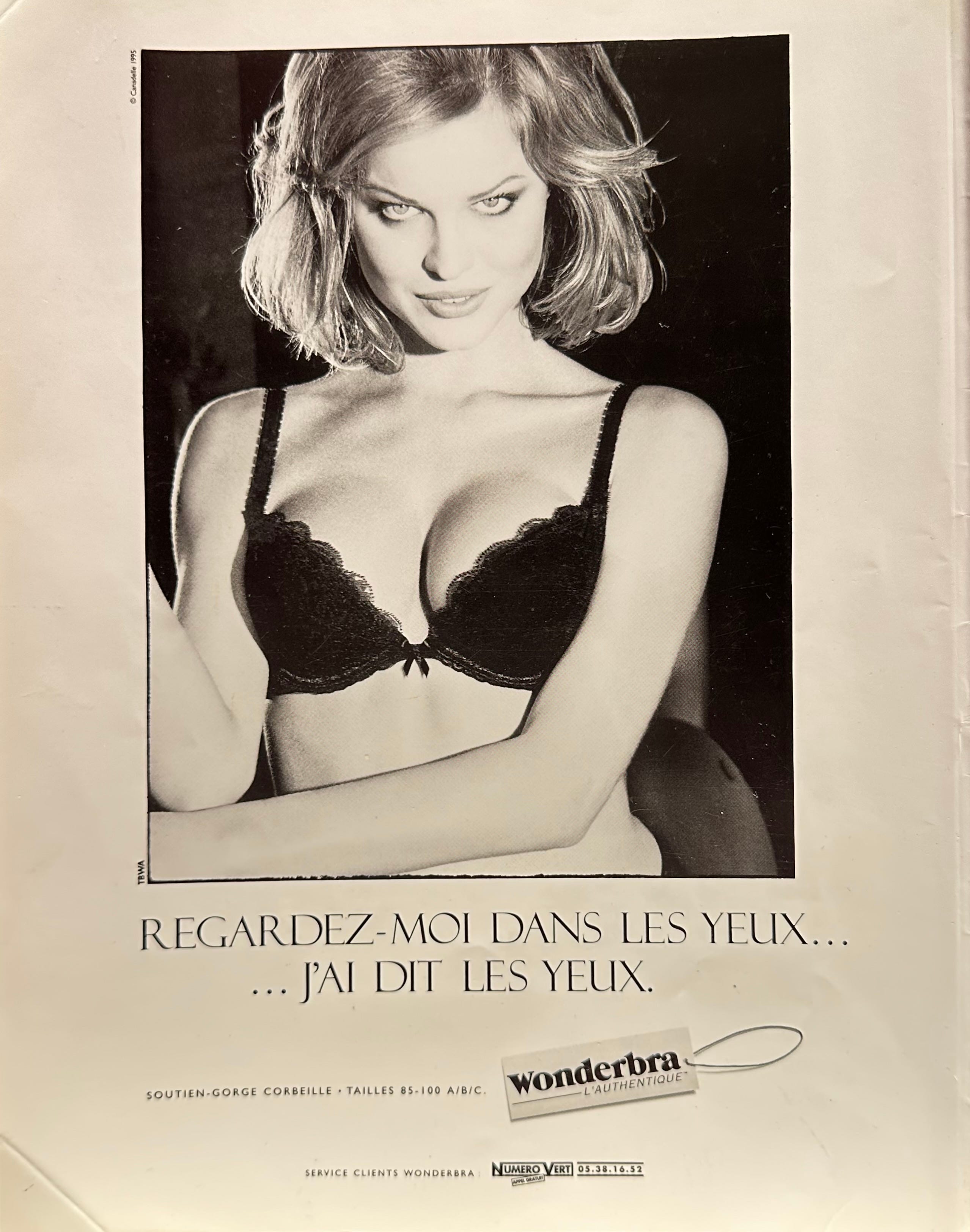
Photo: author, Wonderbra publicity, Revue Dessous, Mode Internationale, 1996
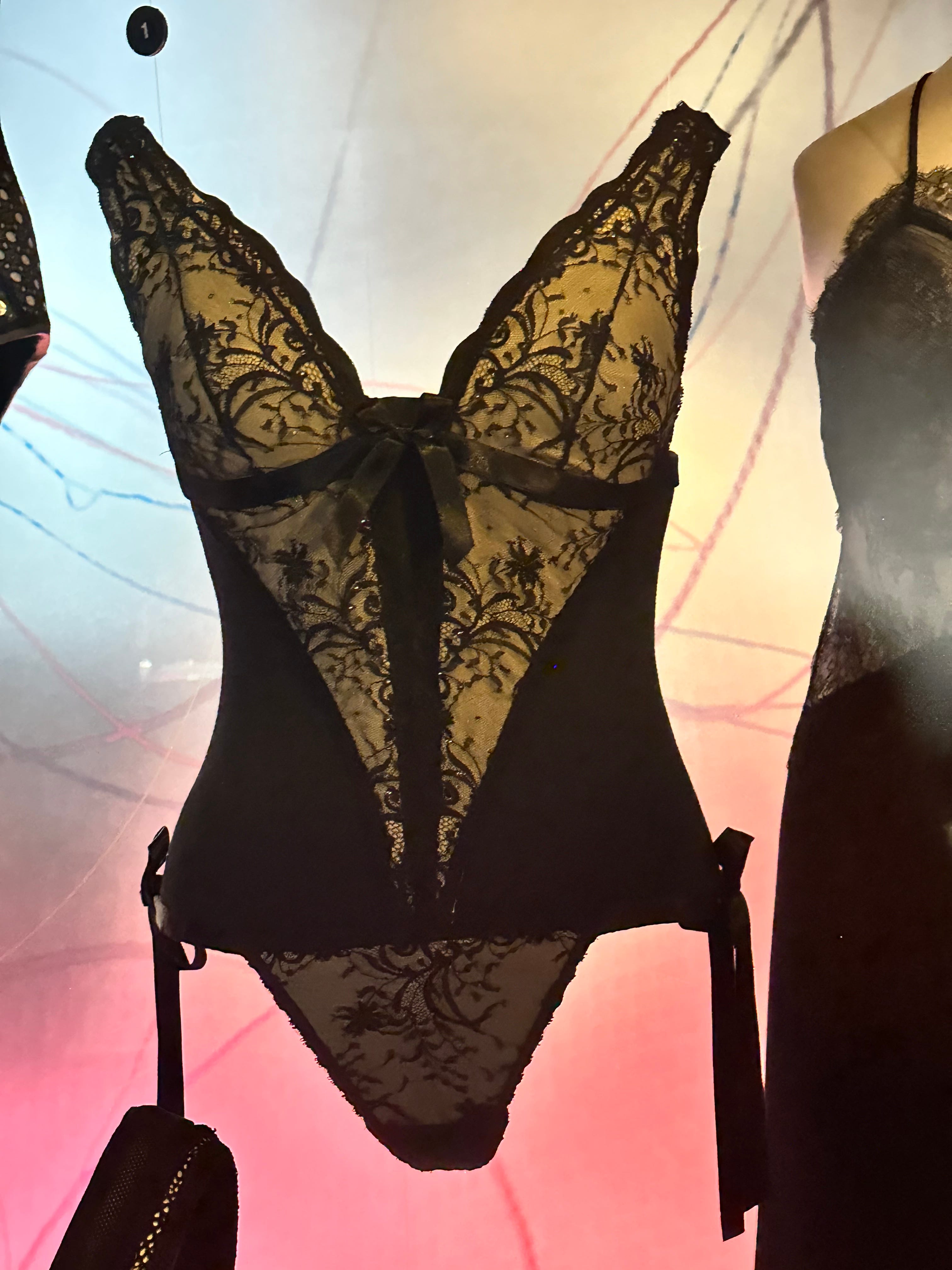
Photo: author, JOLIDON, dentelle Desseilles-Laces, Calais, Body, 2010, Leavers Lace, Swarovski crystals
It is fascinating to see how Lingerie has evolved since the S-shaped ideal female silhouette of the early 1900s was perceived as consisting of the bust thrust forward (creating a plunging bosom) and an arched lower back pushing the hips and derrière backwards, with the tiniest of waists courtesy of a corset. Just how restricting and uncomfortable this must have been!
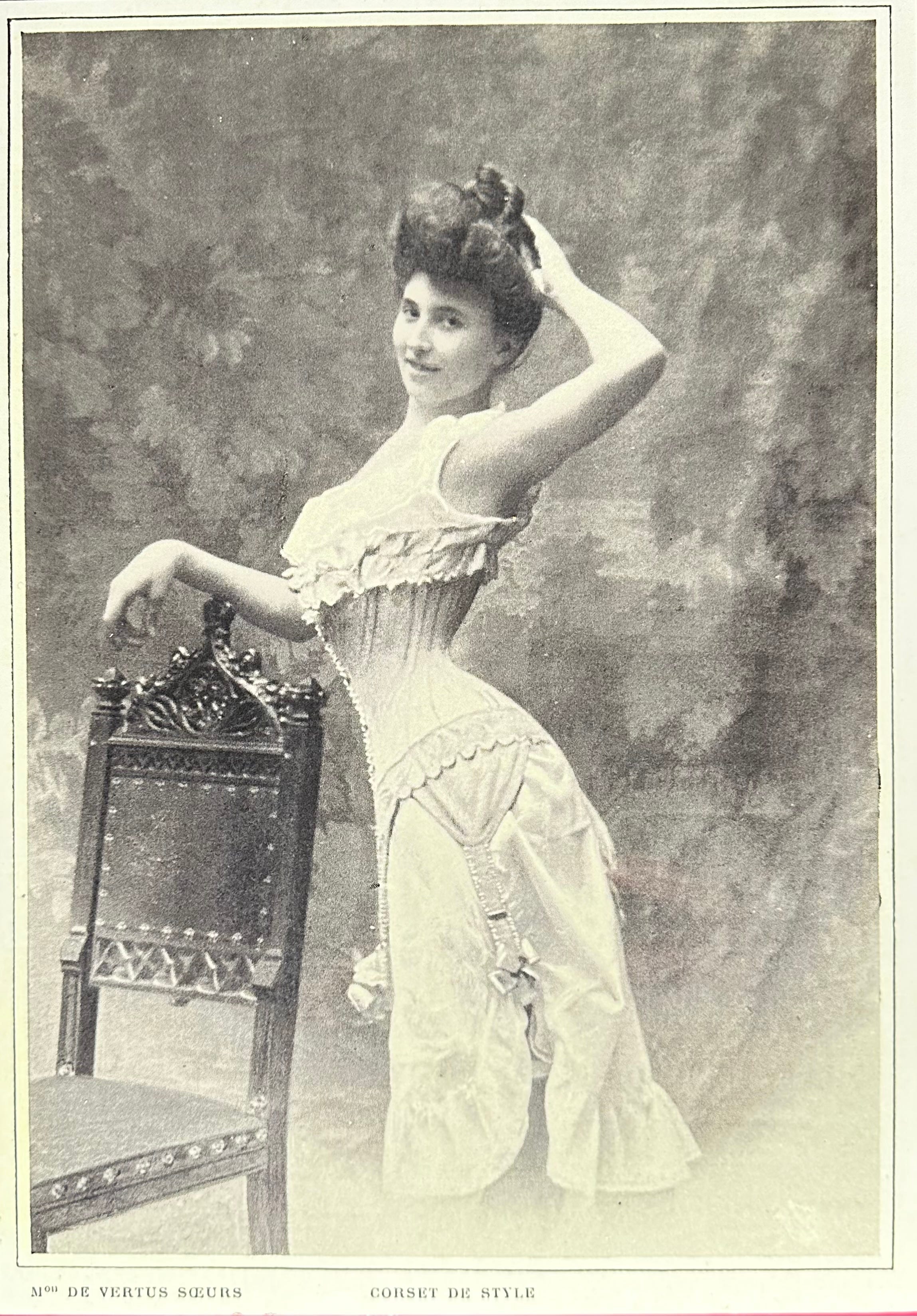
Photo: author, Corset de style, Maison de Vertus Soeurs, Revue Les Modes,1902
It is equally interesting to see how outerwear fashion trends have developed over time.
In the early 19th century, machine-made cotton tulle was only a tenth of the price of fine linen fabrics. Tulle and Lace as new machine-made textiles, won over more and more customers. Lace was used as a trim in the production of the trousseau, household linen, party and ceremonial dress, and the net curtain and lace curtain market was booming.
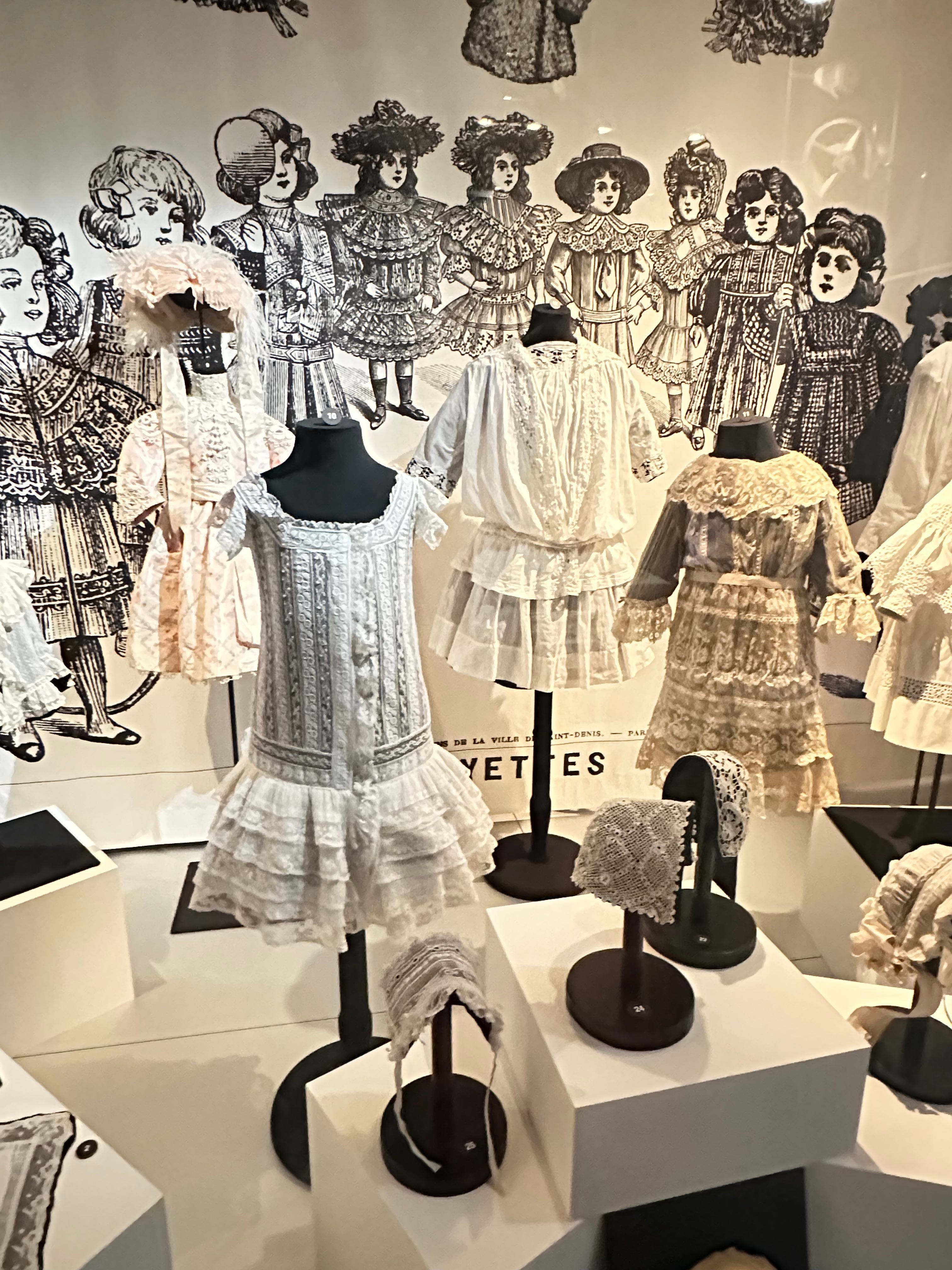
Photo: author
Fashion consolidated these trends: the dream was white, transparency and lightness, with priority given to embroidered or lacy tulle. Under the Second Empire, lengths of tulle were used in abundance for wardrobes and furnishings.
The first department stores were all the rage. Magazines and mail-order catalogues spread the fashion for lace.
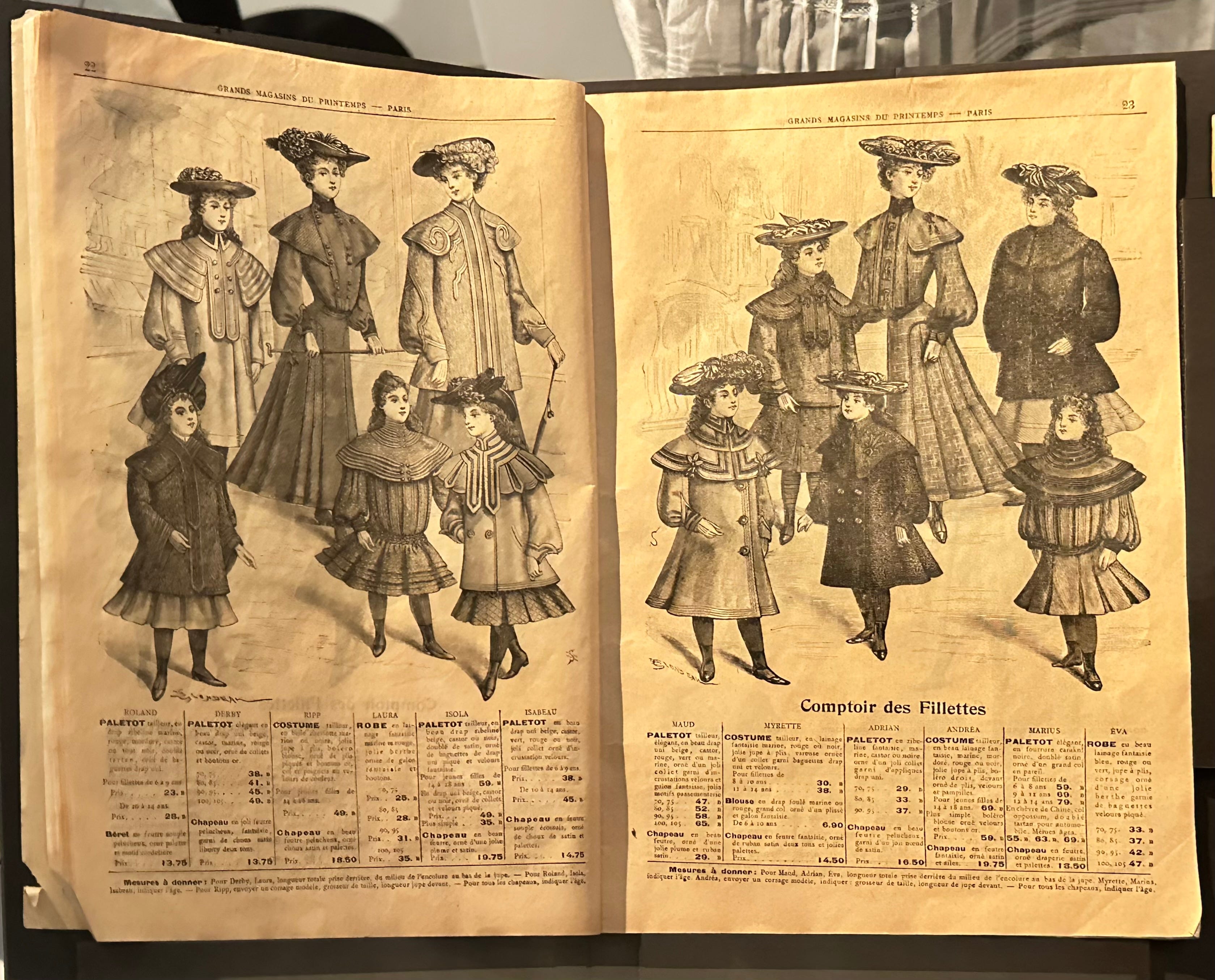
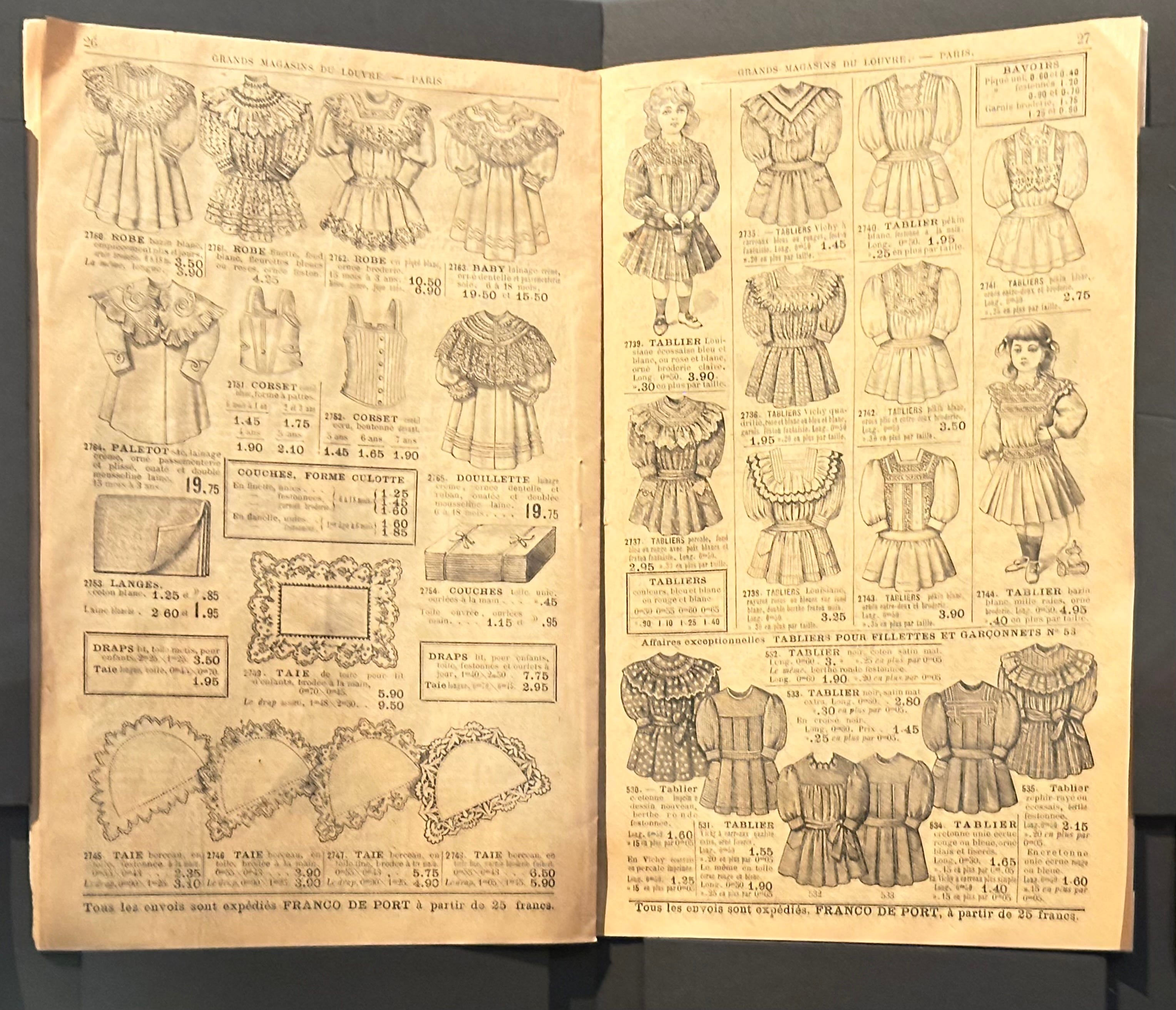
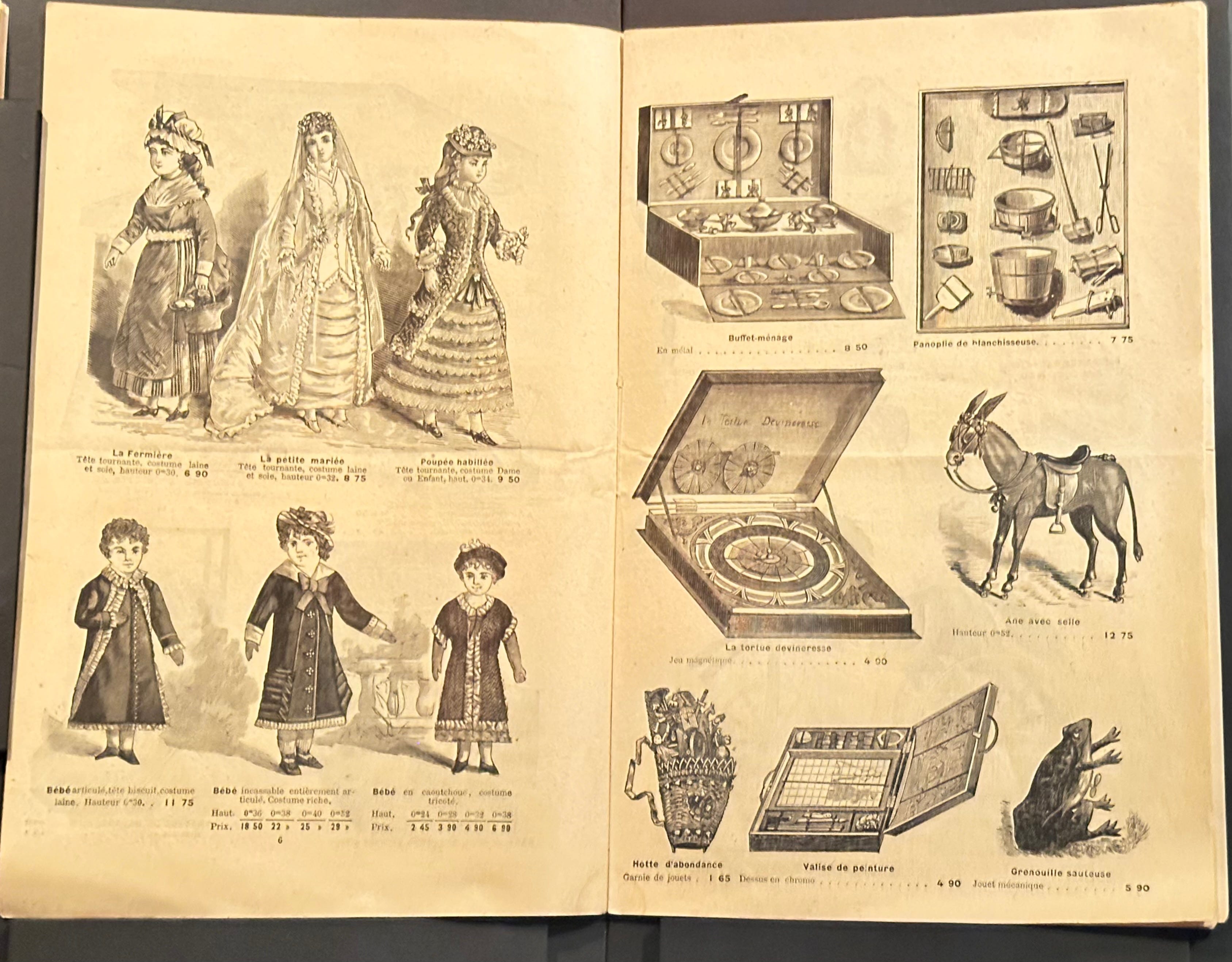
Parisian department store catalogues: PRINTEMPS - Winter 1903 - Girl’s counter; LOUVRE - January 1901 - Catalogue of linen; PRINTEMPS - 1879-80 Toys, gifts Documentation de la CIDM
Early 20th-century fashion, with its curved lines, drew inspiration from nature. The arrival of a fluid, long-limbed silhouette preceded the rationalisation and simplification of clothing during the First World War. The look described as “androgynous” during the 1920s, a total break with the past, defined a flat silhouette and revealed the legs.
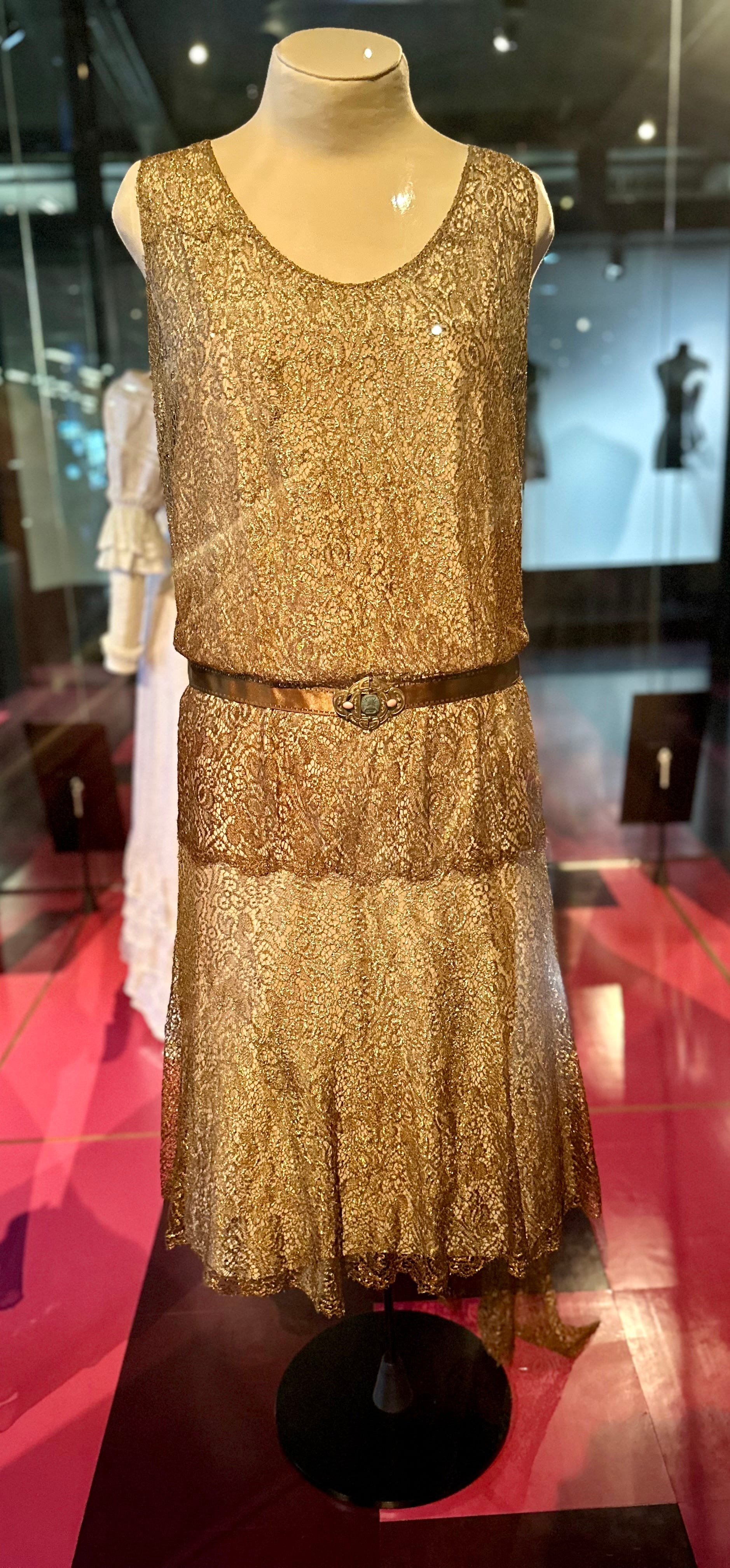
Photo: author, Evening dress, around 1925, Leavers lace made of coppery gold lamé threads, Silk satin belt, metal buckle featuring a stylised scarab beetle and costume stones.
The longer dresses with irregular, floating panels at the end of the decade would become even longer during the 1930s, closely moulding the bust and hips, with the waist restored to its natural place.
A functional fashion of mainly military inspiration, formed of recycling and reusing, characterised the style of clothing during the Second World War.
As a reaction to the dark years of the Occupation, the post-war silhouette highlighted the feminine attributes: fuller bust and hips, slender waist, fuller, longer skirts.
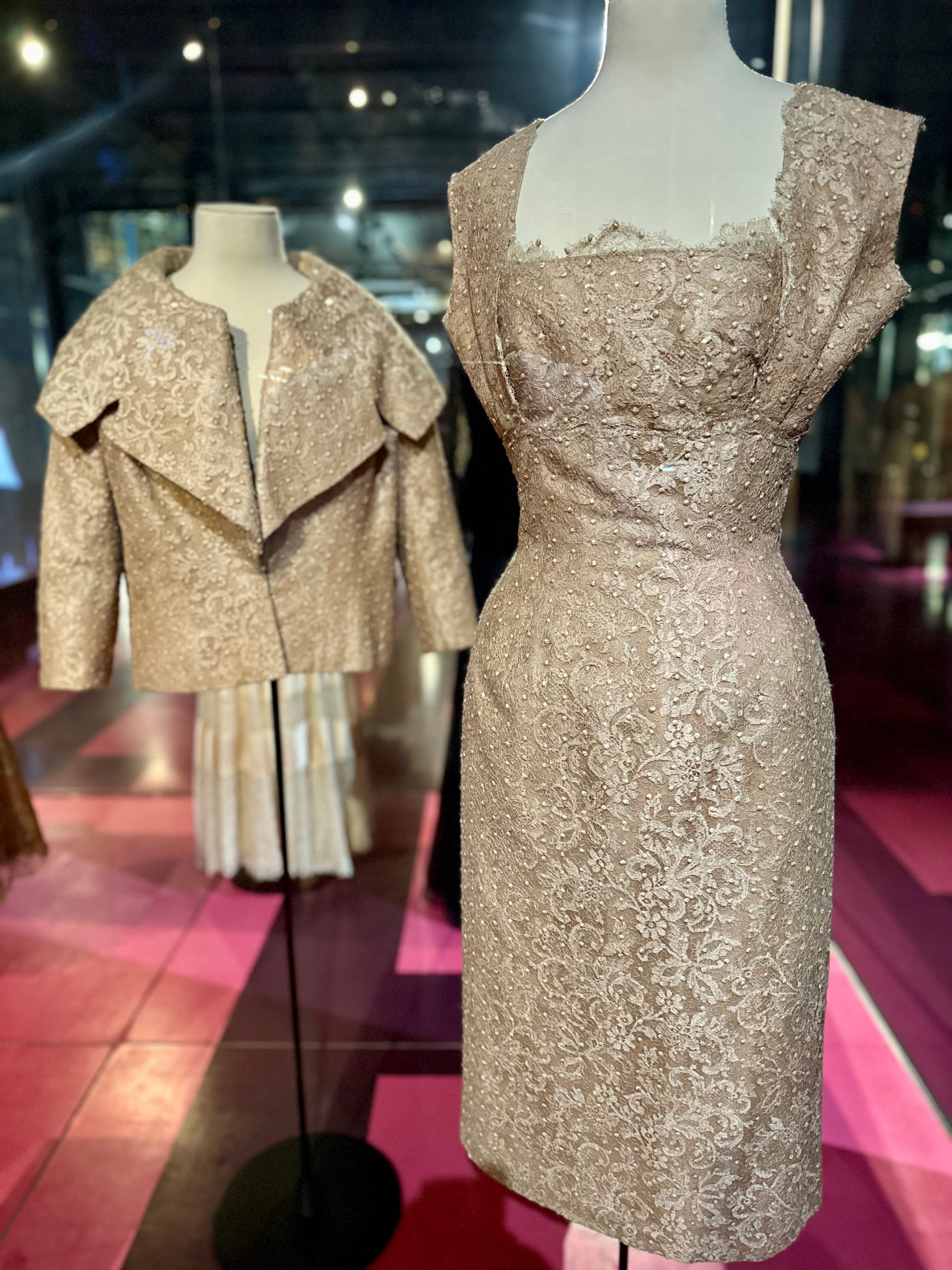
Photo: author, Maison NINA RICCI, Dress and jacket ensemble, 1957, Leavers Lace, silk taffeta, tulle
The 1960 and 1970 decades saw the rise of the protest movements led by young feminists and oppressed minorities.
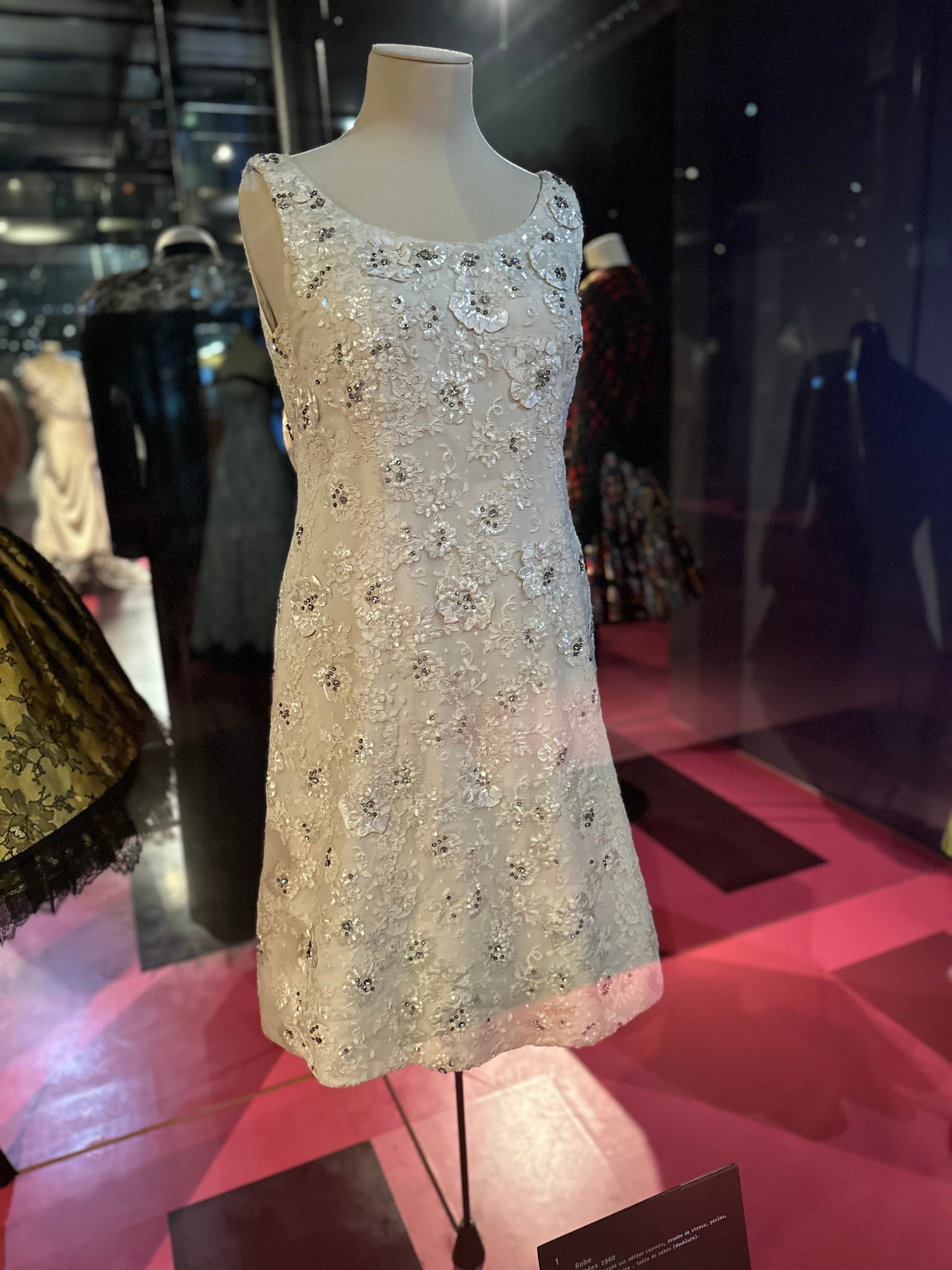
Photo: author, Dress, 1960, Leavers lace, embroidered with rhinestones, pearls, sequins and ribbons, cotton lining
From the 1960s to the 1990s, changes in clothing trends were accelerated by the rise of ready-to-wear, its distribution in shops and the emergence of new designers. Style agencies were now setting the trends, which were popularised by the media. The fortunes of the lace industry rose and fell with the slightest whims of the fashion world.
The designers who worked for a broader modern public at more reasonable prices were then behind some genuine clothing innovations. People choose their clothes to express their social or political positions, and no longer according to the criteria of a dominant fashion.
During the 1980s, fashion began to receive enormous media coverage. The couturiers drew their inspiration from very diverse sources to offer multiple styles.
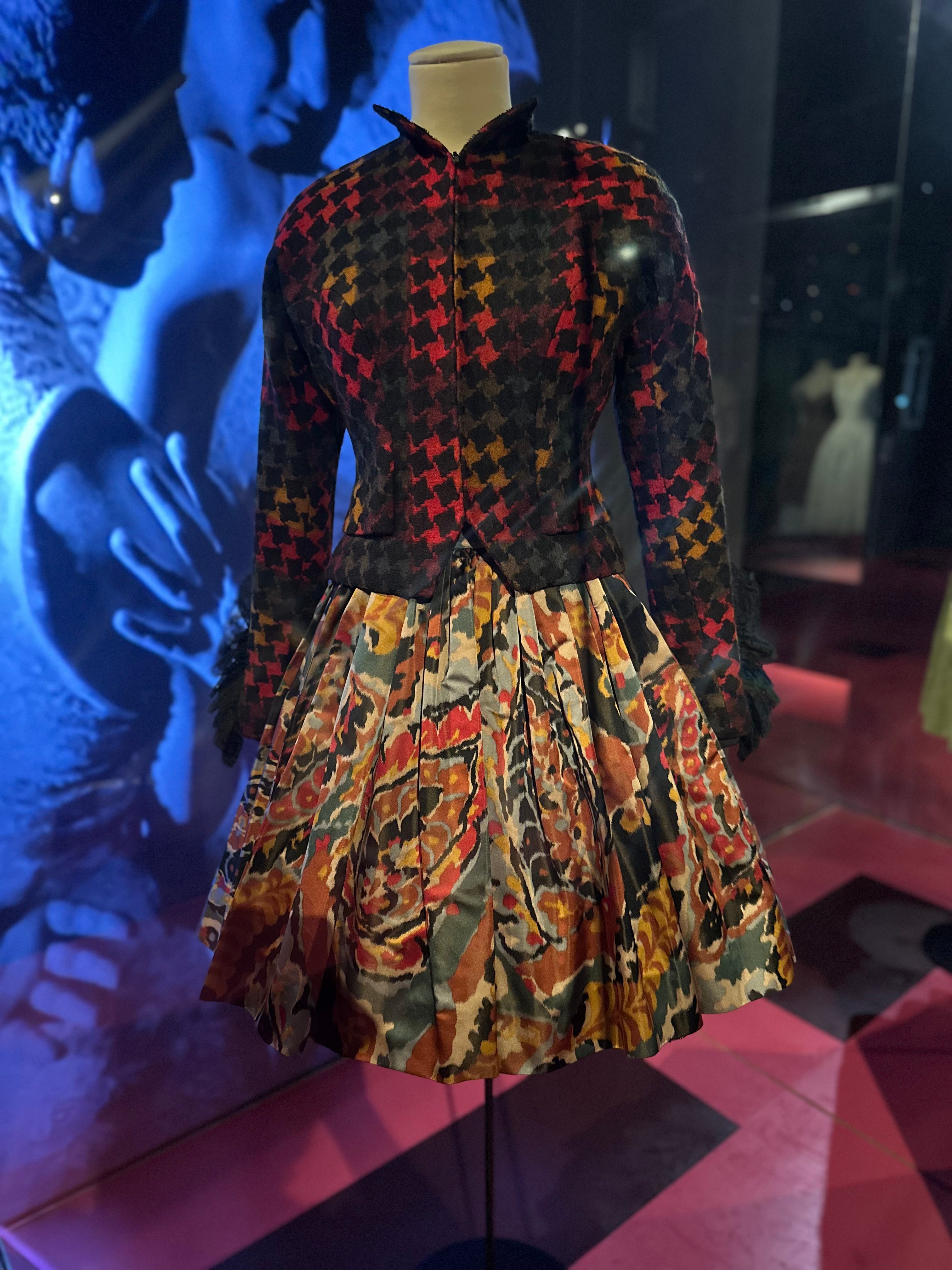
Photo: author, Christian LACROIX, 1987 (first couture collection), Woollen cloth, Leavers lace, Silk satin.
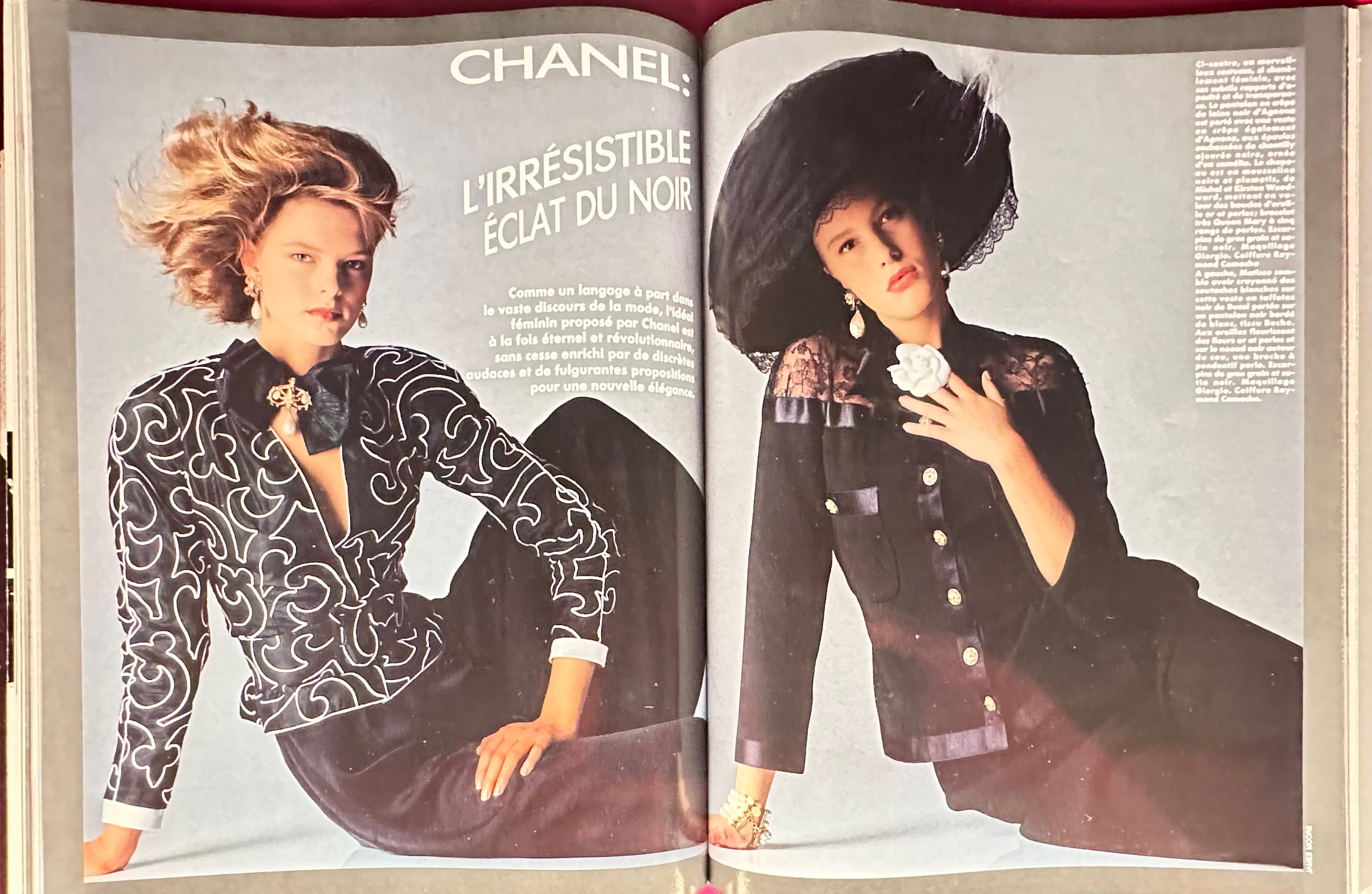
Photo: author, Article Chanel, l’irrésistible éclat du noir, Revue Harper’s Bazaar France,1988
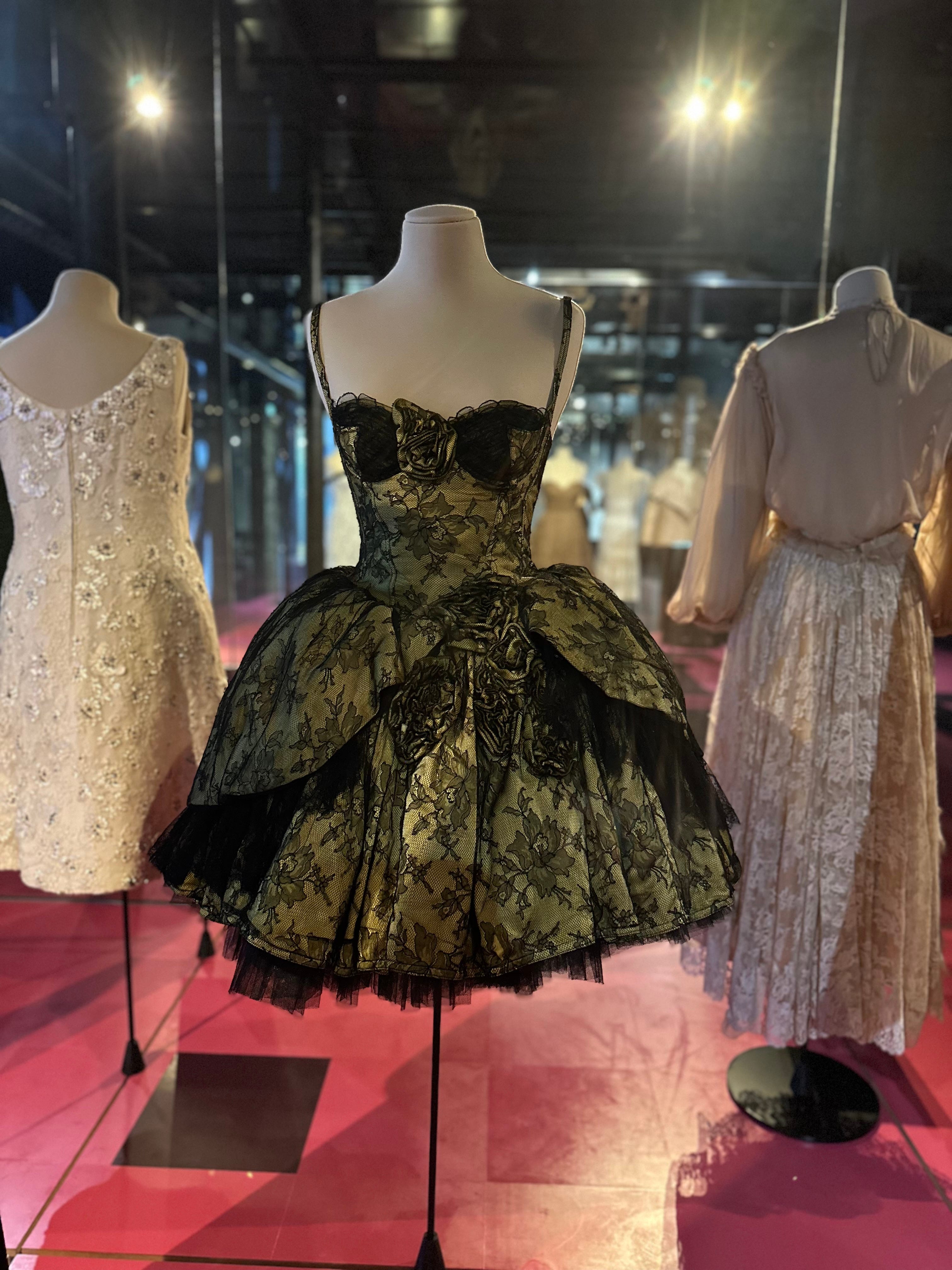
Photo: author, Chantal THOMASS, Dress, Autumn-Winter 1988-1989, Leavers Lace, Tulle, weaving

Photo: Madonna, Like a Virgin, 1984. Costume designed by Moroccan-born Maripol, who studied at the École des Beaux-Arts, Nantes, France, before moving to New York in 1976, aged 19.
As a reaction to so much frivolity and the popularity of lingerie as outerwear in the 1980s, the following decade would be characterised by a certain restraint and discretion, the keyword being minimalism.
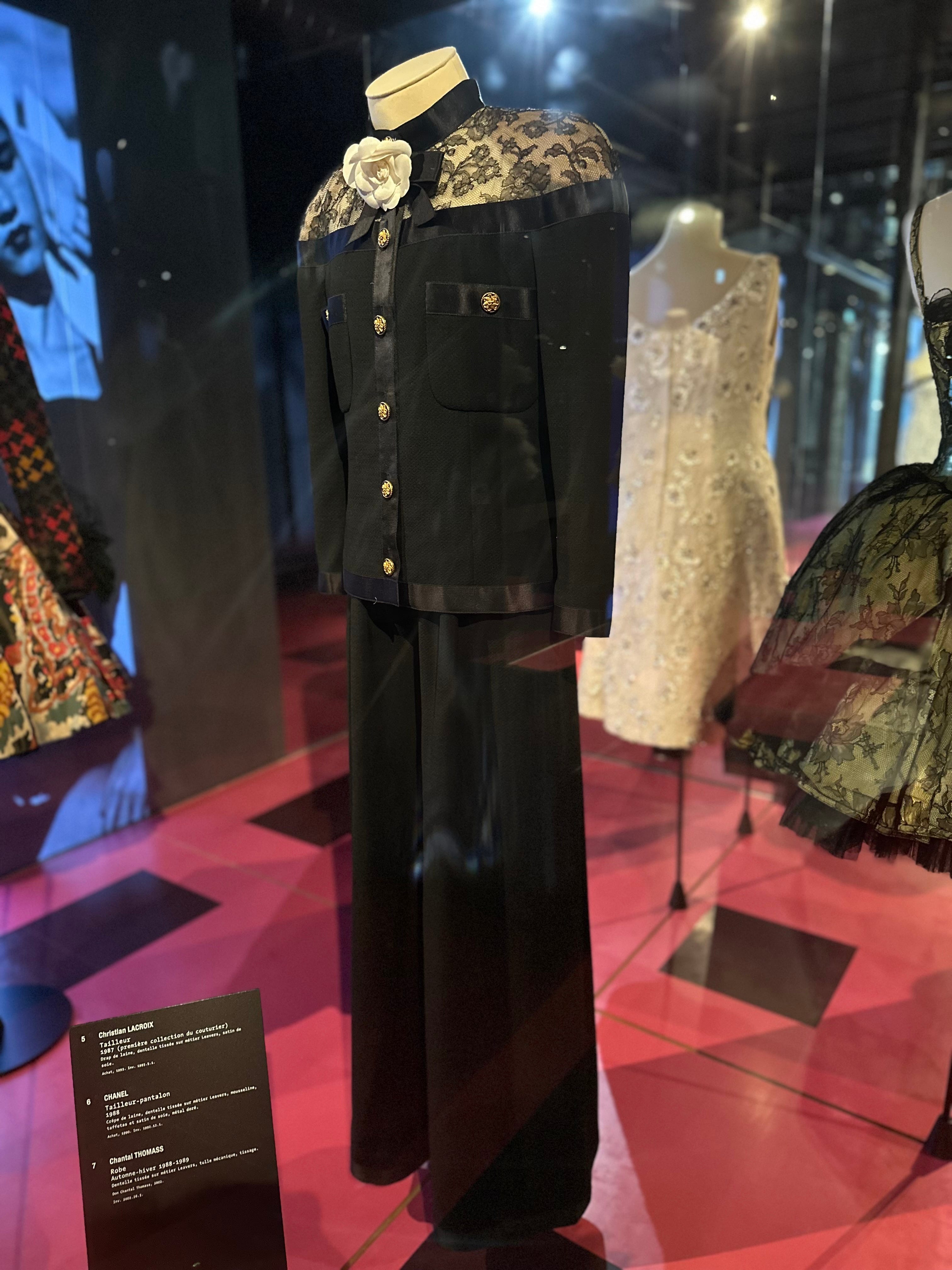
Photo: author, CHANEL, Trouser suit,1988, Wool crepe, Leavers loom lace, muslin, taffeta and sole satin, gold-tone metal.
The lace, the dresses, the lingerie were gloriously decadent. Yet the scientist in me wanted to understand how Leavers Lace was created. So come and join me as I delve into the origins, history and engineering of Leavers Lace creation.
John Heathcote:
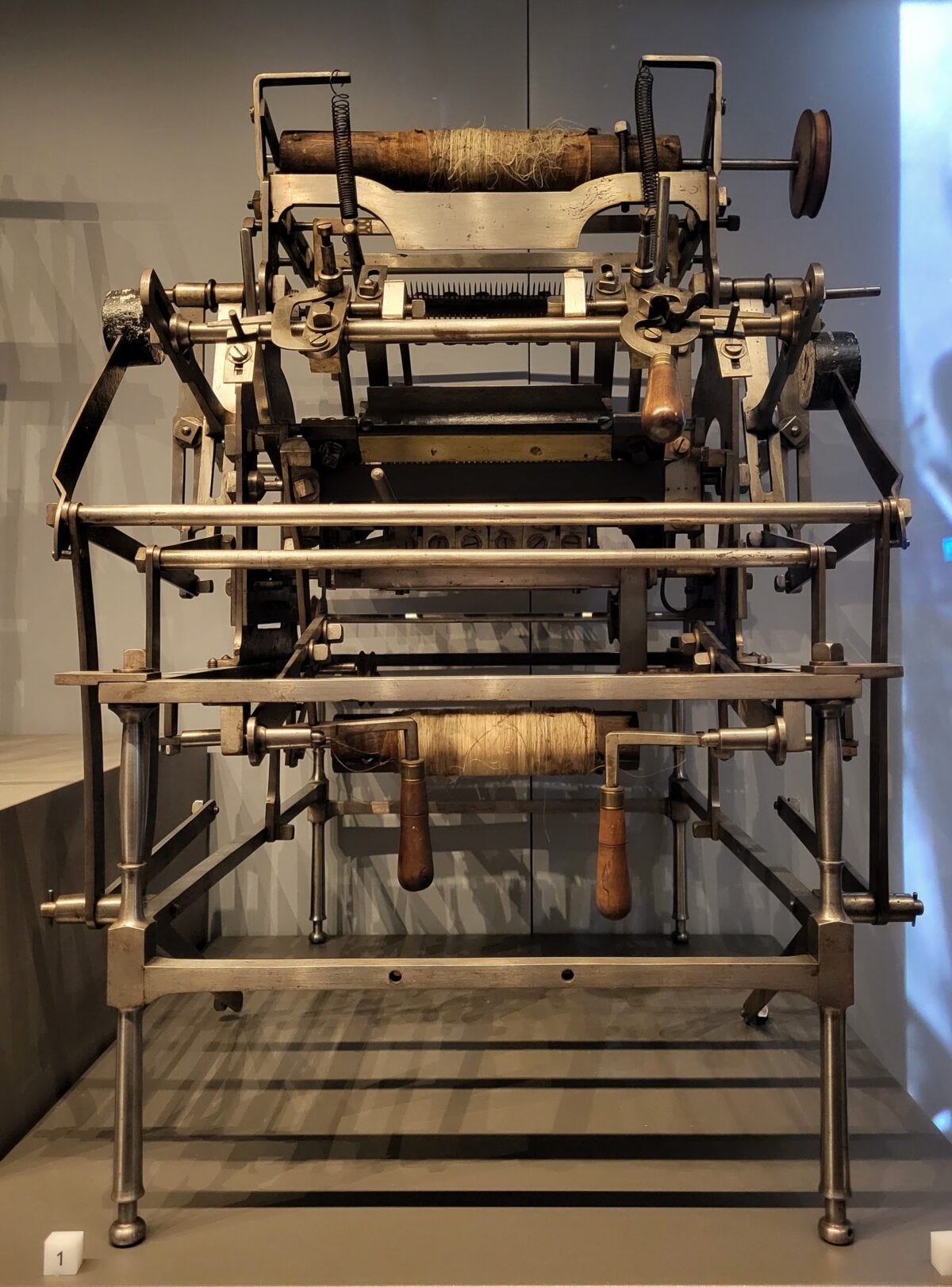
Photo: Heathcoat’s 2nd patent lace machine 1809, nottinghamcastle.org.uk
Machine-produced lace was first created in Nottinghamshire, England. John Heathcote’s original 1809 Old Loughborough bobbin net machine was the first purpose-built commercial Lace machine. Heathcote replaced the shuttle (an elongated shape) of a lace loom with the bobbin (a cylindrical shape around which the thread unwinds at a regular rate).
Heathcote’s machine relied on two tiers of bobbins, which moved positions with each forward and backwards motion of the machine. This produced a base net tulle with no inlaid embroidered patterns. The tulle base was then embroidered by hand to produce a lace fabric.
John Levers:
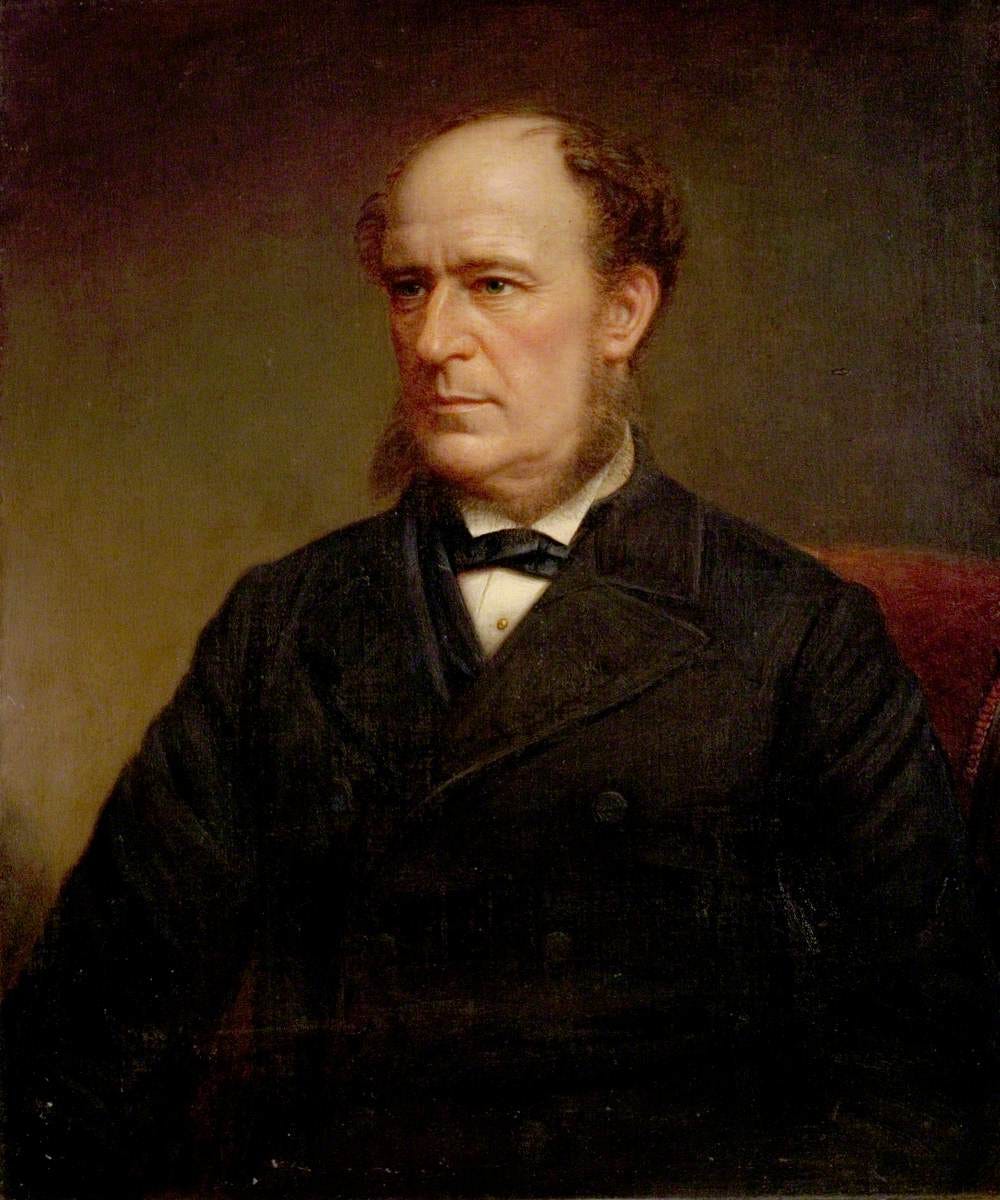
Painting: Nottingham City Museums & Galleries
John Levers was born in 1786 in Sutton in Ashfield, Nottinghamshire, England. At that time, Sutton was the centre of hosiery production, with an emerging manufacture of machine net lace tulle. John Levers was a trained mechanic & engineer. The Levers’ family were all involved in the lace-making industry. He had three siblings: James, a lace maker and lace mechanic; Mary, a lace runner; and Thomas, a lace machine maker.
In 1813, John Levers designed the single-tiered bobbin net Leavers Lace machine. His machine was an adaptation of and improvement on John Heathcote’s original lace-making machine invention.
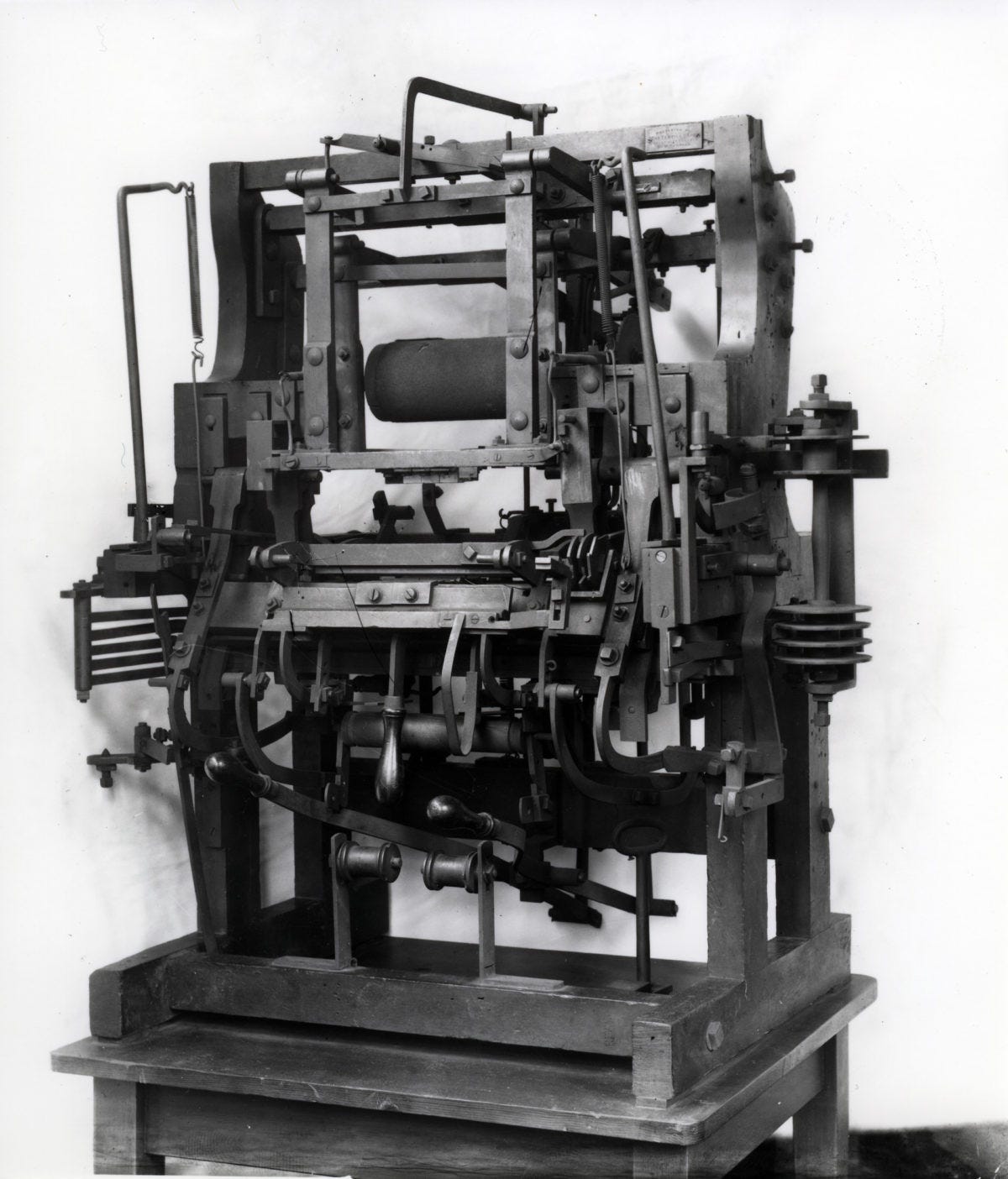
Photo: a rare wooden-framed Leavers machine made by John Levers in Nottingham, Nottingham City Museums and Galleries
The Leavers machine with a single layer of thin bobbins is capable of producing single-tiered patterned net lace. The machine can create intricate lace patterns, with or without a net background, similar to handmade lace.
Due to prohibitive English tax laws, many English lace manufacturers moved to France at this time. In 1821, together with his siblings, mother, two sister-in-laws and his sister’s future husband, John Levers emigrated to Grand-Couronne, near Rouen, on the banks of the river Seine in Normandy. There, John Levers began working in a lace workshop converted into a factory. To help native French speakers pronounce the family surname correctly, the spelling was changed from Levers to Leavers.
In 1833, John Levers successfully obtained a patent for his Lace frame - the Leavers machine.
Significantly, John Lever’s machine allowed for the later addition of Jacquard cards that directly patterned the lace, rather than creating a hexagonal net tulle which had to be subsequently embroidered by hand. Such a feat could never have been achieved on Heathcoat’s original Lace machine, as it relied on two tiers of bobbins.
John Levers died in 1848 in Grand-Couronne, Normandy.
Leavers Lace and Calais:
In the early 19th century, England led the world in mechanical textile manufacture. This manufacturing was protected by making it illegal to export the Lace machines out of the country.
France placed high tariffs on English lace and cotton to protect its own textile industry, making imported English lace very expensive.
In 1816, Robert Webster, assisted by Samuel Clark, smuggled a Lace machine into Calais. The machine was dismantled, packaged and shipped on various boats to Calais. The parts were then reassembled in a shop on Quai du Commerce in the village of Saint-Pierre, outside the walls of Calais itself.
Trade grew rapidly, and soon there were eleven Lace machines in Calais. Other English lace manufacturers and workers followed.
Two significant developments were the advent of steam powered Leaver machines and the Jacquard cards.
Until the middle of the 1830s, the looms were driven by hand, with the turners using a special handle. The length of the machines and, therefore, the width of the pieces of fabric produced were limited by the strength of the men. In Devon, England, hydraulic energy was used as the driving force, but this was impossible in Calais due to the lack of a major waterway
The use of steam-powered machines arrived late in Calais in 1840, when the first industrial boiler room was installed in the Webster & Pearson factory.
There were several successive waves of construction in Saint-Pierre-Calais: from 1840 to 1844, from 1850 to 1856, between 1868 and 1873, and finally the last and the biggest phase from 1878 to 1883, taking the number of Leavers Lace factories to over 50.
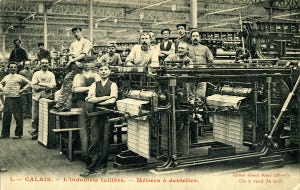
Lace makers in a workshop, published as a postcard in the early 20th century, Grand Bazar Lafayette editions, Cité dentelle mode collection© CIDM
Glossary of Job Roles in a Leavers Lace factory:
The professional worker descriptions below were derived from the Births, Marriages and Deaths records from the Calais and Calais Saint Pierre archives. They tell a fascinating story of the lives of workers in Calais at this time in the 19th century:
French term m/f: English description
brodeuse: embroiderer
couturière: dressmaker
dentellier/dentellière: lacemaker - owner of machines and manager of the processes from making, packaging to selling the finished lace product.
dévideuse (f): winder, usually a female who winds thread from small wooden reels onto a larger reel for use by the bobbin winder.
dévideur (m): winder, usually a male who selects the correct thread yarns and first winds threads onto a large warp mill and then onto the warp drum
dessinateur: designer who creates a drawing of the lace fabric design
esquisseur: draftman modifies the design drawing to create a machine useable sketch
fabricant de rouleaux: wooden reel or spool maker
fabricant de tulle: manufacturer - factory and machine owner
faiseur de tulle: maker of tulle
fileur/fileuse: spinner
laçeur: jacquard card lacer
mécanicien: machine mechanic assists the twist hand to ensure smooth machine operation
ouvrier en tulle: lace worker (generic term for a worker in the lace making industry)
perçeur (de cartons): piercer of the jacquard cards - the card puncher or cutter
plieur/plieuse de tulle: lace presser
pointeur: pattern perforator - modifies sketch design for production and prepares it for the card piercer by piercing the design sheet and adding numbers to indicate the location and colour of each thread
presseur (de bobines): bobbin presser
raccommodeuse: mender - makes good any faults in the fabric
rémonteur/armonteur: bobbin fitter - fits the filled bobbins. After checking each bobbin/carriage assembly, he fits the assemblies to the machine and feeds threads through the machine
survideur: jacker-off - removes used bobbins and carriages from the machine and then the remaining thread from the brass bobbins before handing them on to the bobbin winder. Also, winds thread onto a series of small wooden reels from hanks of spun material for use by the dévideuse and onto a very large wooden-framed drum for use by the wapeur
tulliste: twisthand - general operation of the machine and oversight of the other workers and feeds the threads into the machine
wapeur/wappeur: winds cotton threads onto long metal rollers (warp beams) fitted across the width of the machine. These threads become the warp threads of the fabric
wheeleur/wheeleuse: bobbin winder - winds thread onto bobbins in a series and racks them ready for the bobbin presser. The thread in the bobbin is then used to twist around the warp and beam (weft) threads of the fabric
visiteuse: material checker who marks faults for the menders
The Leaver Machine Process:
The process is really complex, involving up to 20 stages. At the end of the first day, I visited the museum, my head hurt, and I felt confused. I didn’t really fully understand the machine process. And usually, I’m reasonably competent at understanding processes with my scientific background. Perhaps it’s an ageing thing; maybe it’s a second language thing - I’m still not sure, but I knew I was confused. And that made me feel uncomfortable.
So I went back to the museum again the next day. I recorded display video clips in French. I photographed detailed display boards. And I made good use of Google Translate when my imperfect, rudimentary French let me down (frequently). Subsequently, I did research online. I feel I now have a better understanding of the complex processes involved in the Leavers Lace machine. But it sure isn’t perfect. However, I will do my best to share what I understand with you.
The Leavers Lace process comprises three stages:
Stage 1 Preparation
Stage 2 Leavers Machine operation
Stage 3 Finishing
Stage 1 Preparation:
This can be subdivided into two elements:
Stage 1a: Design and Pattern Control with the Jacquard Cards
Stage 1b: Yarn Preparation involving the Bobbins, Drums and Beams
Stage 1a: Design and Pattern Control with the Jacquard Cards:
Designing:
The Dessinateur creates a new lace design using a pencil and paper, which is limited by the capabilities of the Leavers Lace machine.
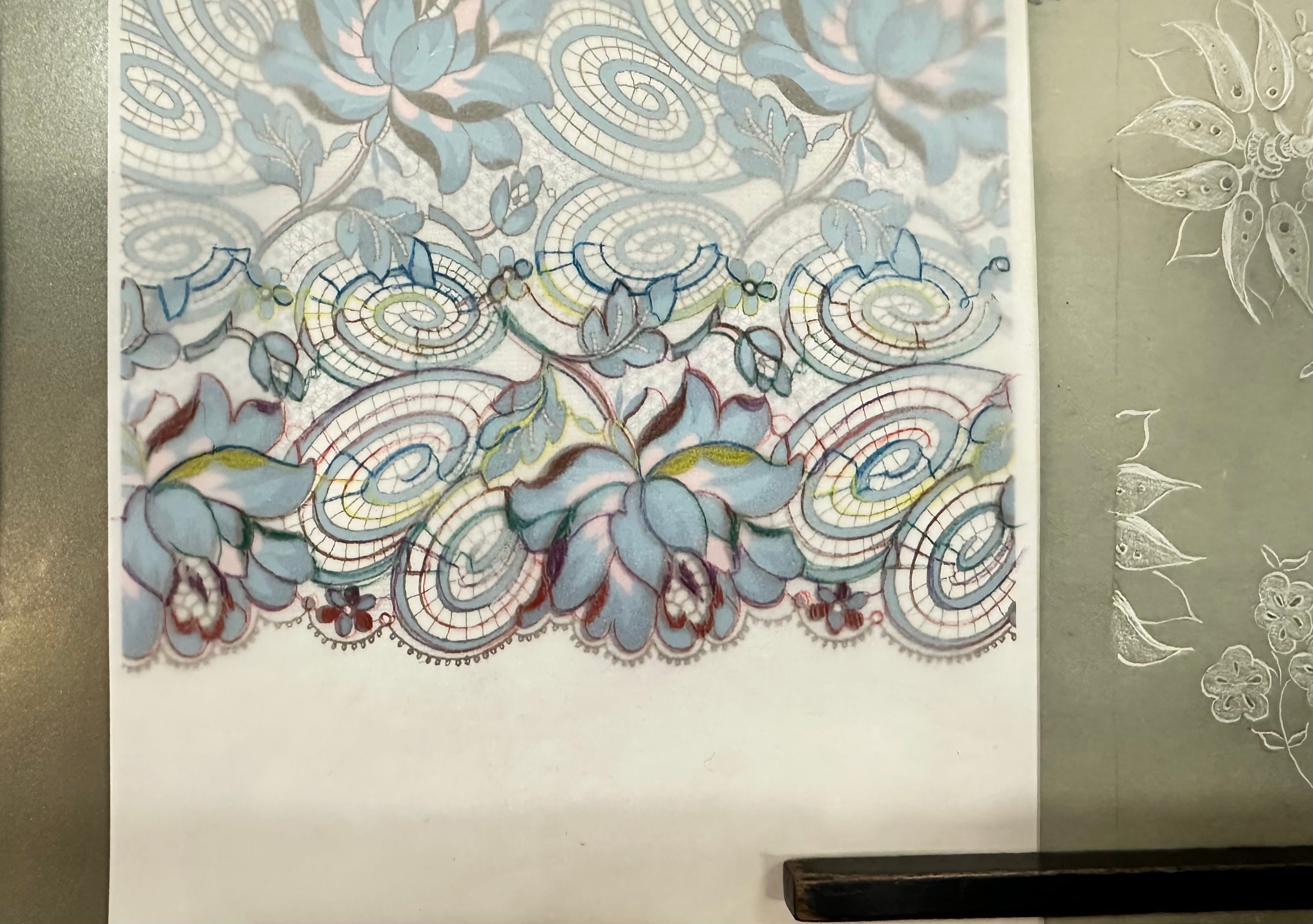
Photo: author
Drafting:
The esquisseur uses a pantograph to convert an enlarged form of the artistic design onto paper. They modify the design using their artistic ability and knowledge of the thousands of warp and beam threads. This is a highly skilled role, and it can take a decade to develop competency.
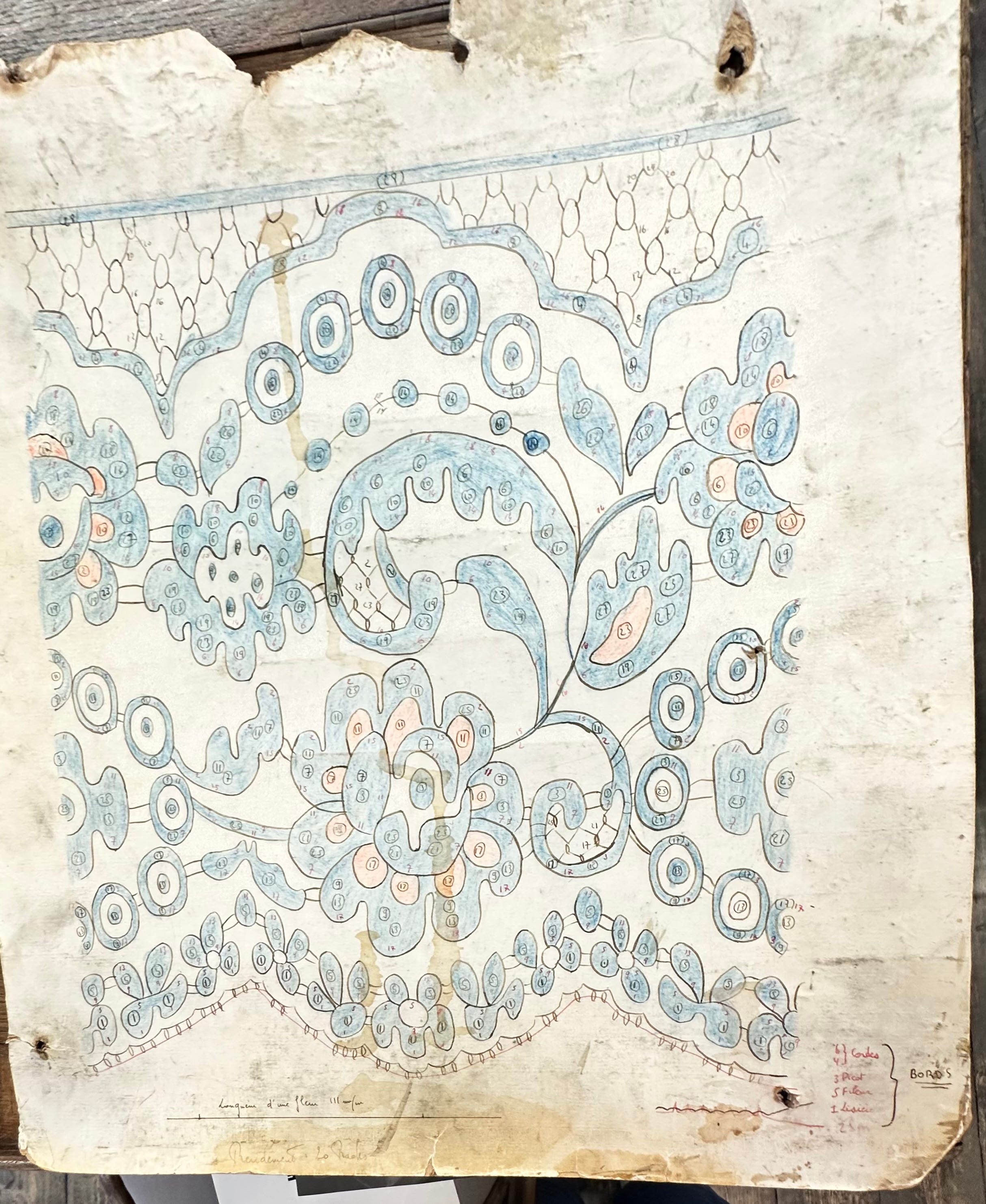
Photo: author
The esquisseur now numbers and colours the sketch to record the movements of every machine part and every yarn thread.
Reading Off:
The esquisseur’s sketch is “read-off” onto a sheet of squared paper. A simplified design is drawn on the paper. Then the pointeur (pattern perforator) perforates and numbers the squared paper, which specifies every thread location and colour. The numbers are tabulated to aid the perçeur.
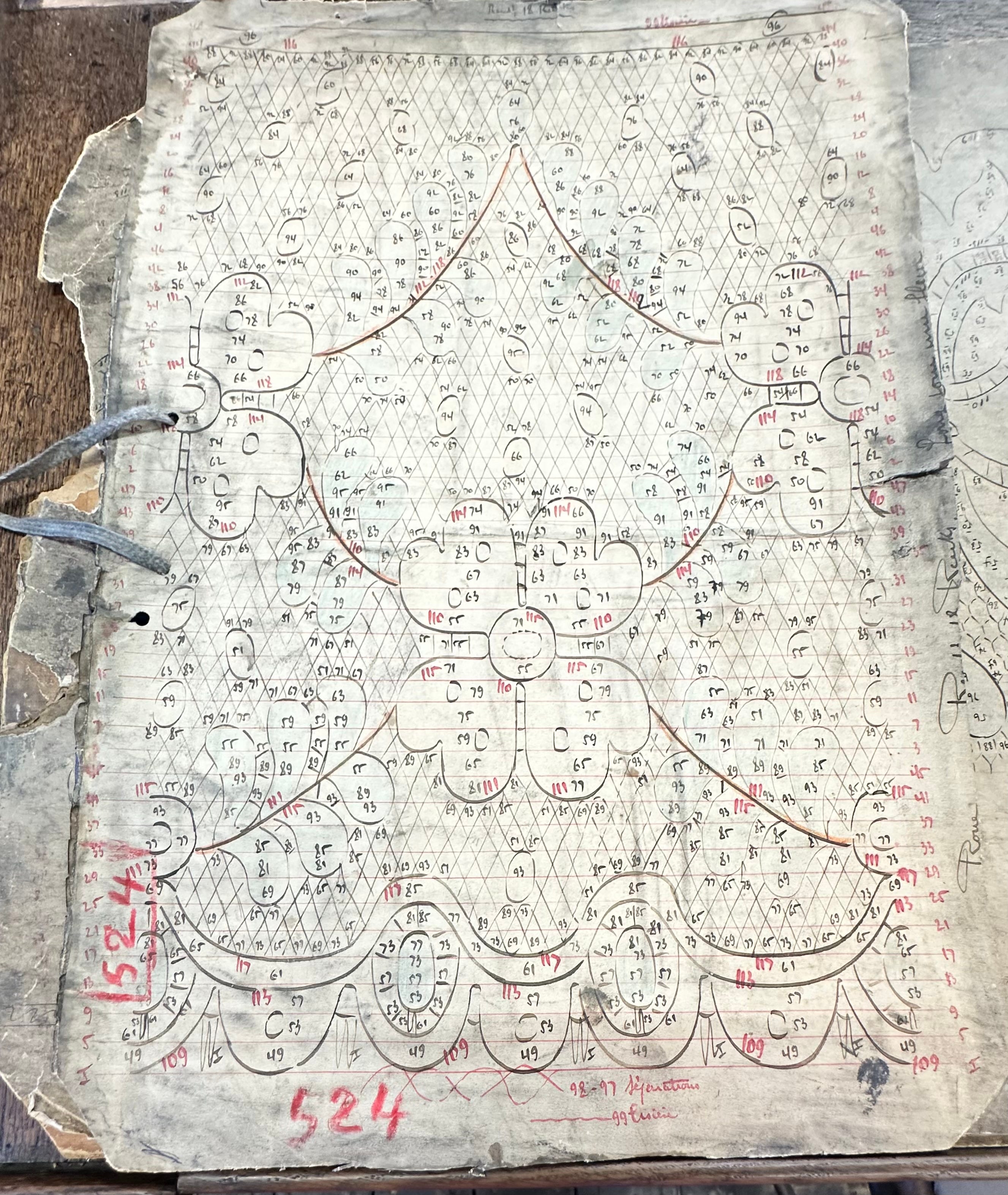
Photo: author
Punching:
The perçeur (card puncher), following the numbered tables, uses a guillotine machine to perforate holes in cardboard cards, according to the scale, sized to fit the Jacquard cylinder.
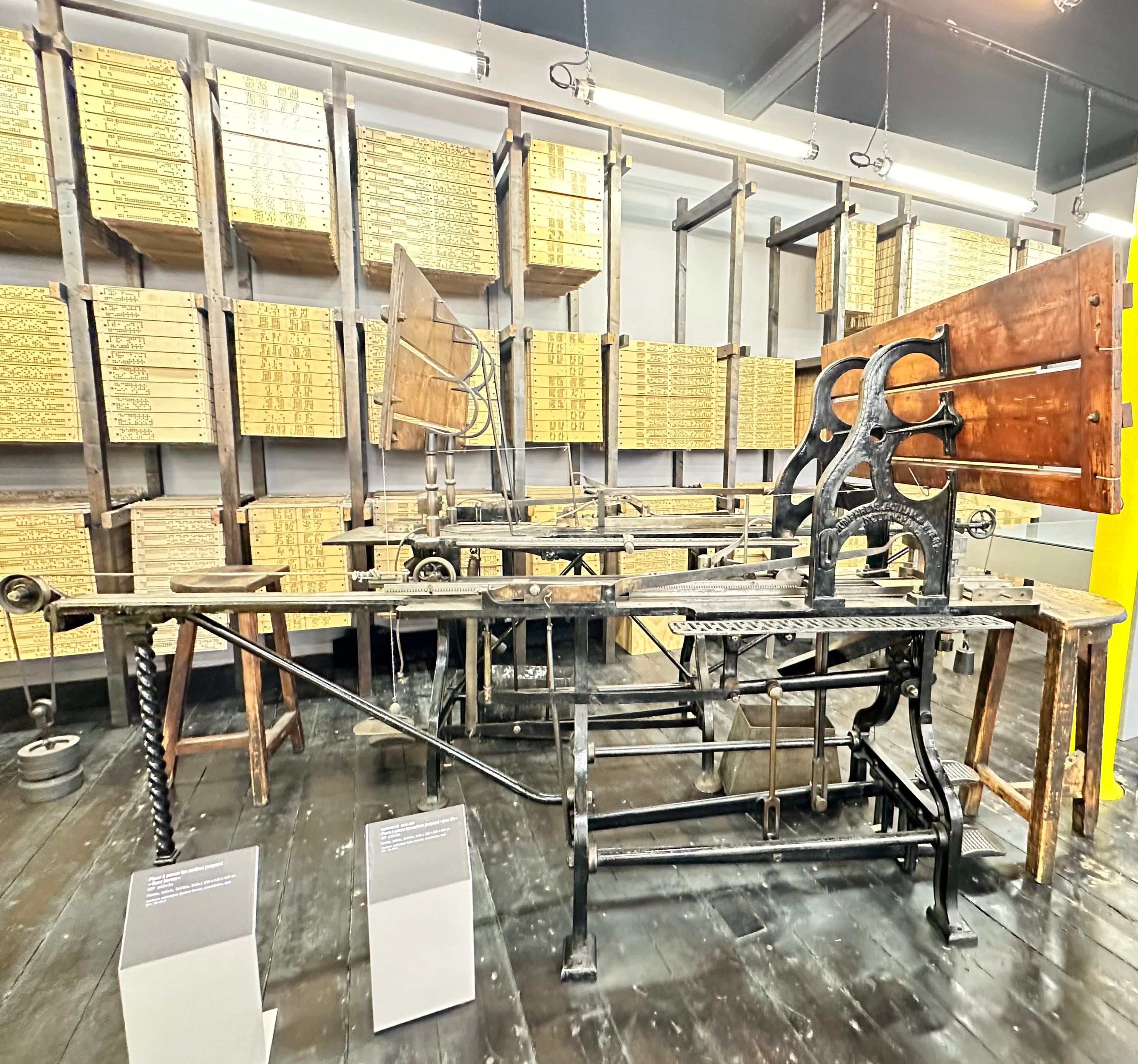
Photo: author, Piano for perforating jacquard cards
On the card-punching machine, he attaches his scale and a Jacquard control card and follows the reading from right to left. The holes are punched with both hands.
The hole pattern dictates the movement of the Jacquard droppers and blades, which thereby control the movement of every bobbin as they twist around the warp threads.
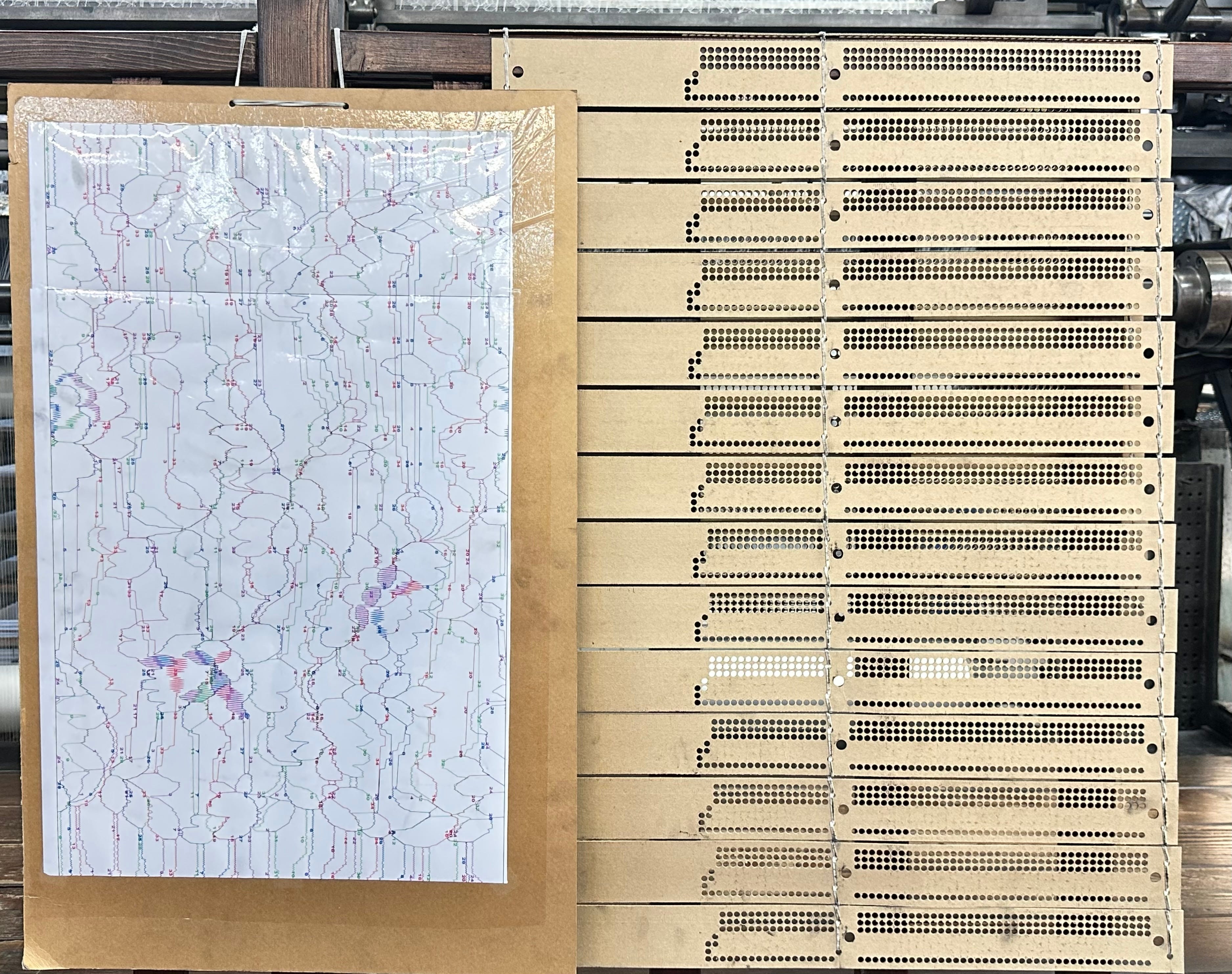
Photo: author
Correcting:
The punched cards are checked, and any errors corrected by plugging with glue and punched again with a hand spike, before the Jacquard cards are given to the lacer.
Lacing:
The laçeur (lacer) first divides the punched Jacquard cards into two packs - even and odd numbered cards. Then he ties each pack of Jacquard cards together, using an upholstery needle to lace up the bundle so it holds firm.
The odd-numbered pack will go to one cylinder, the even-numbered pack to the second cylinder.
Stage 1b: Yarn Preparation involving the Bobbins, Drums and Beams:
At the same time that the Leavers lace design and Jacquard punched cards are being constructed, the bobbins, drums and beams that will be involved in producing lace from the yarns are being prepared.
Spool winding involves selecting the correct threads and yarns and then winding the threads onto the spools and bobbins. There is a succession of specific techniques and actions. Some workers condition the threads and supply the Leavers machine, while others carry out the final mechanical adjustments.
The jacker off removes the thread from the bobbins, then gives them to the bobbin winder, who fills them in series before handing them to the bobbin presser. The latter makes sure they are all the same thickness, then takes them to the bobbin fitter, who puts them in the carriages. The beam builder puts each of the 15,000 roller and beam threads in the Leavers machine while the tullist places the set of 5,000 bobbins inside the loom.
Wheelage:
The wheeleur/wheeleuse or bobbin winder fills the bobbins with threads so that they are ready for the bobbin net machine. Each bobbin is a metallic disc containing holes in a concentric circular pattern.
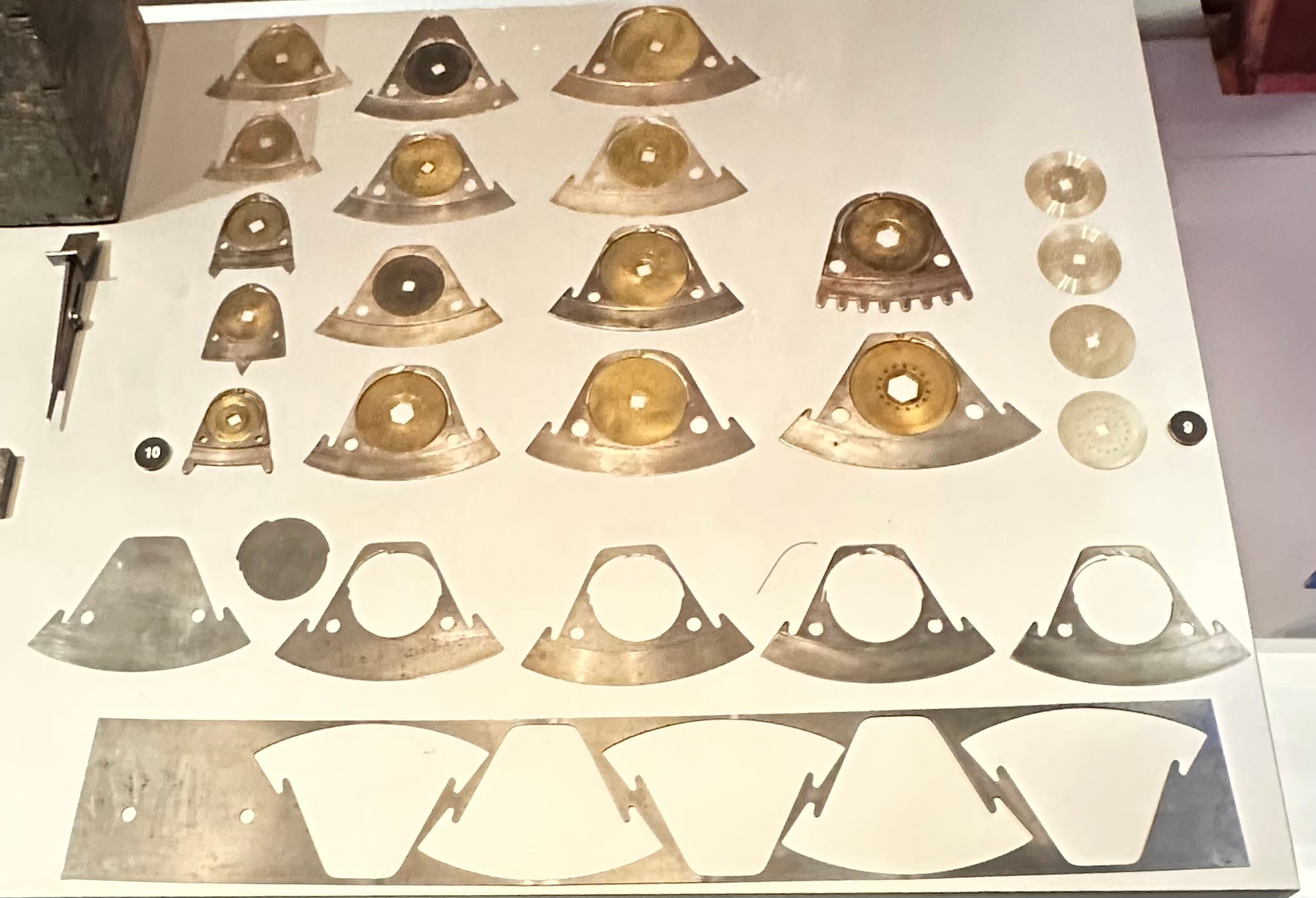
Photo: author, Bobbins and Carriages
Each bobbin sits in a carriage. The wheeler opens the stack of bobbins with their nail and inserts the thread. The wheeler may have 100 threads to insert, producing a winding of 100 bobbins.
The bobbin winder winds one hundred metres of thread onto the bobbins. They work on a table with their nail (metal shaft) and scissors. They hold the drum firm with their leg, take the bundle of bobbins that they put on the drive shaft, position each thread in the groove of the bobbins and control the filling with a serrated wheel.
For one set of the machine, there are 47 windings of 100 bobbins. So that makes 4,700 for a single set. All the threads are aligned one after the other - you can’t have them overlapping. Precision is necessary here to avoid errors in the produced Leavers Lace.
Pressing and Heating
Once the bobbin winder has wound a set of bobbins, the presseur de bobines (the bobbin presser) will flatten the threaded bobbins in a special machine, using a 200 - 250 kg weight. The bobbins are pressed into a thin uniform thickness. Then the presser heats the bobbins in a furnace oven at 100 degrees Celsius for 15 to 30 minutes.
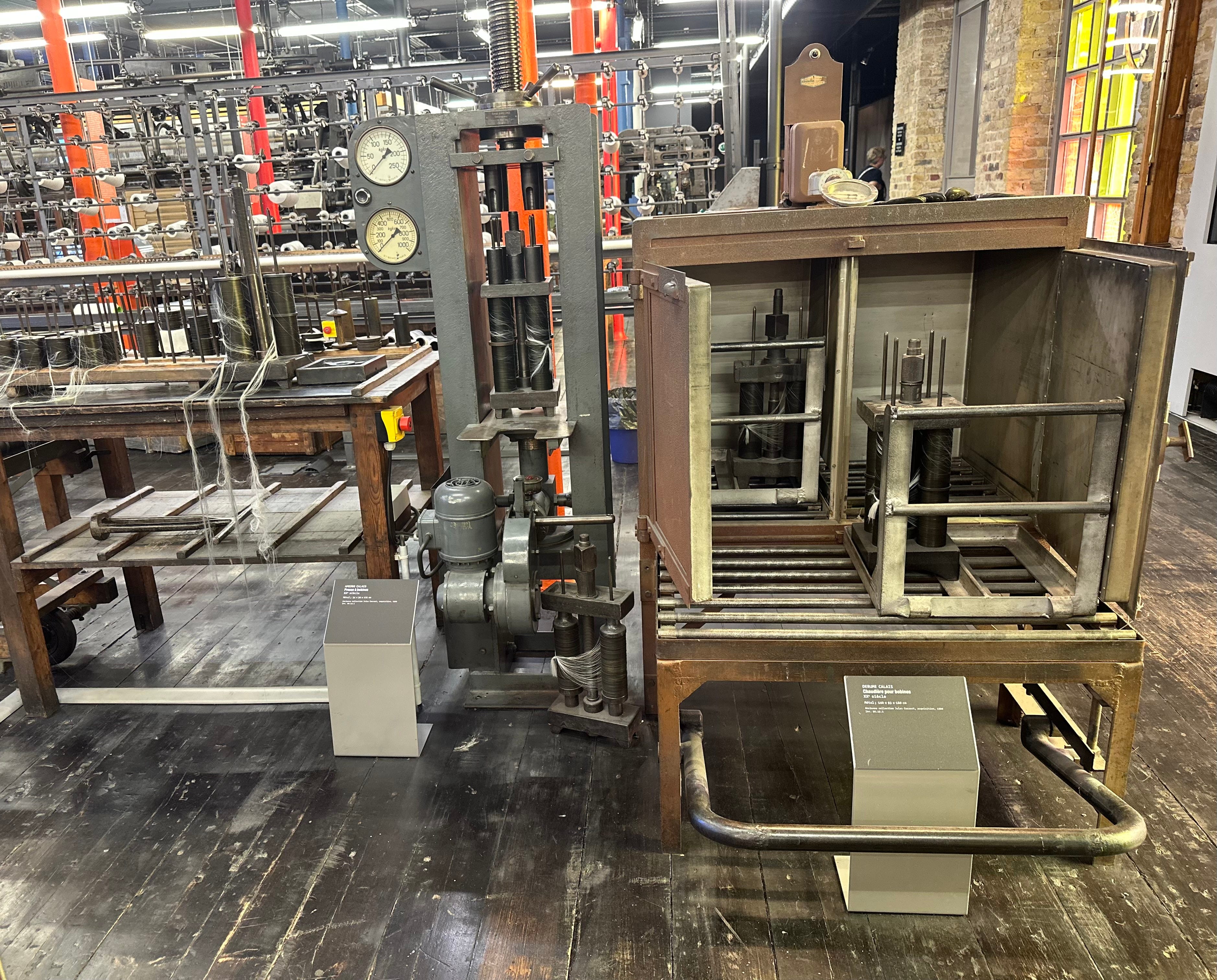
Photo: author
Once heated, the presser leaves the threaded bobbins to cool.
Next, the prepared threaded filled bobbins in their carriages are placed in the Leaver machine, one carriage to each space in the comb bar. The comb bars run the entire length of the machine and face each other, one at the front and the other at the back of the threads. The comb bars will ensure that the bobbins move in a uniform motion.
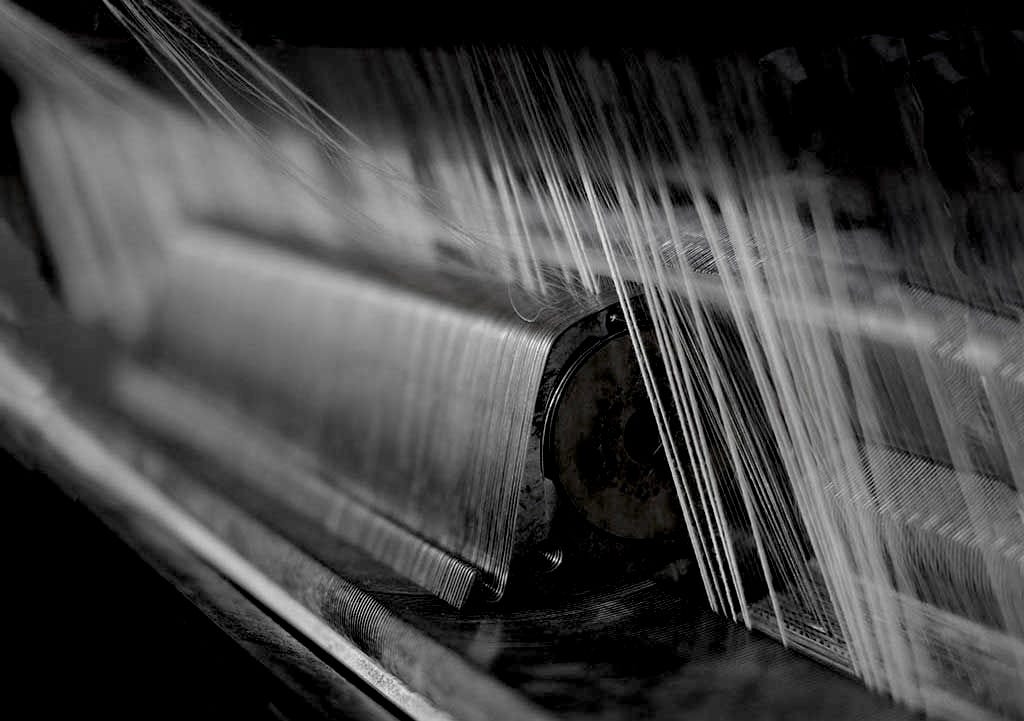
Photo: author, assembled bobbins in their carriages, carefully positioned in the Comb
Remontage:
Throughout the day’s production, as the carriages move back and forth in the Leavers machine, the bobbins are gradually emptied of thread.
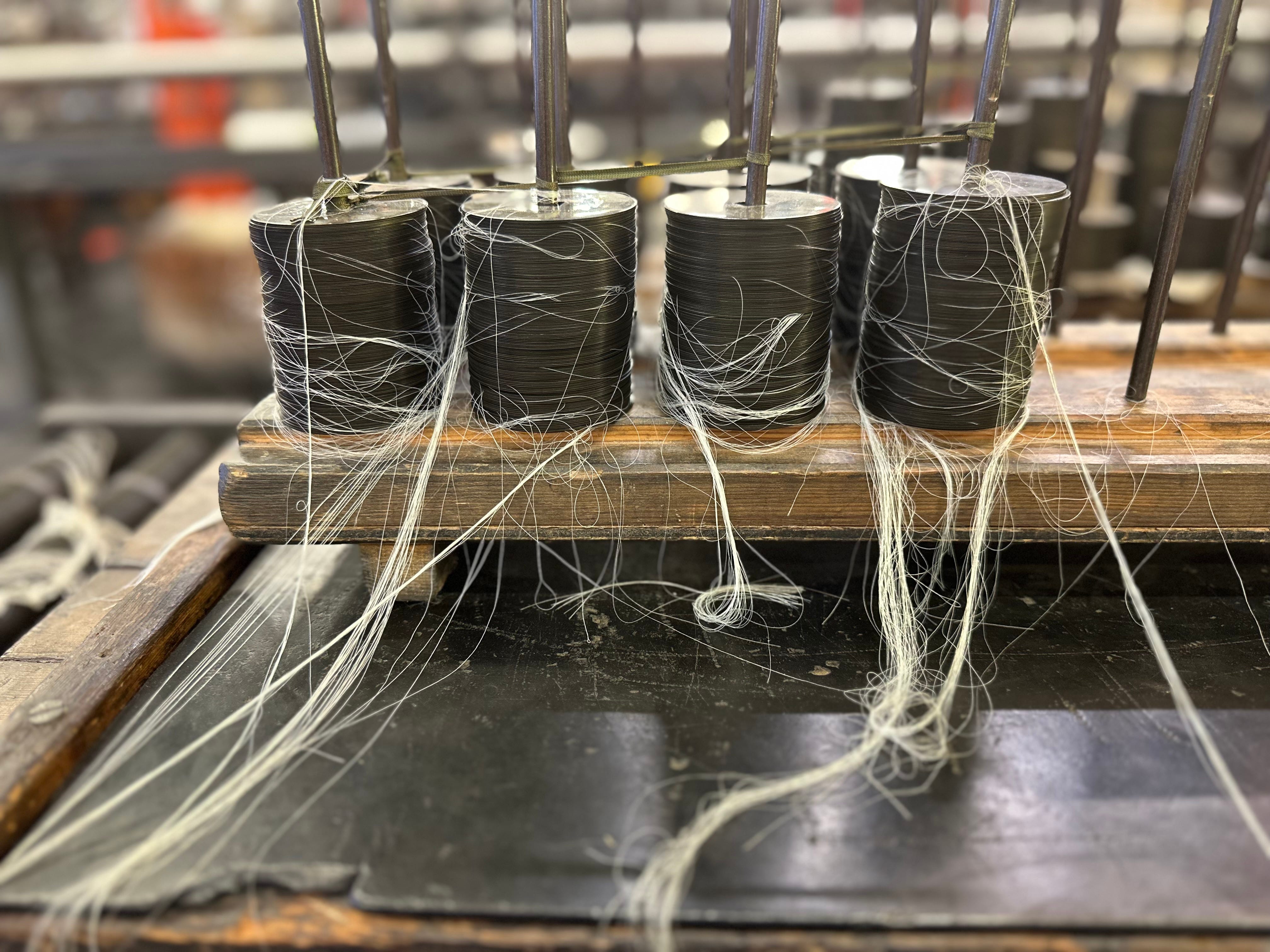
Photo: author
The bobbins are continually loaded and refitted in their carriages. The bobbin is threaded by inserting it in its carriage; the spring on the bobbin is set, and the end is threaded using the hook on the bobbin block.
Once the bobbin is threaded with another 100 m of thread, it goes back to the frame. The frame is kept supplied with carriages and inserted bobbins. On a frame that produces four racks of lace per hour, it takes approximately 15 hours to empty a full set of bobbins, but it depends on the complexity of the lace design.
Wappage:
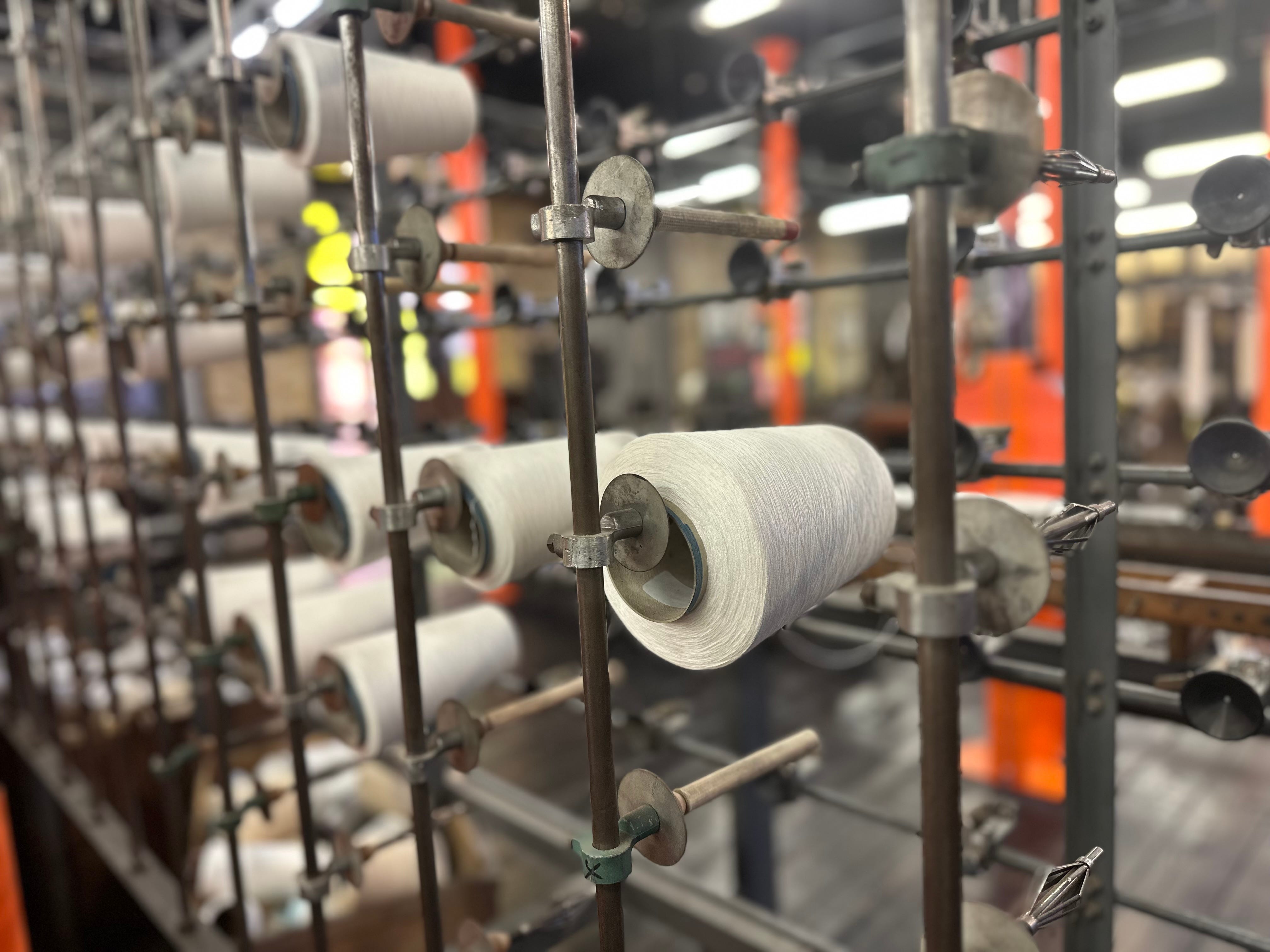
Photo: author
It’s the wapeur/wappeur’s (the beamer's) job to fill the warp beams by winding the warp threads from a creel of spools or cones onto long metal rollers (the warp beams) fitted across the width of the machine.
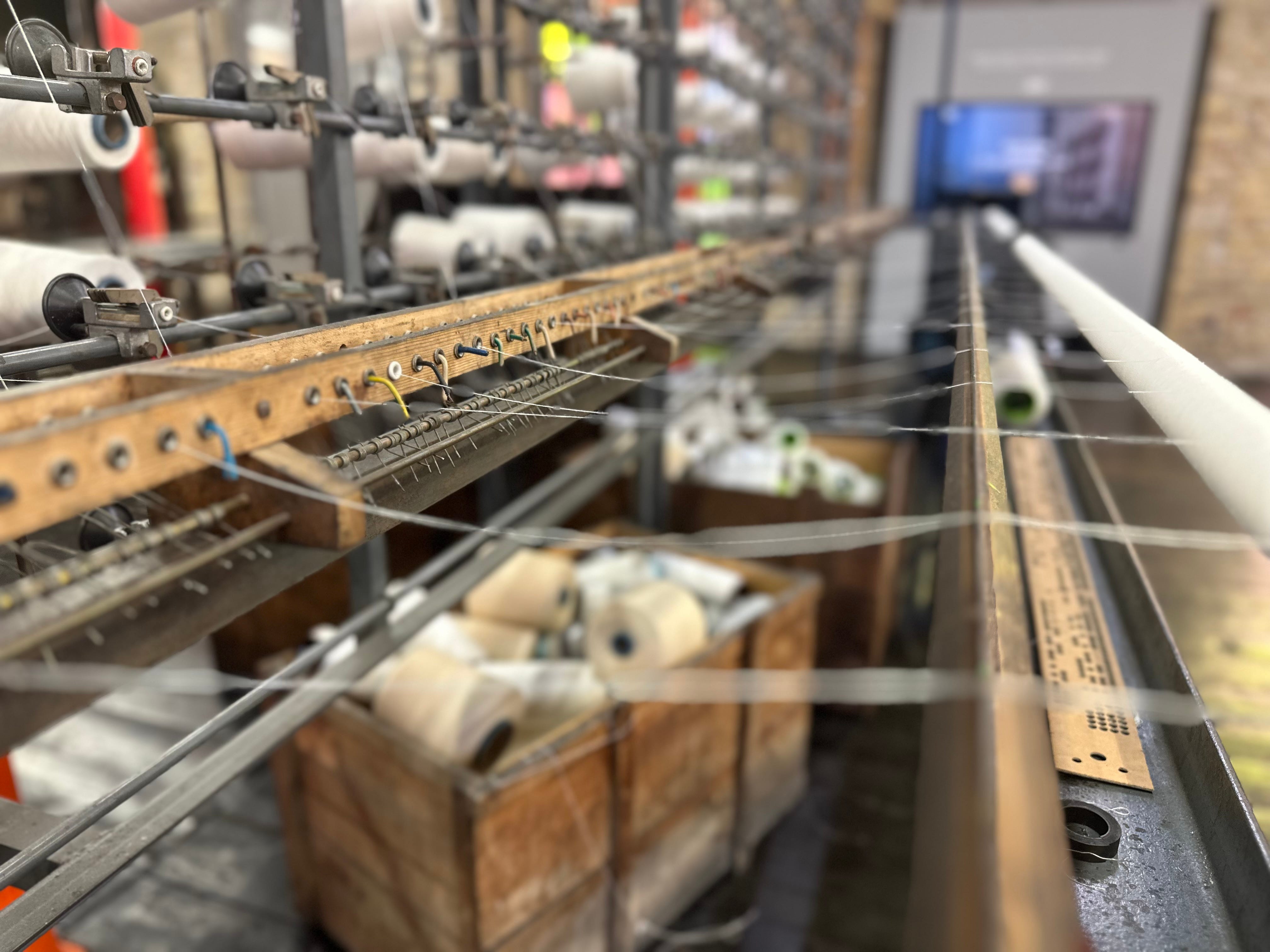
Photo: author
These threads become the vertical warp threads of the fabric, which are fed into the Leavers machine.
The number of beams depends on the lace pattern and the width chosen by the esquisseur (draughtsperson).
The number of threads corresponds to the frame’s production width and how fine the net tulle needs to be.
The threads go through the tension unit. Then bars are added to even out the tension. This is necessary to avoid defects and maintain quality.
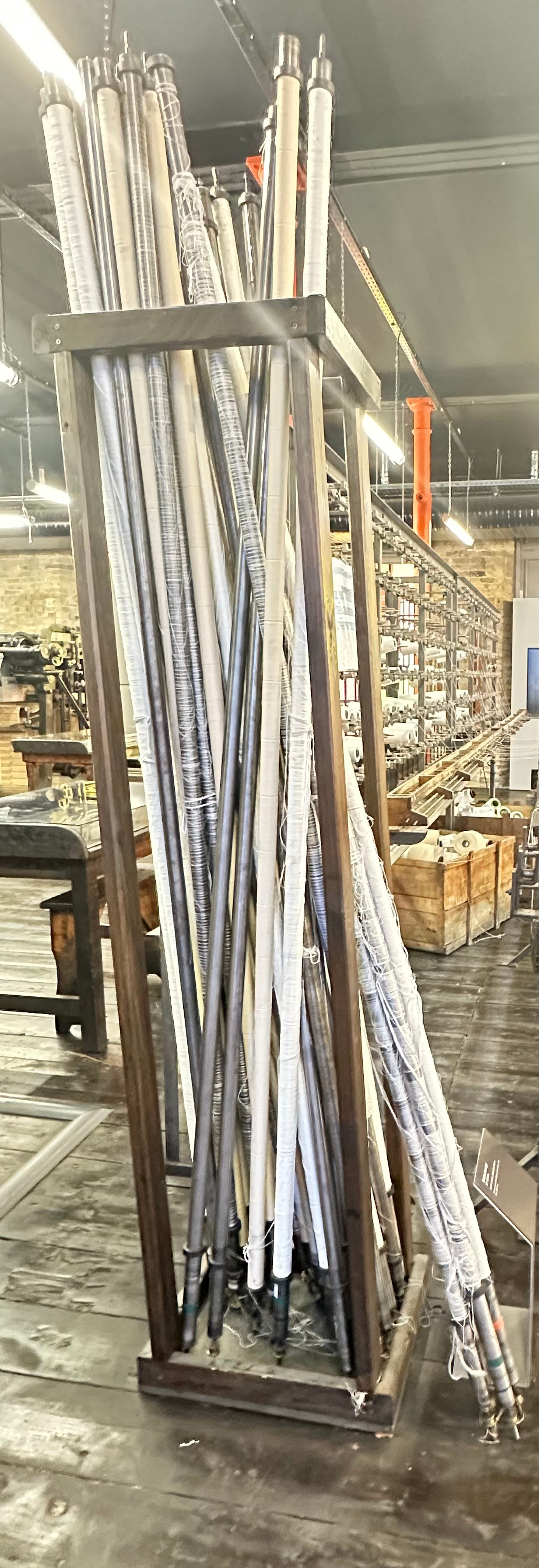
Photo: author, Warp bars wound with thread under tension, ready for the Leavers Machine.
Montage des Fils:
The Chainer positions the warp beams, consisting of wound threads under tension on long metal rollers, underneath the Leavers Machine frame.
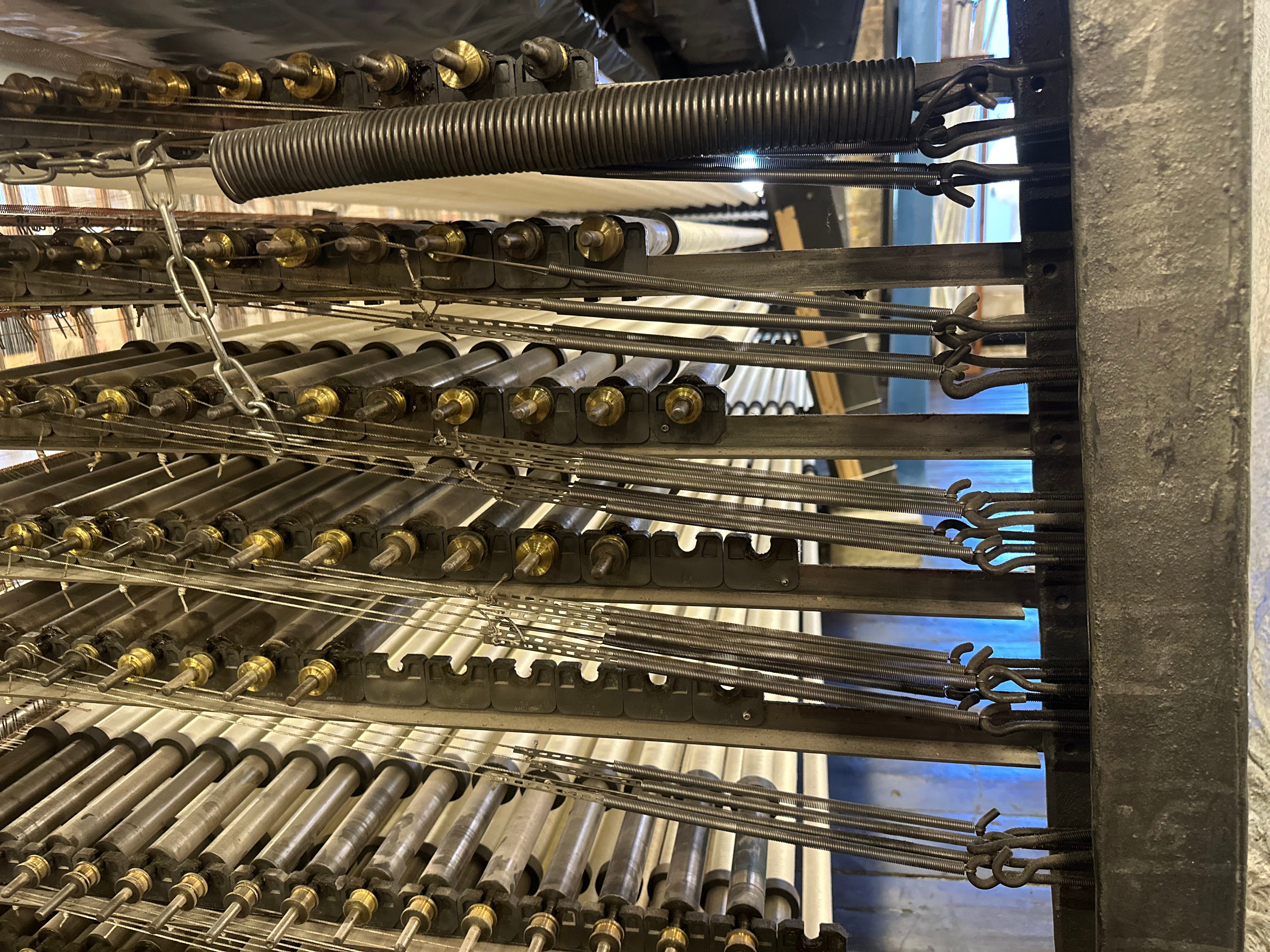
Photo: author
When a design changes, a beam has to be added, putting it in the rack at the back of the frame.
The threads are positioned by passing them up by hand and firstly threading them through a stainless steel horizontal plate with guide holes (called a sley) and then to another set of holes in an individual bar, and are finally tied off at the top roller.
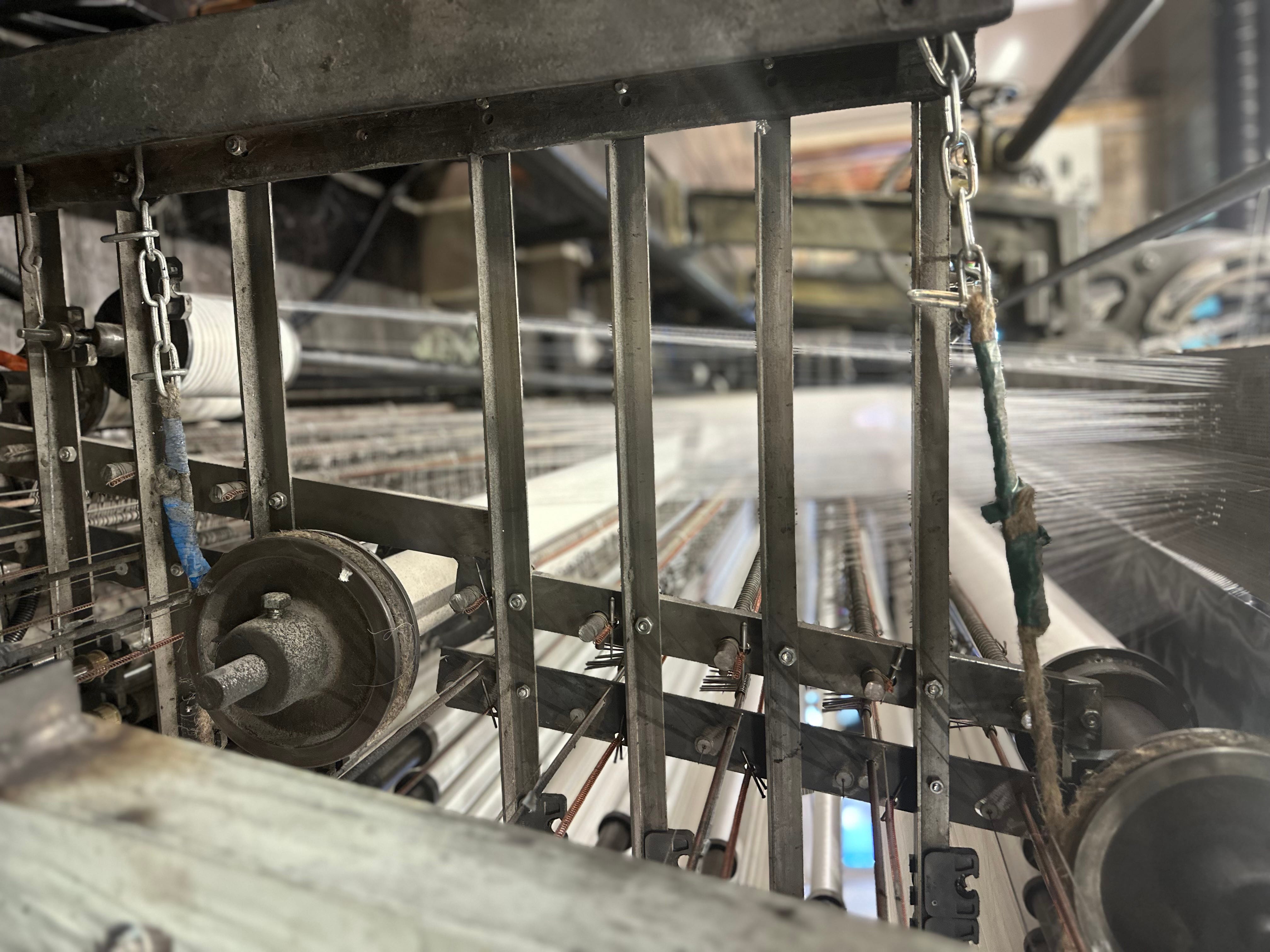
Photo: author
Stage 2 Leavers Machine operation
Four different types of yarn threads with different functions are used in Leavers Lace production:
Warp Threads - which work vertically.
Beam (Weft) Threads - which are always horizontal.
Gimp threads - which form the raised motif on top of the background transparent net tulle.
Liner threads - which separate the net from the motif. They outline the motifs.
The threads are pulled up by the motion of the machine. The threads twist together at the face of work. When the threads cross, the thread is caught by the other threads.
The vertical Warp threads and the horizontal Weft threads twisting together will form the background transparent net tulle.
The vertical warp threads are held parallel to each other and under tension. There are two sets of warp threads, right twist and left twist - one used for stability and the other used for twisting. An S-twist thread is on the front warp (right warp) and a Z- twist on the back warp (left warp, reverse warp). The reverse warp threads lock the front warp threads against the bobbin threads.
The bobbin and the carriage together act as the horizontal weft thread and are the cornerstone of the Leavers Machine.
The bobbins always follow the same oscillating path in the combs. The warp threads pass in front of or behind the bobbin threads, to the right or to the left according to the action of the Jacquard on the steel bars through which they are threaded.
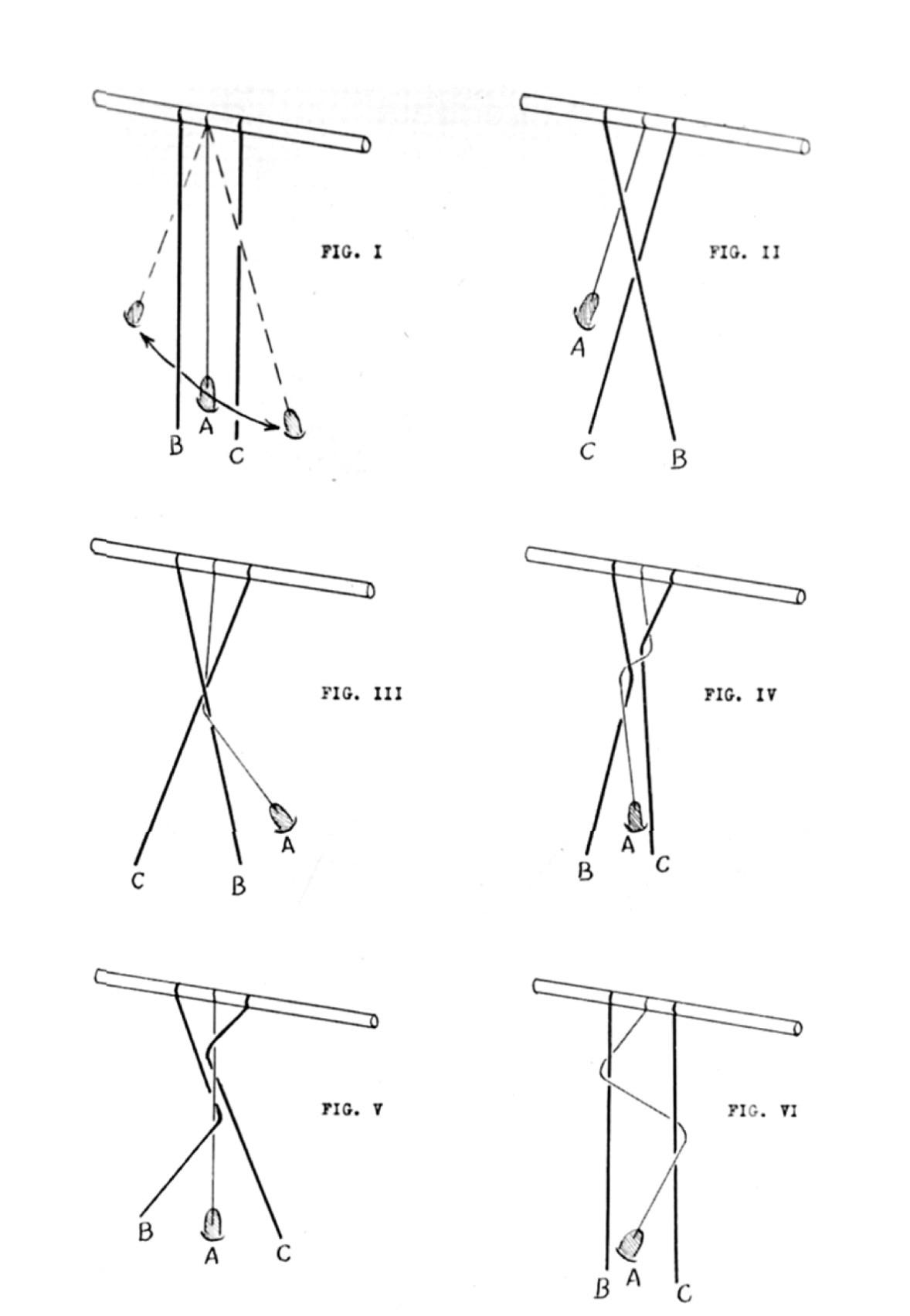
Diagram: University of Arizona
FIG. I From a rod a weight (A) representing the carriage and bobbin is suspended by a thread representing the bobbin thread. At equal distances on each side of this thread are two other threads (B&C) representing the warp threads.
If the weight “A” swings from and toward the observer and warp threads B & C remain stationary there will be no result.
FIG. II Warp Threads B & C are drawn to opposite sides while the bobbin thread A is behind them away from the observer.
FIG. III The bobbin thread A moves forward through the crossed warp threads B and C.
FIG. IV Warp threads B & C resume their original positions and a twisting action results.
FIG. V If the bobbin thread attached to weight “A” is under tension and the warp threads are loose (I.e. not under tension), then the warp threads B and C will twist around the bobbin threads.
FIG. VI If the warp threads B & C are under tension and the bobbin thread is loose, then the bobbin thread will twist around the warp threads.
This produces the delicate Leavers Lace hexagonal net tulle.
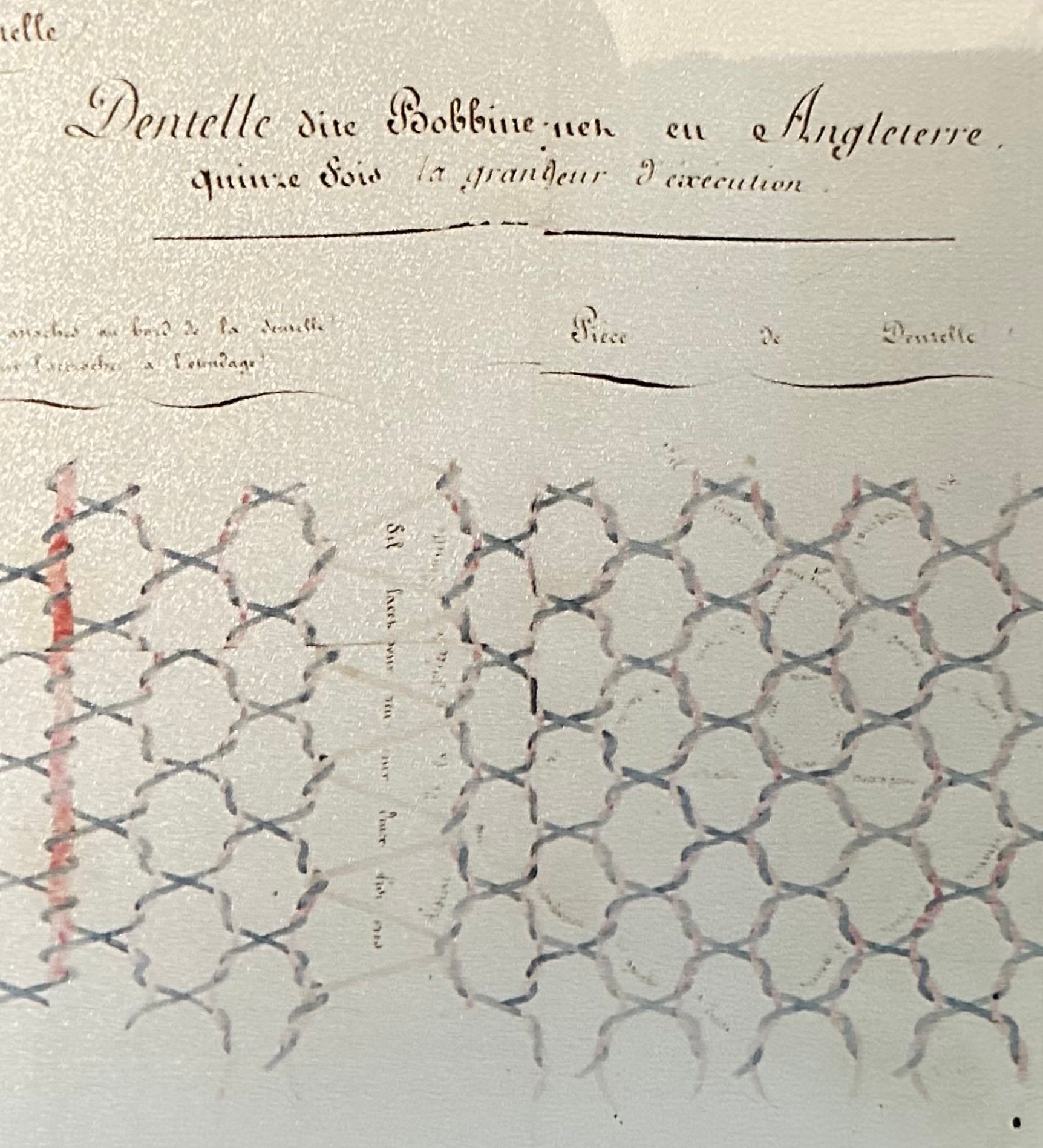
Photo: author
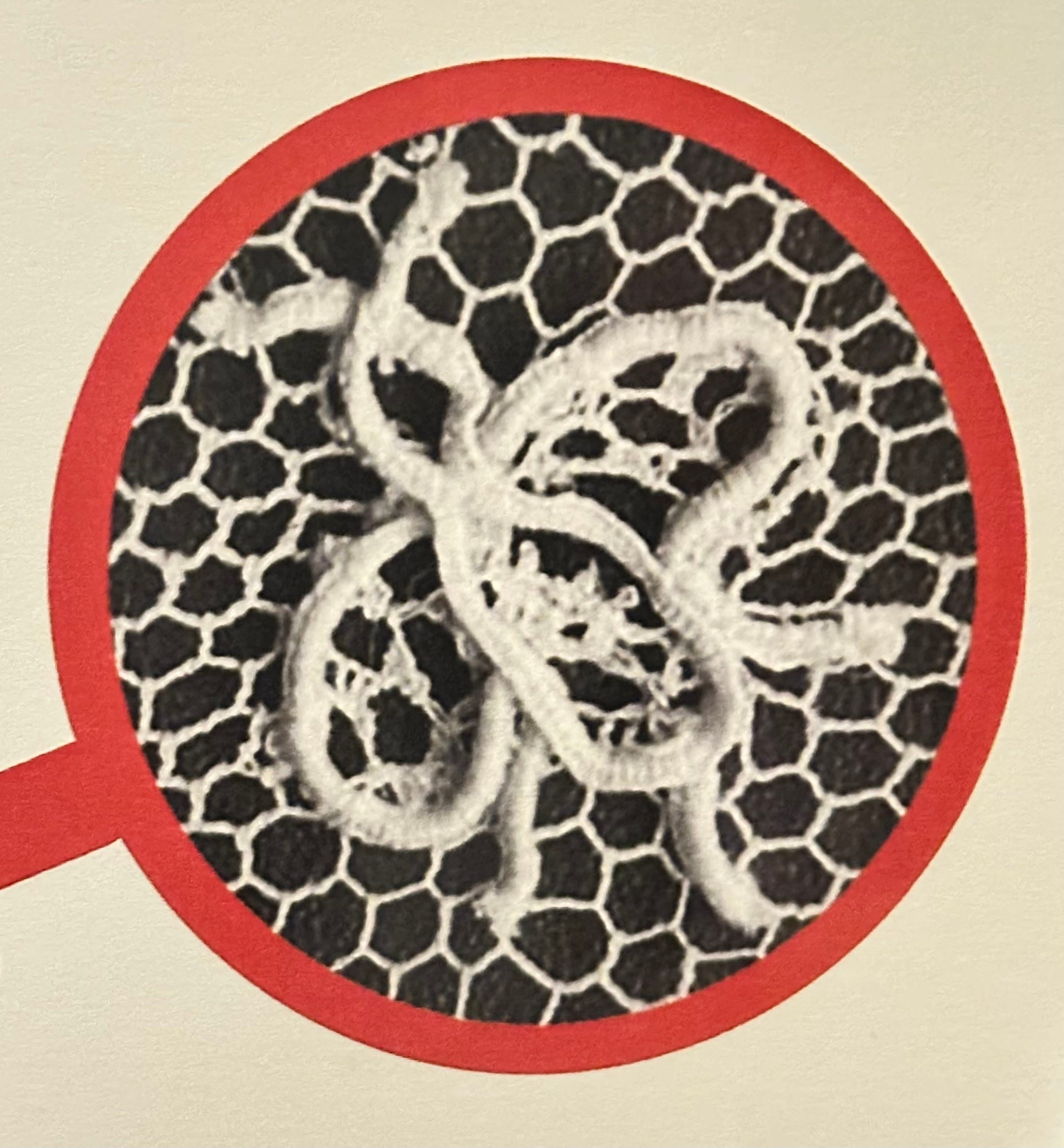
Photo: author, hexagonal shape of the fine Leavers Lace net tulle background, with a raised bee motif
I was beginning to form a clearer understanding of how the different threads were twisted and woven together to form the net tulle and the motifs.
But I was still confused by the machinery. How did it actually work?
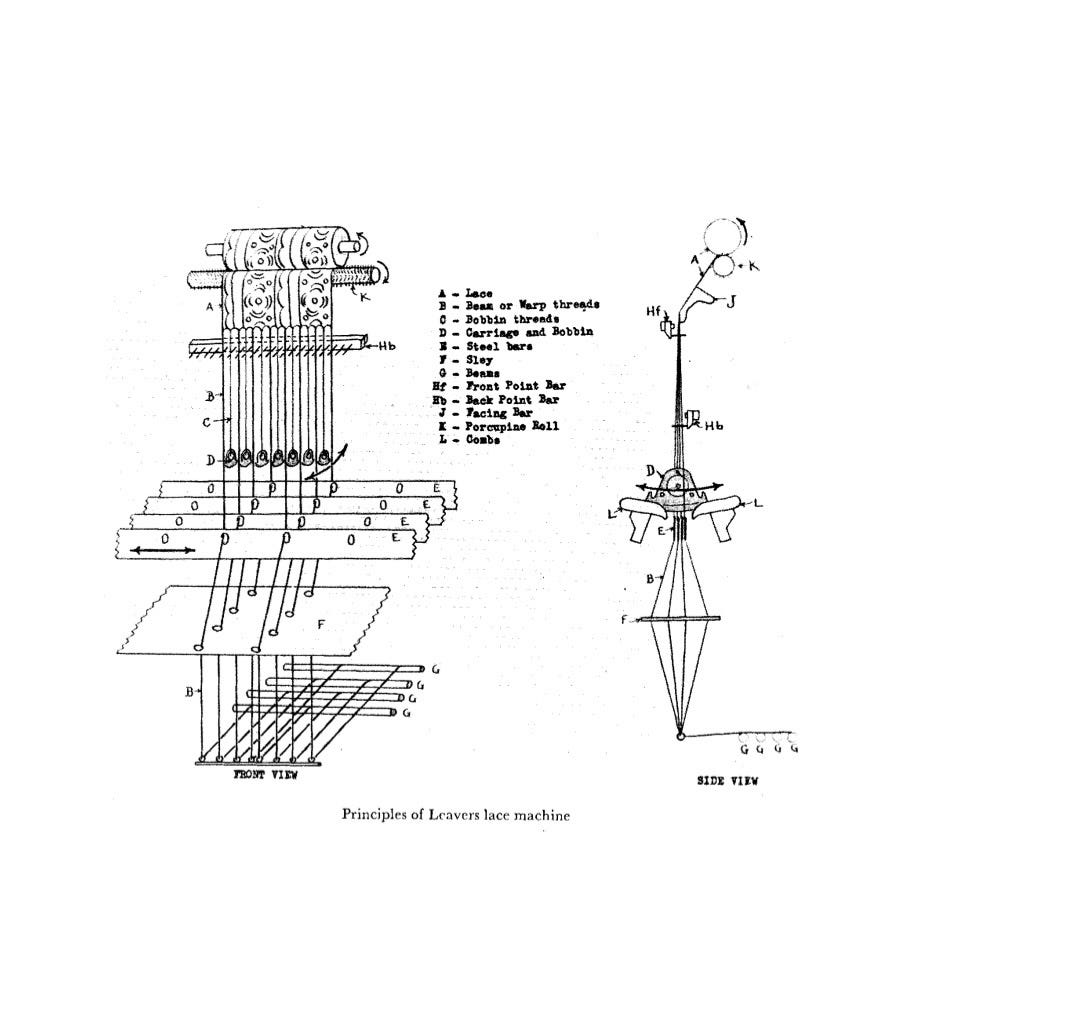
Diagram: University of Arizona
The diagram above, courtesy of the University of Arizona, really helped me to understand the mechanism in this complex process.
The bobbins (D) swing like pendulums, through the warp threads, always in the same path, being guided by the slots of the combs (L).
The steel bars (E), through which the warp ends are threaded, are controlled by the Jacquard mechanism and may move either to the right or to the left. The direction and distance the steel bars move is predetermined by the Jacquard punch pattern.
After the bobbin carriages (D), move from front to back, the steel bars move - some to the right, others to the left.
The back point bar (Hb) moves up and compresses the twists of the previous motion, to form another bit of lace fabric.
The Porcupine roll (K) turns enough to make room for this newly formed lace. The front point bar (Hf) moves down into position for the next motion.
Are you still with me? It took me a very long time to understand.
Here’s a video clip from my visit to the Cité de la Dentelle museum in Calais. Here you will find one of the experienced, highly skilled artisan master lacemakers explaining (in French) how the machine works. Even if your French is rudimentary like mine or you don’t understand French at all, the visuals and the sounds illustrate the mighty process involved in Leavers Lace creation.
Video: author, 3 minutes
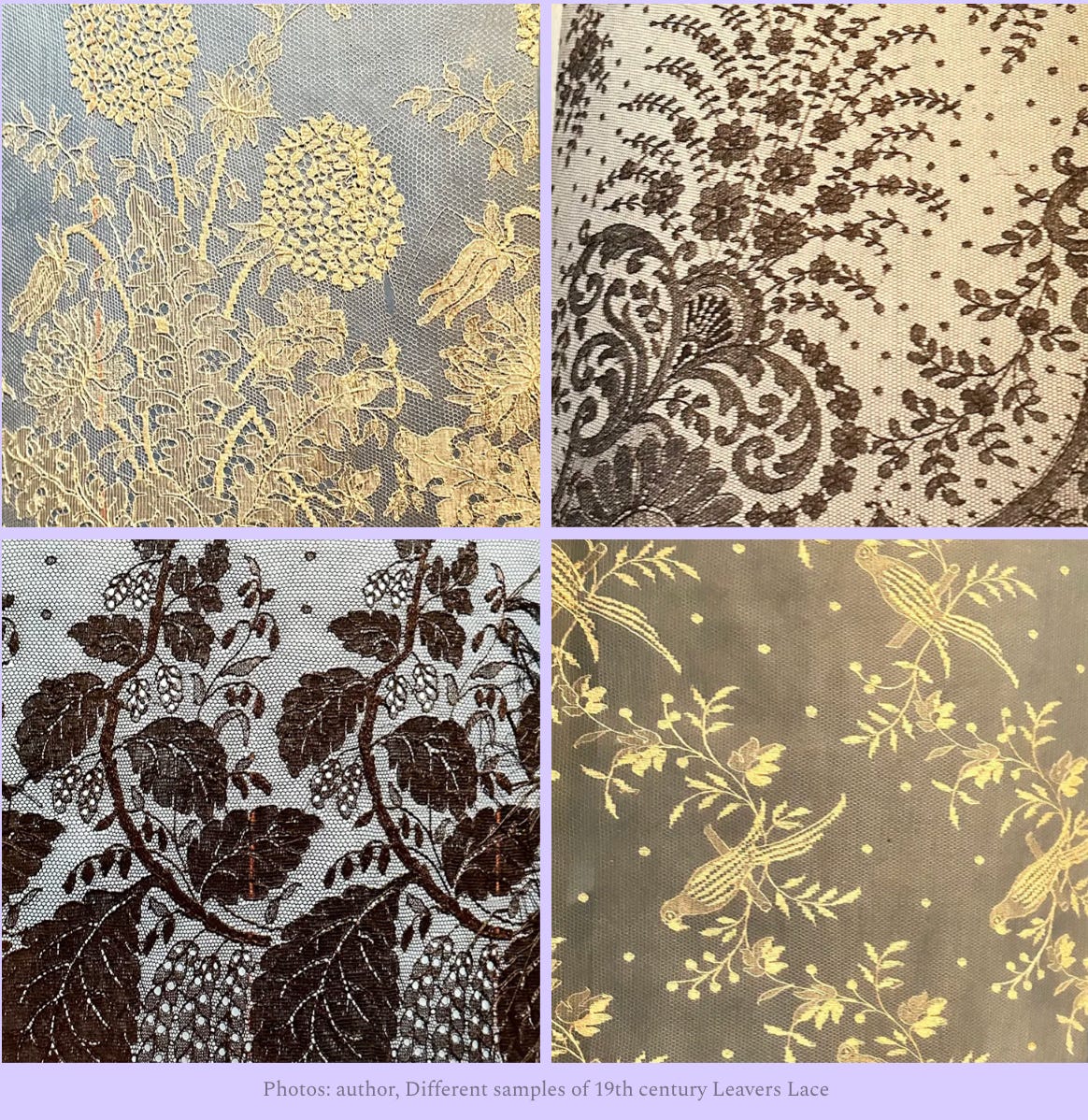
The resultant delicate Leavers lace produced is described as “lace in the brown”.
Stage 3 Finishing:
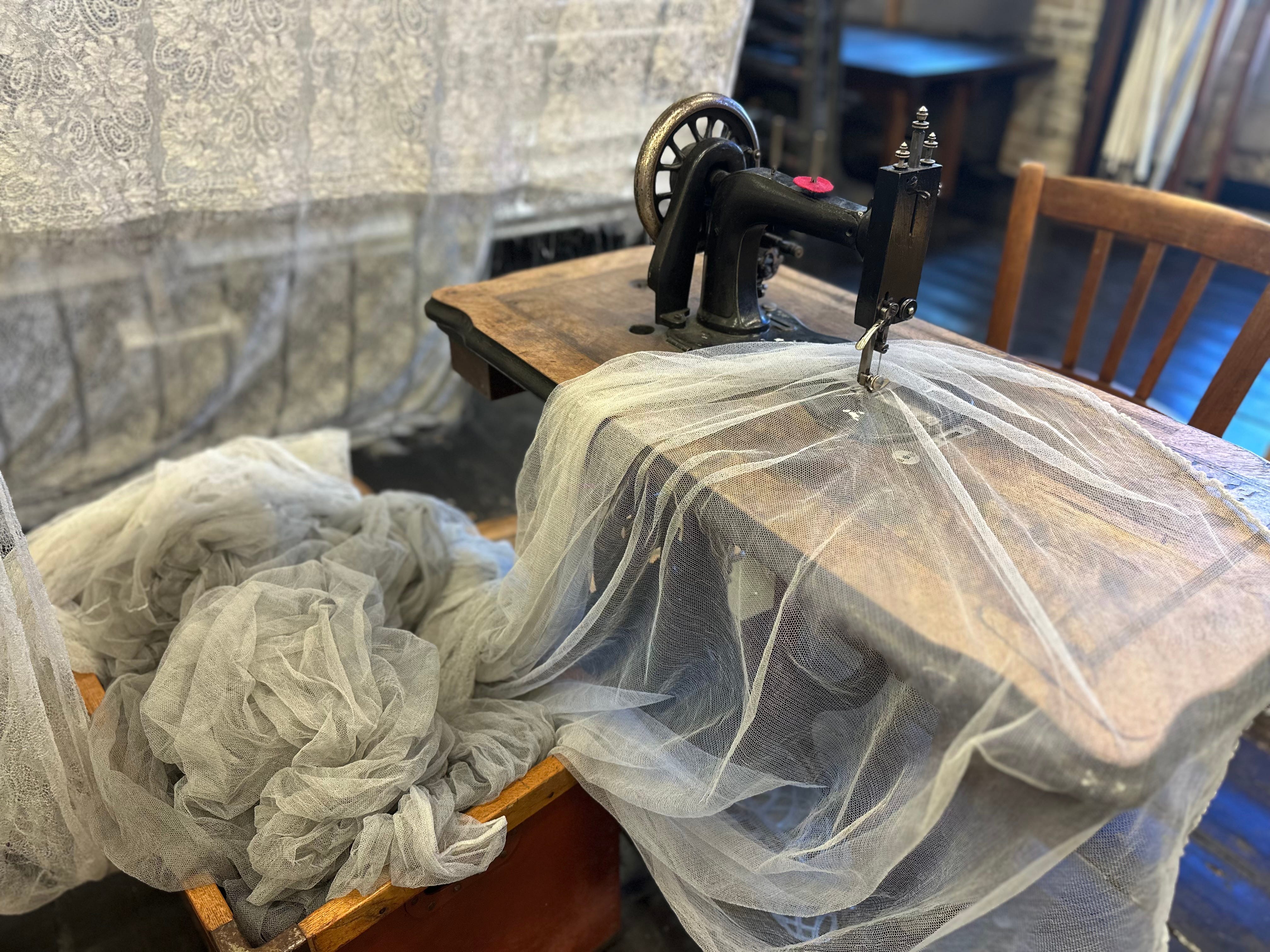
Photo: author, The mender repairs any snags found on the lace. Defects are repaired with a needle for dresses or on a sewing machine for braids. Generally, it is a question of errors in the adjustment of punch-cards, thread passage or broken threads.
Due to the intensive mechanisation of the Leavers machine process, the lace at this stage may be soiled and needs to be:
mended
washed
dyed
dressed
embroidered
scalloped
sampled for quality control
before the finished Leavers lace is wrapped and packed, ready to be shipped off to haute couture designers in Paris, Milan, New York, London and further afield.
Reflections:
What a history. What a complex technology. The genius of John Levers’ engineering and design. What sustainability - the 100 - 150 year old Leavers machines are still working today. What a beautiful luxury textile.
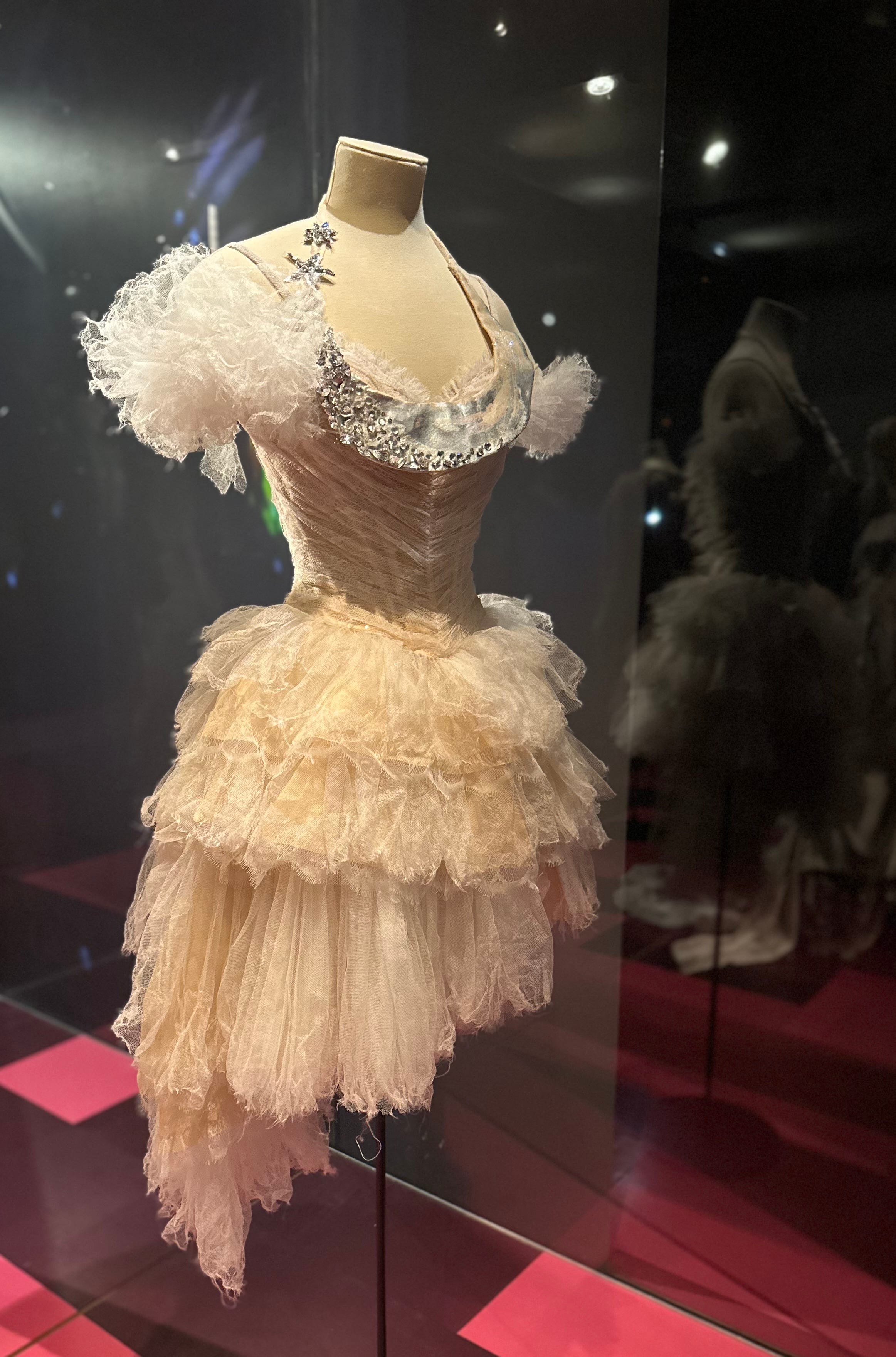
Photo: author, BALENCIAGA (directeur artistique : Nicolas Ghesquière), Evening dress, 2011-2012, Leavers Lace (Sophie Hallette, Caudry), Embroidered Tulle (Bischoff), Silk mousseline.
And remember, 90% of the world’s woven lace is produced in just six factories in Calais and Caudry in Northern France, on centuries-old Leavers Lace looms, by less than 4000 highly trained and skilled artisan master lacemakers.
This is a French artisan industry, culture and history that deserves to be supported, preserved and protected.
Wandering through the museum, observing the displays of Leavers Lace and fashion through time was pleasurable, decadent and inspiring…sigh, a girl can dream, right?
YouTube, Madonna, Like a Virgin, 1984.
This “girl”, alas, will forever be lost in the 1980s music of that time. Lace tops (probably made from synthetic fibres as opposed to silk, linen, cotton or wool due to a student budget), messy curled (permed) hair tied loosely up and back with more lace, dangly diamanté earrings, maybe a splash of psychedelic colour, (more lace) black stockings, big buckled belt on the hips.
Fun times.
à bientôt
Caroline
Introducing Contributor, Caroline McCormick-Clarke
Immerse yourself in all of Caroline’s articles on her Contributor page.
I was introduced to lace-making in Le-Puy-en-Velay, and just got back from another town known for the craft. I don't think I'll ever write about it, though, because you have written the definitive piece on French lace-making! Or else I'll use it as a reference and footnote you!
An excellent piece, Caroline! You set the bar high!
Judy