

In France, yesterday’s scraps are today’s dinner — and, increasingly, tomorrow’s legislation.
TL;DR
France has long turned scraps into menu staples — bouillabaisse, cassoulet, pot-au-feu — and since 2016, supermarkets are banned from wasting food, to mixed effect. anti-gaspi apps like Too Good To Go, Nous anti-gaspi shops, and socialist events like Disco Soupe. La Chanson des Restos — France’s cheesy 80s We Are the World moment — still funds millions of meals. Want in? Download the apps, check the ding-and-dent shelf at the supermarket, or start with the simple pot-au-feu recipe below.
[ed note: Unless you’re here for a philosophical moment and a reflection on food waste, just skip to the recipe and the video.]
Philosophical moment:
Food waste isn’t just about saving money or feeling virtuous — it’s about respect for the process of production. Every carrot, bit of bread, every scrap in the pot means there is time, labor, and land behind it. To waste food is to ignore that. Stretching a meal, sharing leftovers, or rescuing a bag of bakery bread isn’t just thrift, it’s respect for the process.
Of course, it also saves money, but anyone who’s grown a vegetable could tell you how much goes into it.
anti-gaspi (French, adj./noun)
(adj.) Short for anti-gaspillage (“anti-waste”); used to describe practices, products, or laws to reduce food waste.
Ex. Un rayon anti-gaspi – a supermarket section offering discounted items close to expiry or imperfect in appearance.
Thrift
From pot-au-feu simmered for days (and just left out all week before refrigeration) to the 2016 Loi Garot, which bans supermarkets from throwing away edible food, the French have a long habit of economizing food.
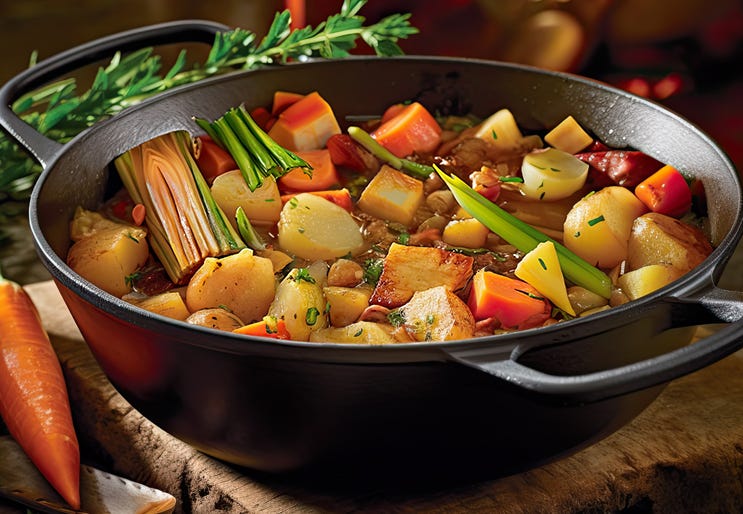
French cooking classics stretch the humble & imperfect into quality. Fishermen’s scraps became bouillabaisse in Marseille. Sunday roasts return as hachis Parmentier, a potato-and-meat bake named for France’s most famous potato evangelist.
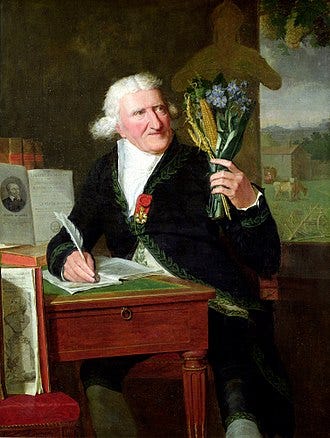
In the southwest, beans, bones, and sausage scraps became cassoulet. Provençal ratatouille started life as a way to save overripe garden vegetables from the compost pile.
A dish by many other names
Pot-au-feu has cousins around the world: in Korea, seolleongtang is a pale beef bone soup, served mild and seasoned at the table, while sancocho stretches meat and root vegetables into a communal broth. Different flavors, same spirit — nothing wasted, everything shared. People have been surviving like that for centuries.
Kitchen habits to national law
The 2016 Loi Garot banned supermarkets from throwing away edible food, forcing them to donate instead. The rules later expanded to caterers and the food industry, intending to cut waste in half by 2025.
They didn’t make the deadline.
France is moving in the right direction; it has teeth on paper, but progress is slower than promised. Retail has seen some wins, but 50% will take more than supermarkets — it needs tougher enforcement and real shifts in households, producers, and processors too.
[ed note: “teeth on paper” is a really weird phrase. I’m keeping it.]
In the U.S., about 30–40% of the food supply is wasted every year — roughly 60 million tons, a number that hasn’t budged since 2010.
In France, food waste hit 10 million tons in 2016, costing €16 billion just to throw it out. There’s a reason composting bins are popping up all over the city I live in. After the Loi Garot banned supermarkets from tossing edible food, waste dropped 10% by 2020 — real, but slow.
Food waste is a bad deal on every front: it hurts people who go hungry, it wastes money, and it damages the planet. But the future we want isn’t going to arrive in one sweeping reform — it’s going to come from small, stubborn gains like this.
Retail effects
Carrefour and Intermarché now have anti-gaspi shelves for “imperfect” produce and short-dated yogurt, while a few shops sell nothing but surplus. Apps like Too Good To Go and Phenix make it normal to grab bakery bags or discounted groceries instead of letting them rot.
We use Too Good To Go most weeks — a sack from the bakery in town, loaves of bread we might not normally buy, but they’re great. It’s more bread than two people can handle, but you freeze it, repurpose it, and share it with neighbors.
Events and organizations like Disco Soupe turn ugly vegetables into free communal meals, and groups like Les Gars-pilleurs salvage discarded supermarket food.
This isn’t everywhere, but it is present. And some have a very socialist vibe, but food doesn’t get wasted, and more people eat.
Recipe: A Pot-au-Feu for Warm Days
Pot-au-feu, “pot on the fire,” is called the grandmother of French stews.
People have made expensive ones, but at heart it’s meat, vegetables, and water left to work out their own flavors — a kind of French fridge clean-out.
Carrots and leeks are classic, but turnips bring an earthy sweetness, and turnip greens (or collards) add depth without weighing the broth down. I like to do it simply, and a slow cooker on low means it’s easy to keep the broth clear.
A Light Pot-au-Feu (late Summer Style)
Meat: ~2 lbs (1 kg) chuck roast, short ribs, or chicken thighs — cheap cuts work best.
Pot: Cover with ~10 cups (2.5 L) cold water; add salt, 1 bay leaf, 2–3 sprigs thyme. Bring to a boil, skim foam, then simmer 30 min.
Veg: Add 3 carrots, 2 leeks, 2 turnips, 2 potatoes, a handful of greens (large chunks). Or you can chuck in similar amounts of stray vegetables.
Cook: Simmer 60–90 min more, until meat is tender and veg sweet.
Serve: Clear broth in bowls or mugs; meat and veg plated. Serve mustard, pickles, or coarse salt at the table.
Next day: Reheat — richer and better
Slow-Cooker Version
Place meat, water, salt, bay leaf, thyme in cooker - low for 6–8 hours (or high 3–4)
Add vegetables halfway through
Finish the same way: serve broth light, season at the table, save leftovers
Les chanson des Restos Enfoirés (1986)
La Chanson des Restos was written by Jean-Jacques Goldman for comedian Coluche’s food charity Les Restos du Cœur (“Restaurants of the Heart”). Like France’s own We Are the World, bringing together stars to sing for a cause — Yves Montand, Catherine Deneuve, Nathalie Baye, Michel Platini, Michel Drucker, Michel Sardou, Véronique Sanson, Eddy Mitchell, Julien Clerc, Renaud, Françoise Hardy, France Gall, Daniel Balavoine, Johnny Hallyday, Josiane Balasko, and many others. It was huge, all volunteers for the cause, and a video that looks like it was filmed for under €20.
The lyrics are pure 80s pop — “don’t waste food”, sung with big hair, over-earnest delivery, canned guitar riffs, and a chorus that sticks. The video splices together singers in the studio with montage shots of food processing: fish being filleted, chickens on rotisseries, cafeteria trays sliding past. It looks cheap, but weirdly unforgettable.
Unlike We Are the World, Les chansons des restos grew into an annual televised concert by Les Enfoirés, still funding millions of meals each year..
What about you — do you stretch meals, grab anti-gaspi deals, or rescue leftovers? Drop a comment with your best trick (or your biggest food waste frustration).

Introducing Contributor, Keith Christiansen
Immerse yourself in all of Keith’s articles→
I'm generally a big user of leftovers, but perhaps the most anti-gaspi move I've made is putting off food shopping until our stock of fresh food is nearly depleted. Sometimes the fridge gets pretty empty, but it's better than finding floppy or worse, rotting vegetables there.
Leftovers are a chance for creativity. I do enjoy that. (Sometimes I make a dish that goes through several transformations over the course of a few days. Less work, overall!)