

This is one of the articles I’m letting out into the world for FREE, part of our Beyond the Clichés: French Culture Deep-Dive Collection, where I go deeper, well beyond travel to & moving to France, and into the France that refuses to be simple. Most of that collection is exclusively for PAID subscribers, but occasionally a story feels too good not to share: light and fun, yet very interesting. This is one of those.
To access the entire Deep-Dive Collection, upgrade your subscription here.
Bonne lecture,
Judy
I didn’t know about the award when I walked into the Kelvin Club last evening.
I was there for Kelvin Confidential, James Hewison’s intimate interview series, because Mick Harvey was the guest and I wanted to hear what he had to say. Fifty years in music, The Birthday Party, Nick Cave and the Bad Seeds, and a solo career that keeps surprising people. A life lived so deeply inside sound that I imagined even his silences would be interesting.
The bar was more full than usual. I squeezed into the second row, centre, close enough to watch his face when he answered. He has that quality some artists carry, of seeming to exist slightly apart from the noise of things, even when the noise is applause for him. He’d think before answering, and more than once laughed and said “it was a long time ago,” reaching back through fifty years of memories and music with the air of someone who had lived it rather than catalogued it.

It was only when Hewison raised it that I learned France had just named Harvey a Chevalier des Arts et des Lettres [Knight of the Order of Arts and Letters], one of its highest cultural honours. The recognition was for something Harvey had spent thirty years doing quietly, almost stubbornly: translating and interpreting the songs of Serge Gainsbourg for ears that had never heard them.
Harvey described the honour as “very flattering,” then moved on. The work was clearly what interested him, not the medal.

But it was something else he said that I keep returning to. Asked how he approached the translation of Gainsbourg’s songs, he paused and said something to the effect that music cannot be described in words. That language always falls short. In that sense, music is untranslatable.
I smiled. I agreed.
Here was the man France had just honoured for translating the untranslatable, telling a room full of people that the thing he’d spent three decades doing was, in some fundamental way, impossible.

The Italians have a phrase: traduttore, traditore. Translator, traitor. The pun itself dissolves in any other language, which rather makes the point. Robert Frost said something similar about poetry, that it is precisely what gets lost in translation. Gainsbourg’s songs were poetry, layered with wordplay, irony, and a very particular Parisian darkness that seemed inseparable from the French that made it.
Hewison pressed the point gently. You didn’t only translate these songs, he said. You interpreted them. Harvey agreed, and that distinction is where the whole thing opens up. Translation is an act of fidelity, of service to something that already exists. Interpretation is something else: bringing yourself so completely to the work that what comes out the other side could only have come from you. Harvey did both, and the friction between them is where his Gainsbourg albums live.

The connection began in 1980s West Berlin, where Harvey had moved with Nick Cave, the city humming with French exiles carrying their music with them. Something in Gainsbourg’s world lodged and never left. Across four albums over two decades, he translated and interpreted fifty compositions, working to hold the rhyme, the metre, and the meaning together, a task he once described as walking through a minefield.
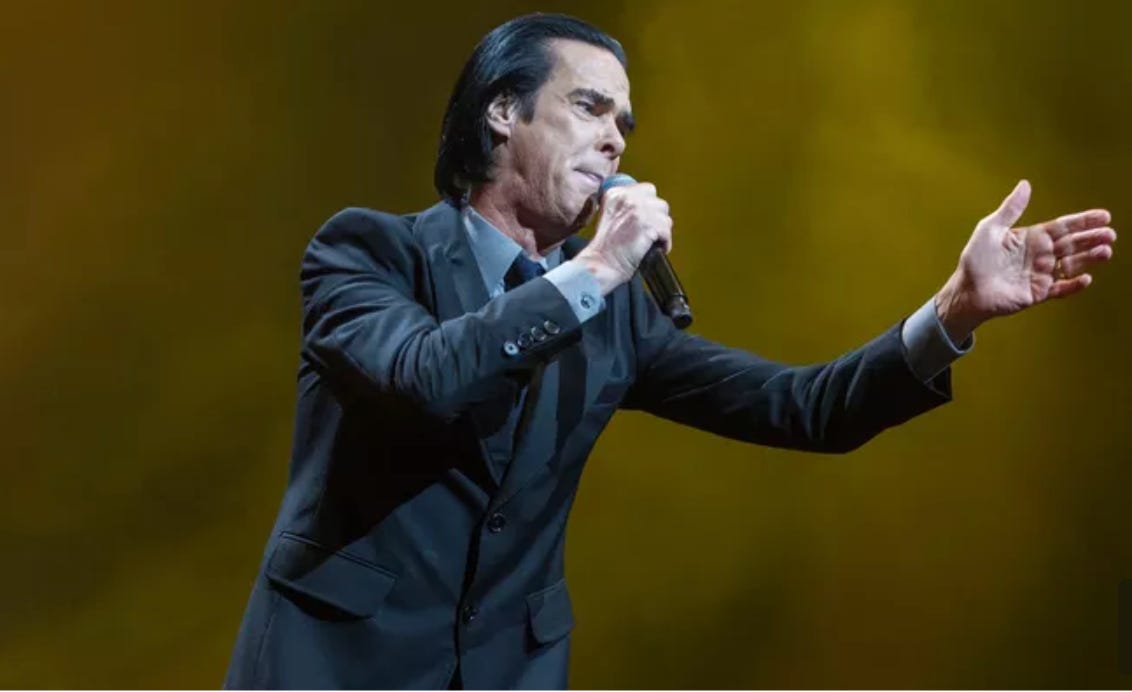
Nick Cave received the same French honour last year, and sitting there watching Harvey speak, I wasn’t surprised. There’s something these two Australians share with Gainsbourg himself that France clearly recognises: darkness worn elegantly, literature inside popular music, provocation that actually means something.
Gainsbourg died in 1991, having spent much of his life being scandalous, difficult and magnificent. President Mitterrand called him “notre Baudelaire, notre Apollinaire” [our Baudelaire, our Apollinaire]. France canonises its provocateurs. It tends to do it after the fact, but it does it wholeheartedly.
By honouring Harvey, France said something quietly radical: that carrying a culture across a border, with devotion and artistry and no native claim to it, is itself an act worth a chevalier. Harvey interpreted a man whose genius was inseparable from the French language and gave that genius a new life in another tongue.
He sat in that bar at the Kelvin Club, a man France had just honoured for translating the untranslatable, speaking about an artist whose work was built on exactly the things that resist translation. And somehow, across thirty years and an ocean, he had translated them anyway.
Traduttore, traditore. Translator, traitor. Or, in Mick Harvey’s case: Musician, translator, chevalier.
À bientôt,
Judy
Introducing Contributor, Judy MacMahon:
Visit her Contributor Page — Explore more of Judy’s work
Loved this! Your writing and the topic. I feel your soul in it.
Judy that was both beautifully written and captivating... I could quote many lines but the one that feels so pertinent during these trembling days is "France said something quietly radical: that carrying a culture across a border, with devotion and artistry and no native claim to it," how the world needs this understanding to spread...
Thank you for this!
PS The first link to The Kelvin Club, doesn't seem to be working, just a heads up!